

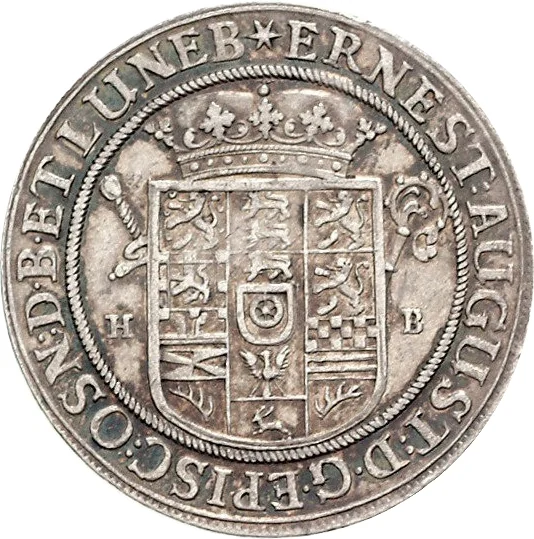
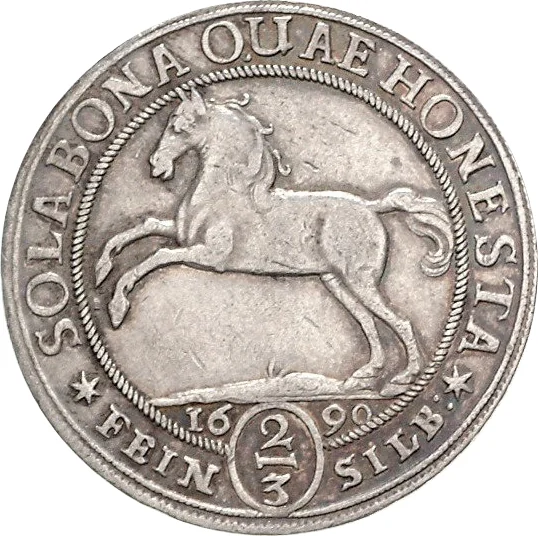
⅔ Thaler – Brunswick-Lüneburg-Calenberg
Germany
Context
Years: 1689–1693
Country: Germany 
Issuer: Brunswick-Lüneburg-Calenberg
Ruler: Ernest Augustus
Currency:
Demonetized: Yes
References
KM: #Click to copy to clipboard340
Numista: #68004
Obverse
Description:
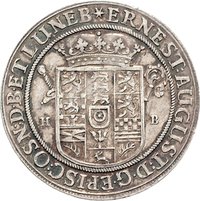
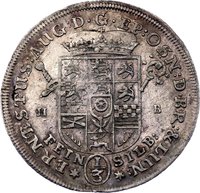
Shield with crown; HB flanking.
Inscription:
ERNEST:AUGUST:D·G·EPISC:OSN:D·B·ET LUNEB*
H B
H B
Script: Latin
Engraver: Heinrich Bonhorst
Reverse
Description:
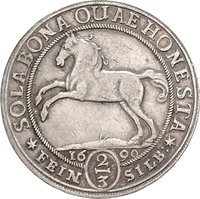
Horse leaping left. Lower third divides date and FEIN-SILB.
Inscription:
SOLA BONA QUAE HONESTA
1690
(2/3)
*FINE SILB:*
1690
(2/3)
*FINE SILB:*
Script: Latin
Edge
Mints
| Name | Mark |
|---|---|
| Clausthal | — |
Mintings
| Year | Mint Mark | Mintage | Quality | Collection |
|---|---|---|---|---|
| 1689 | — | — | ||
| 1690 | — | — | ||
| 1691 | — | — | ||
| 1692 | — | — | ||
| 1693 | — | — |
Historical background
In 1689, the Duchy of Brunswick-Lüneburg, specifically the Principality of Calenberg under Duke Ernst August, was entangled in the complex and problematic monetary system of the Holy Roman Empire. The region operated within the framework of the Reichsmünzordnung (Imperial Coinage Ordinance), but these regulations were widely ignored by the myriad of states issuing their own currency. Calenberg, like its neighbours, minted its own coins—primarily Taler and smaller Groschen—but their value and silver content were unstable due to the pressures of state finance and fluctuating bullion markets. This period was characterized by a proliferation of underweight and debased coins circulating alongside older, full-weight pieces, leading to chronic confusion and loss of public trust.
The monetary situation was further strained by the geopolitical demands of the era. Duke Ernst August’s ambitions, including his pursuit of the prestigious Electorate of Hanover (achieved in 1692), required substantial revenue. Simultaneously, the broader German states were financially burdened by the ongoing War of the League of Augsburg (1688-1697), which increased military expenditure and incentivized currency manipulation. Consequently, the Calenberg mint often engaged in deliberate debasement—reducing the precious metal content in coins—to generate seigniorage profit, thereby funding the duke’s projects but exacerbating inflation and disrupting local trade.
This environment created a chaotic Kipper- und Wipperzeit (clipping and culling period) effect, where bad money drove out good. Merchants and the public hoarded older, high-value coins while passing on the debased ones, worsening the circulation problem. The result was a fragmented and unreliable currency system within Calenberg, where the nominal and intrinsic value of money were severely disconnected, hindering economic activity and placing a practical burden on daily transactions. This instability would eventually contribute to broader 18th-century reforms, but in 1689, it remained a persistent and disruptive feature of the principality’s economy.
The monetary situation was further strained by the geopolitical demands of the era. Duke Ernst August’s ambitions, including his pursuit of the prestigious Electorate of Hanover (achieved in 1692), required substantial revenue. Simultaneously, the broader German states were financially burdened by the ongoing War of the League of Augsburg (1688-1697), which increased military expenditure and incentivized currency manipulation. Consequently, the Calenberg mint often engaged in deliberate debasement—reducing the precious metal content in coins—to generate seigniorage profit, thereby funding the duke’s projects but exacerbating inflation and disrupting local trade.
This environment created a chaotic Kipper- und Wipperzeit (clipping and culling period) effect, where bad money drove out good. Merchants and the public hoarded older, high-value coins while passing on the debased ones, worsening the circulation problem. The result was a fragmented and unreliable currency system within Calenberg, where the nominal and intrinsic value of money were severely disconnected, hindering economic activity and placing a practical burden on daily transactions. This instability would eventually contribute to broader 18th-century reforms, but in 1689, it remained a persistent and disruptive feature of the principality’s economy.
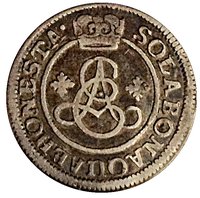
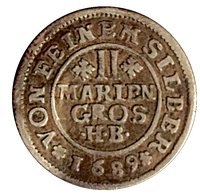
💎 Extremely Rare