

1 dam – Kathmandu Kingdom
Add to wishlist
Nepal
Context
Years: 1735–1746
Country: Nepal
Issuer: Kathmandu Kingdom
Ruler: Jaya Prakash Malla
Currency:
(1546—1932)
Demonetized: Yes
Material
Diameter: 8 mm
Weight: 0.05 g
Silver Weight:: 0.05 g
Shape: Irregular round
Composition: Silver
Magnetic: No
References
KM: #
Numista: #66339
Value
Bullion value: $0.13
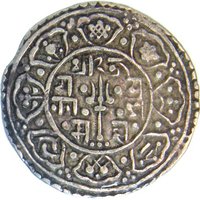
Obverse
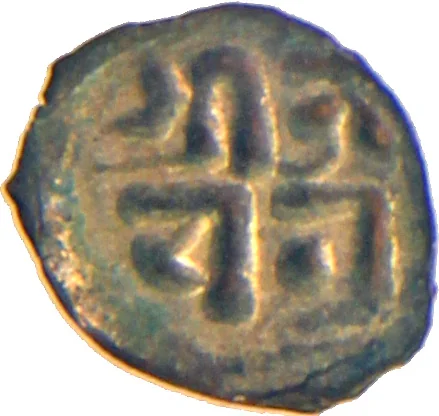
Description:
4 characters, 2 lines. Uniface.
Inscription:
Shri/Ja
Ya/Pra
Ya/Pra
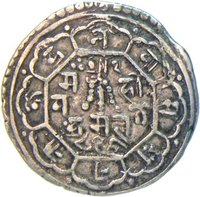
Reverse
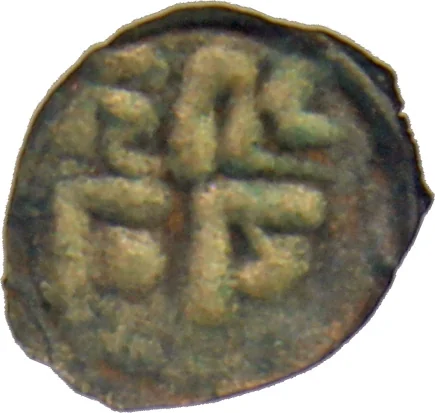
Description:
Blank.
Edge
Plain
Mintings
| Year | Mint Mark | Mintage | Quality | Collection |
|---|---|---|---|---|
| — | — | — |
Historical background
In 1735, the Kathmandu Valley was not a single kingdom but a confederation of three rival city-states: Kathmandu, Patan, and Bhaktapur, each ruled by its own Malla king. This period, while culturally rich, was politically fragmented and marked by intense competition. The economy was primarily agrarian and trade-based, with the valley serving as a vital transit point for trans-Himalayan trade between Tibet and the Indian plains. This trade, in wool, salt, spices, and textiles, was the lifeblood of the region and the primary driver for its monetary needs.
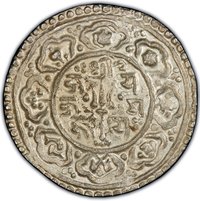
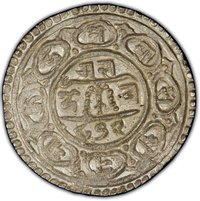
The currency system was complex and reflected both this trade and the political rivalries. The most important circulating medium was the Mohar, a silver coin minted independently by each of the three kingdoms. While similar in name and metal, the coins bore distinct symbols and script (often in Sanskrit or Newari) to denote their city of origin, turning currency into a tool of royal prestige and sovereignty. Alongside the Mohar, other coins like the Dam (copper) and Fanam (gold) were used for smaller and larger transactions, respectively. Crucially, a significant volume of trade was conducted using foreign coinage, particularly Tibetan silver tangkas and Mughal Indian rupees, which flowed into the valley via merchants, highlighting the region's economic integration with broader Asian networks.
This monetary landscape was inherently unstable. The varying weight and purity of the coins issued by the three Malla courts, combined with the influx of foreign currencies, created a chaotic exchange environment. Merchants and money-changers (sarrafs) played a critical role in assessing value, but the lack of standardization was a hindrance to commerce. Furthermore, the kings often debased their coinage—reducing silver content—to finance their lavish courts and frequent internecine wars, leading to inflation and eroding public trust. Thus, in 1735, the currency situation was a direct mirror of the valley's political disunity, setting the stage for the eventual unification and monetary reforms that would follow under the Gorkhali conquest decades later.
The currency system was complex and reflected both this trade and the political rivalries. The most important circulating medium was the Mohar, a silver coin minted independently by each of the three kingdoms. While similar in name and metal, the coins bore distinct symbols and script (often in Sanskrit or Newari) to denote their city of origin, turning currency into a tool of royal prestige and sovereignty. Alongside the Mohar, other coins like the Dam (copper) and Fanam (gold) were used for smaller and larger transactions, respectively. Crucially, a significant volume of trade was conducted using foreign coinage, particularly Tibetan silver tangkas and Mughal Indian rupees, which flowed into the valley via merchants, highlighting the region's economic integration with broader Asian networks.
This monetary landscape was inherently unstable. The varying weight and purity of the coins issued by the three Malla courts, combined with the influx of foreign currencies, created a chaotic exchange environment. Merchants and money-changers (sarrafs) played a critical role in assessing value, but the lack of standardization was a hindrance to commerce. Furthermore, the kings often debased their coinage—reducing silver content—to finance their lavish courts and frequent internecine wars, leading to inflation and eroding public trust. Thus, in 1735, the currency situation was a direct mirror of the valley's political disunity, setting the stage for the eventual unification and monetary reforms that would follow under the Gorkhali conquest decades later.
💎 Very Rare