

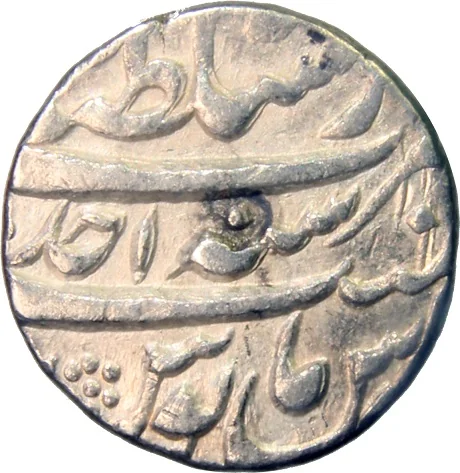
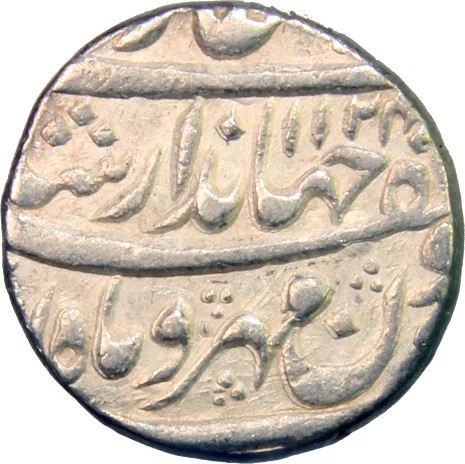
1 Rupee – Mughal Empire
India
Context
Year: 1712
Islamic (Hijri) Year: 1124
Country: India 
Issuer: Mughal Empire
Ruler: Jahandar Shah
Currency:
(1540—1842)
Demonetized: Yes
Material
References
KM: #Click to copy to clipboard363.17
Numista: #65610
Value
Bullion value: $33.42
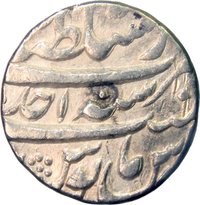
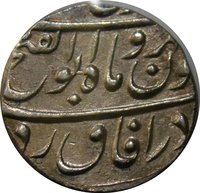
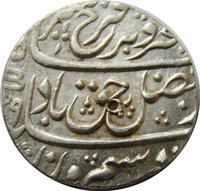
Obverse
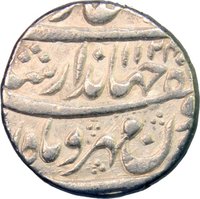
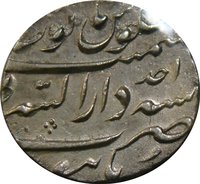
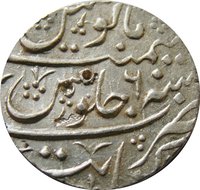
Reverse
Inscription:
AH 1124
Edge
Plain
Mintings
| Year | Mint Mark | Mintage | Quality | Collection |
|---|---|---|---|---|
| 1712 | — | — |
Historical background
By 1712, the Mughal Empire's currency system, once a pillar of its economic strength, was showing severe signs of strain under the weight of political instability. The death of Emperor Aurangzeb in 1707 had triggered a series of costly succession wars, draining the imperial treasury. Successive emperors, including Bahadur Shah I and the briefly reigning Jahandar Shah in 1712, resorted to debasing the silver rupee—the empire's primary currency—by reducing its purity to fund military campaigns and buy the loyalty of fractious nobles. This practice eroded public trust in the coinage and sparked price inflation, as more coins of lower intrinsic value chased the same goods.
The system was further undermined by a decline in central administrative control. Provincial governors and regional powers began striking their own coins, often imitating Mughal designs but with local standards of weight and purity. This fragmented the once-uniform monetary zone, creating complexity for merchants and hindering long-distance trade. Simultaneously, the influx of New World silver into India via European trading companies, which had historically boosted the Mughal economy, began to have destabilizing effects, as it was increasingly hoarded by regional elites or diverted to coastal powers rather than flowing into the imperial coffers.
Consequently, the currency situation in 1712 reflected the empire's broader political decay. The rupee was no longer a universally trusted symbol of imperial authority but a variable commodity. This monetary instability exacerbated economic uncertainty, discouraged investment, and weakened the fiscal foundation necessary to maintain the army and bureaucracy. The erosion of a standardized currency thus mirrored and accelerated the Mughal Empire's transition from a centralized state towards a collection of increasingly independent regional entities.
The system was further undermined by a decline in central administrative control. Provincial governors and regional powers began striking their own coins, often imitating Mughal designs but with local standards of weight and purity. This fragmented the once-uniform monetary zone, creating complexity for merchants and hindering long-distance trade. Simultaneously, the influx of New World silver into India via European trading companies, which had historically boosted the Mughal economy, began to have destabilizing effects, as it was increasingly hoarded by regional elites or diverted to coastal powers rather than flowing into the imperial coffers.
Consequently, the currency situation in 1712 reflected the empire's broader political decay. The rupee was no longer a universally trusted symbol of imperial authority but a variable commodity. This monetary instability exacerbated economic uncertainty, discouraged investment, and weakened the fiscal foundation necessary to maintain the army and bureaucracy. The erosion of a standardized currency thus mirrored and accelerated the Mughal Empire's transition from a centralized state towards a collection of increasingly independent regional entities.
✨ Legendary