

1 Rupee – Mughal Empire
India
Context
Years: 1573–1579
Country: India 
Issuer: Mughal Empire
Ruler: Akbar
Currency:
(1540—1842)
Demonetized: Yes
Material
Diameter: 25 mm
Weight: 11.27 g
Silver weight: 11.27 g
Shape: Irregular round
Composition: Silver
Magnetic: No
References
KM: #Click to copy to clipboard80.2
Numista: #65314
Value
Bullion value: $32.75
Obverse
Description:
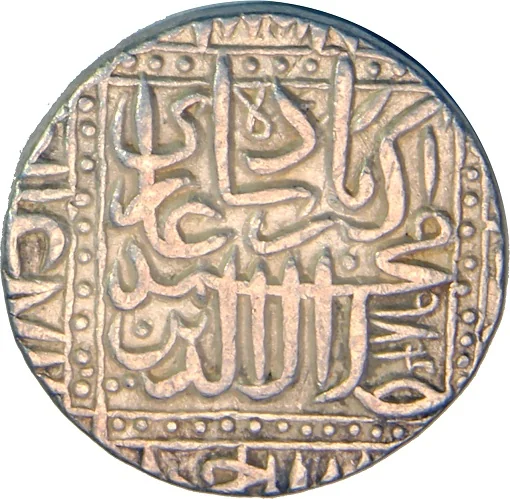
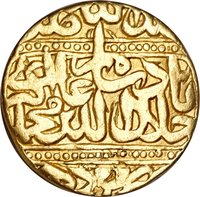
Akbar's name and Hijri date in dotted square.
Reverse
Description:
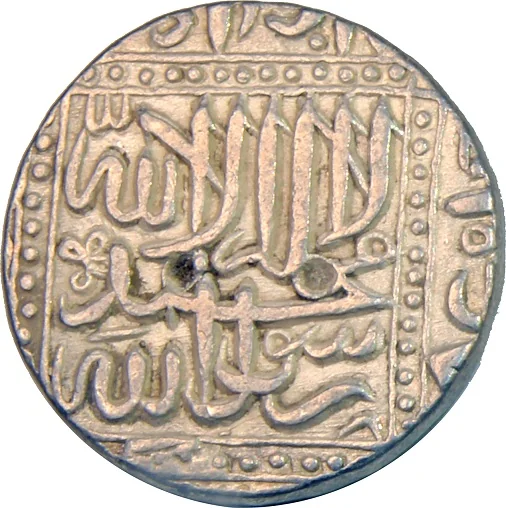
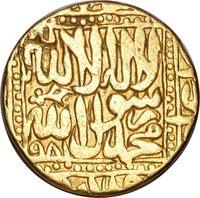
Kalima in dotted square.
Edge
Plain
Mintings
| Year | Mint Mark | Mintage | Quality | Collection |
|---|---|---|---|---|
| 1573 | — | — | ||
| 1574 | — | — | ||
| 1575 | — | — | ||
| 1576 | — | — | ||
| 1577 | — | — | ||
| 1578 | — | — | ||
| 1579 | — | — |
Historical background
In 1573, the Mughal Empire's currency system was firmly under the control of Emperor Akbar, who had recently consolidated his power after the decisive Battle of Tukaroi in Bengal. The monetary landscape was dominated by silver and copper coins, with the silver rupee (or rupya) as the primary unit of account for high-value transactions and state revenue. These coins were minted with a high degree of purity and uniformity in imperial mints (dar al-zarb), a practice that enhanced their reliability and acceptance across the vast empire. Copper dams served as the ubiquitous currency for everyday market exchanges, taxation, and local wages, creating a bimetallic system that facilitated commerce at all levels of society.
Akbar’s administration was actively reforming the fiscal and monetary structures during this period. The empire was transitioning from a system where local rulers and previous dynasties (like the Suris) had issued their own coinage to one of centralized imperial authority. While the old Afghan sikka (coinage) remained in circulation, Akbar was asserting his sovereignty by increasingly issuing coins in his own name from mints in major cities like Delhi, Agra, and Lahore. This was not just an economic measure but a potent political statement, symbolizing his claim as the legitimate ruler of Hindustan.
The currency situation in 1573 was stable and functional, providing a solid foundation for the empire's growing economy. However, it was on the cusp of significant evolution. Within the next decade, Akbar would implement his profound monetary and land revenue reforms, most notably the zabt system under Raja Todar Mal, which assessed taxes in cash (silver rupees) rather than kind. This policy would dramatically increase the demand for standardized silver coinage, further centralizing minting operations and solidifying the rupee's role as the backbone of the Mughal economy for centuries to come.
Akbar’s administration was actively reforming the fiscal and monetary structures during this period. The empire was transitioning from a system where local rulers and previous dynasties (like the Suris) had issued their own coinage to one of centralized imperial authority. While the old Afghan sikka (coinage) remained in circulation, Akbar was asserting his sovereignty by increasingly issuing coins in his own name from mints in major cities like Delhi, Agra, and Lahore. This was not just an economic measure but a potent political statement, symbolizing his claim as the legitimate ruler of Hindustan.
The currency situation in 1573 was stable and functional, providing a solid foundation for the empire's growing economy. However, it was on the cusp of significant evolution. Within the next decade, Akbar would implement his profound monetary and land revenue reforms, most notably the zabt system under Raja Todar Mal, which assessed taxes in cash (silver rupees) rather than kind. This policy would dramatically increase the demand for standardized silver coinage, further centralizing minting operations and solidifying the rupee's role as the backbone of the Mughal economy for centuries to come.
💎 Extremely Rare