

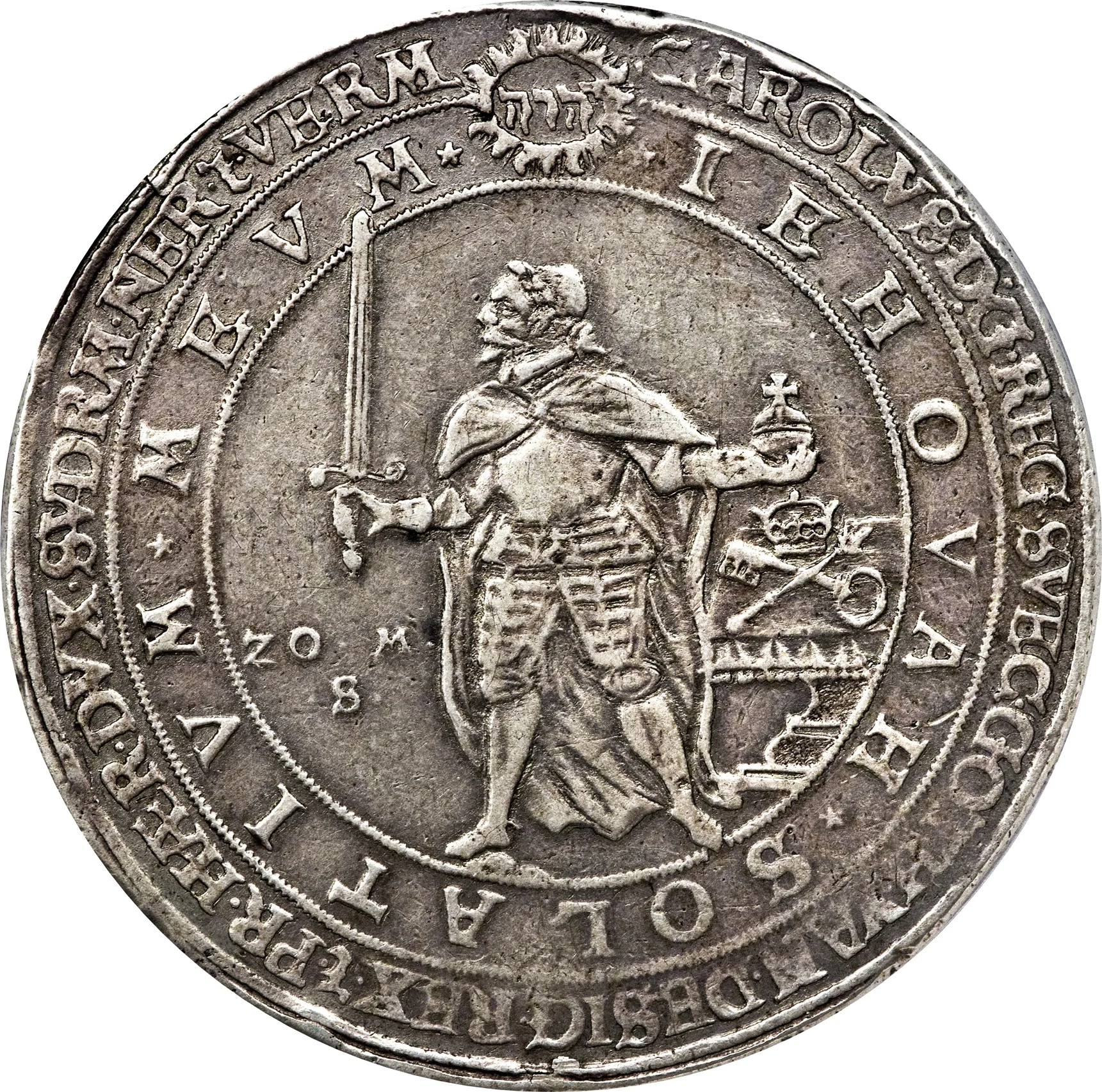

Obverse
Description:
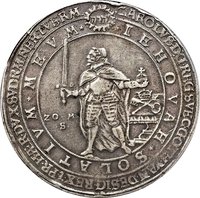
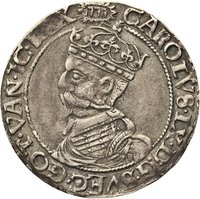
King Karl IX in armor faces left, wearing a mantle and laurel wreath. He holds a raised sword and a Globus Cruciger. The value is at left; at right, a table bears the Crown of Sweden with crossed scepter and key. A double legend circle surrounds him, with the radiant Hebrew name of Jehovah above his head. The inner circle contains his motto.
Inscription:
יהוה
CAROLVS·D:G·REG·SVEC·GOTH·VAN·DESIG·REX·&·PR·HÆR·DVX·VDRM·NER·&·VERM·
* IEHOVAH * SOLATIVM * MEVM *
______
20 M
S
CAROLVS·D:G·REG·SVEC·GOTH·VAN·DESIG·REX·&·PR·HÆR·DVX·VDRM·NER·&·VERM·
* IEHOVAH * SOLATIVM * MEVM *
______
20 M
S
Script: Latin
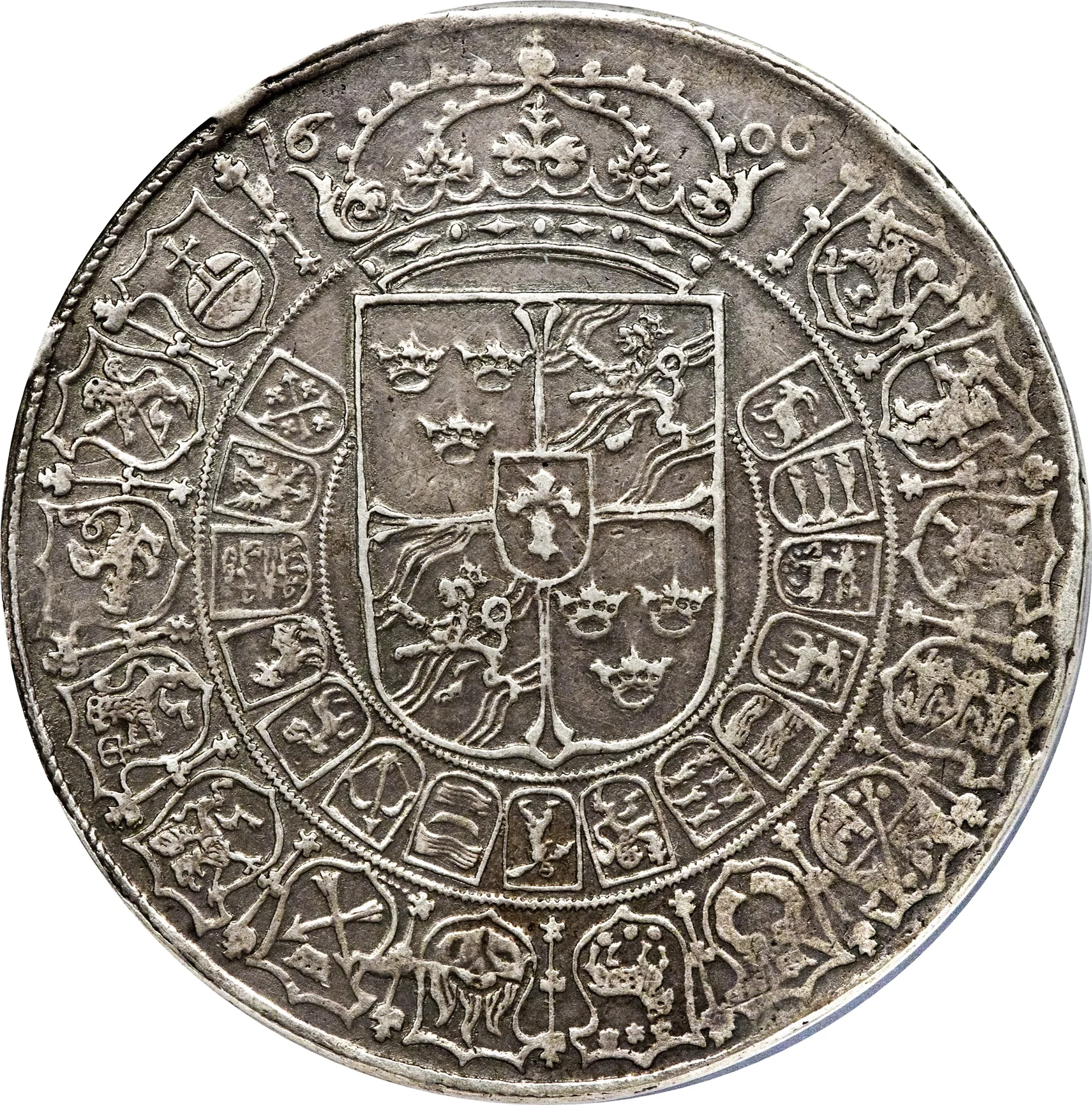
Reverse
Description:
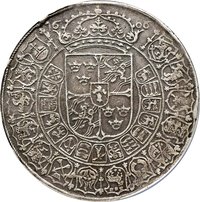
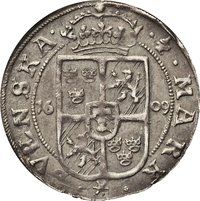
A crowned flat-topped shield bearing the full Greater Arms of Sweden, encircled by two rings of shields representing the provinces and fiefs. The outer ring has fifteen flat-topped shields; the inner ring has fourteen more detailed ones. The date is divided above, flanking the crown.
Inscription:
16 06
Script: Latin
Edge
Mintings
| Year | Mint Mark | Mintage | Quality | Collection |
|---|---|---|---|---|
| 1606 | — | — |
Historical background
In 1606, Sweden operated under a complex and strained monetary system, a legacy of the ongoing Polish-Swedish War (1600-1611) and earlier debasements. The primary currency was the Swedish riksdaler, a large silver coin, but the real workhorse of daily commerce was the öre and mark system, where 1 riksdaler = 4 marks = 32 öre. However, the kingdom was plagued by a severe shortage of precious metals, leading to a chronic lack of high-value coinage for state finances and international trade. This scarcity was exacerbated by the enormous costs of maintaining armies abroad, which drained silver from the realm.
The situation was further complicated by the widespread circulation of foreign coins, particularly German and Dutch issues, which were often of superior and more reliable silver content. Alongside these, older, heavily debased Swedish coins from the reign of Erik XIV (1560-68) still circulated, creating a chaotic multi-tiered system. This led to Gresham's Law in practice, where "bad money drives out good"—people hoarded full-weight domestic and foreign coins, while spending the debased ones, undermining trust in the currency and causing price inflation, especially for the crown when procuring war supplies.
Recognizing the crisis, King Karl IX had begun a cautious monetary reform. His government aimed to restore confidence by minting new, higher-quality copper and silver coins at the Stockholm mint, asserting royal control over the currency. The year 1606 fell within this period of attempted stabilization, but the fundamental pressures of war finance meant these measures were only partially successful. The underlying structural problems would persist, setting the stage for the more radical and consequential solutions—including the famous introduction of heavy copper plate money—that would define Swedish currency in the decades to follow.
The situation was further complicated by the widespread circulation of foreign coins, particularly German and Dutch issues, which were often of superior and more reliable silver content. Alongside these, older, heavily debased Swedish coins from the reign of Erik XIV (1560-68) still circulated, creating a chaotic multi-tiered system. This led to Gresham's Law in practice, where "bad money drives out good"—people hoarded full-weight domestic and foreign coins, while spending the debased ones, undermining trust in the currency and causing price inflation, especially for the crown when procuring war supplies.
Recognizing the crisis, King Karl IX had begun a cautious monetary reform. His government aimed to restore confidence by minting new, higher-quality copper and silver coins at the Stockholm mint, asserting royal control over the currency. The year 1606 fell within this period of attempted stabilization, but the fundamental pressures of war finance meant these measures were only partially successful. The underlying structural problems would persist, setting the stage for the more radical and consequential solutions—including the famous introduction of heavy copper plate money—that would define Swedish currency in the decades to follow.
✨ Legendary