

1 Riksdaler – Sweden
Sweden
Context
Year: 1654
Issuer: Sweden 
Ruler: Charles X Gustav
Currency:
(1598—1665)
Demonetized: Yes
Total mintage: 3,877
Material
References
KM: #Click to copy to clipboard214
Numista: #64180
Value
Bullion value: $71.10
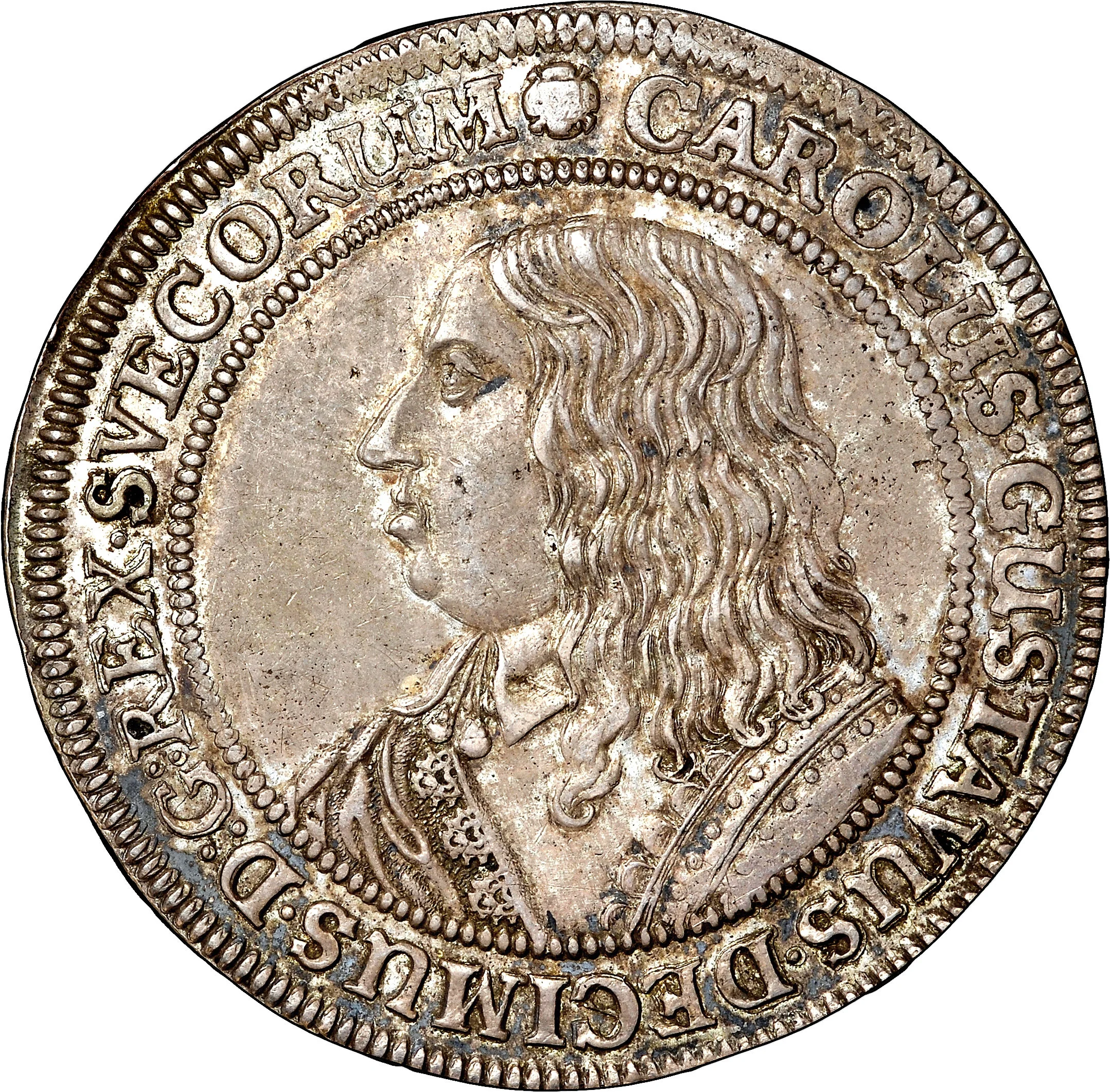
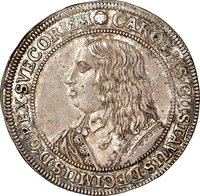
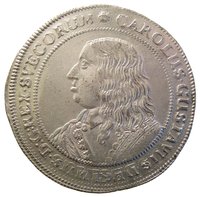
Obverse
Description:
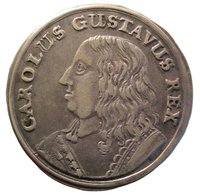
King's bust in beaded circle, legend around.
Inscription:
CAROLUS·GUSTAVUS·DECIMUS·D:G:REX·SVECORUM
Script: Latin
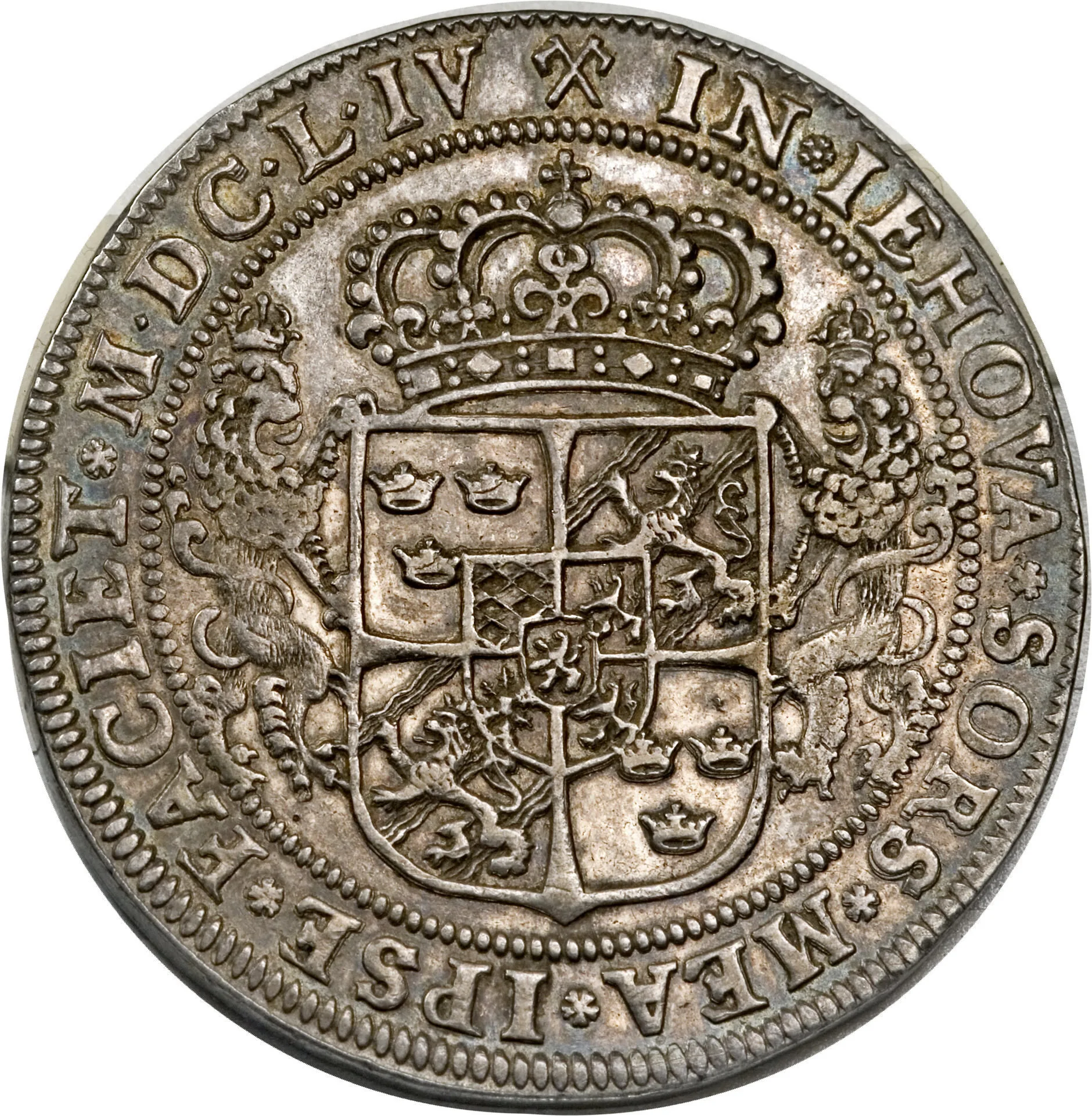
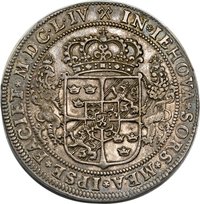
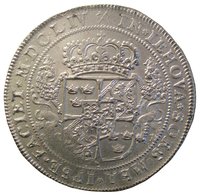
Reverse
Description:
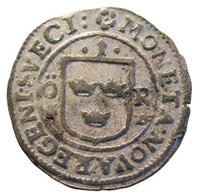
Swedish crowned shield flanked by lions within a beaded circle, surrounded by a legend and date in Roman numerals.
Inscription:
IN·IEHOVA·SORS·MEA·IPSE·FACIET · M·DC·L·IV
Script: Latin
Edge
Mintings
| Year | Mint Mark | Mintage | Quality | Collection |
|---|---|---|---|---|
| 1654 | — | 3,877 |
Historical background
In 1654, Sweden was grappling with a severe and complex currency crisis, a direct consequence of the immense financial strain of the Thirty Years' War (1618-1648). To fund its expansive military campaigns, the Swedish state, under Queen Christina, had heavily debased the copper coinage that formed the backbone of its monetary system. The famous plåtmynt (plate money)—large, cumbersome rectangular sheets of copper—saw their intrinsic copper value plummet far below their face value, while the parallel silver currency was scarce and hoarded. This created a chaotic dual-currency system where prices were unstable and public trust in the coinage was eroding.
The situation was exacerbated by the government's fiscal policy. Facing a massive war debt and depleted treasury, the crown continued to manipulate the currency to cover its deficits, leading to rapid inflation. The disparity between the overvalued copper money and the undervalued silver rippled through the economy, disrupting trade and causing hardship for the common population, who were often paid in depreciated copper. Furthermore, Sweden's ambitious attempts to establish a copper standard, driven by its dominance of European copper production, were failing under the weight of these economic pressures.
Queen Christina's abdication in June 1654 transferred this dire financial legacy to her successor, King Charles X Gustav. The new monarch inherited a kingdom where the monetary system was in disarray, state finances were crippled, and economic stability was urgently needed. The currency situation of 1654 thus set the stage for subsequent, though only partially successful, monetary reforms as Sweden sought to stabilize its economy and consolidate its emergent great power status in the postwar era.
The situation was exacerbated by the government's fiscal policy. Facing a massive war debt and depleted treasury, the crown continued to manipulate the currency to cover its deficits, leading to rapid inflation. The disparity between the overvalued copper money and the undervalued silver rippled through the economy, disrupting trade and causing hardship for the common population, who were often paid in depreciated copper. Furthermore, Sweden's ambitious attempts to establish a copper standard, driven by its dominance of European copper production, were failing under the weight of these economic pressures.
Queen Christina's abdication in June 1654 transferred this dire financial legacy to her successor, King Charles X Gustav. The new monarch inherited a kingdom where the monetary system was in disarray, state finances were crippled, and economic stability was urgently needed. The currency situation of 1654 thus set the stage for subsequent, though only partially successful, monetary reforms as Sweden sought to stabilize its economy and consolidate its emergent great power status in the postwar era.
Series: 1654 Sweden circulation coins
✨ Legendary