

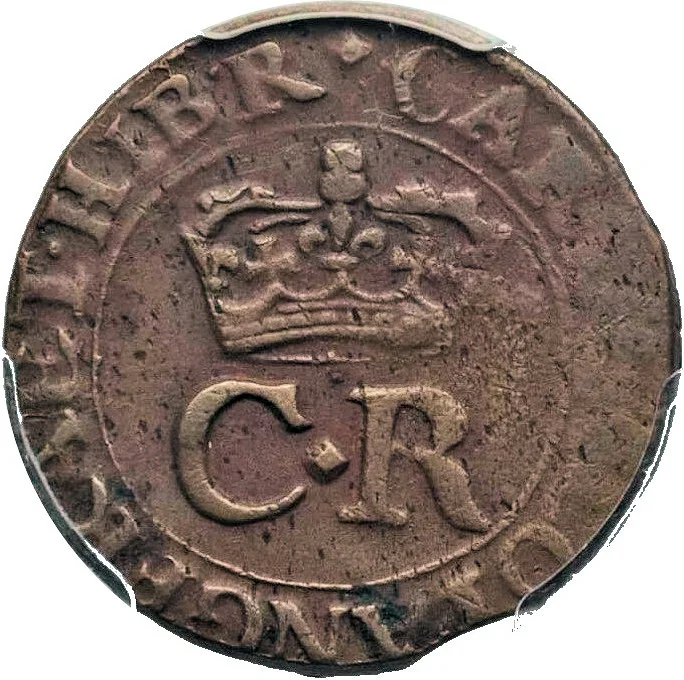
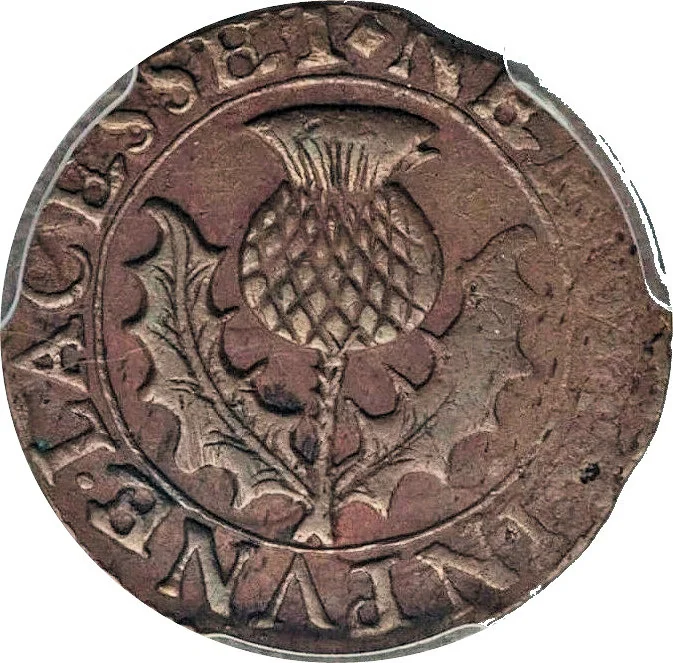
2 Pence – Scotland
United Kingdom
Context
Years: 1642–1650
Country: United Kingdom 
Issuer: Scotland 
Ruler: Charles I
Currency:
(1136—1707)
Demonetized: Yes
Total mintage: 11,086,463
Material
References
KM: #Click to copy to clipboard69
Numista: #63398
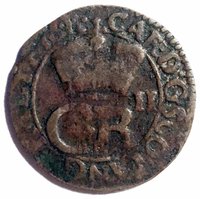
Obverse
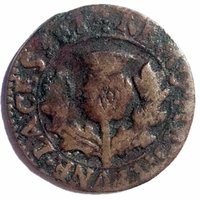
Reverse
Description:
Thistle: a spiny, flowering weed.
Inscription:
NEMO · ME · IMPVNE · LACESSET
Script: Latin
Edge
Plain
Mints
| Name | Mark |
|---|---|
| Edinburgh | — |
Mintings
| Year | Mint Mark | Mintage | Quality | Collection |
|---|---|---|---|---|
| — | — | 11,086,463 |
Historical background
In 1642, Scotland was in a state of monetary and political flux, caught between its own recent revolution and the outbreak of the English Civil War. The nation operated on a distinct coinage system, nominally pegged to England’s but with its own valuations and physical currency. The primary circulating coins were silver marks, merks, and pounds, but the system was hampered by chronic shortages of specie (coin), leading to widespread use of informal credit, bills, and even foreign coins in daily transactions. This scarcity was exacerbated by economic disruption and the hoarding of precious metal.
Politically, the situation was defined by the aftermath of the 1638 National Covenant and the 1641 Treaty of London. Scotland had effectively secured its Presbyterian religious settlement from King Charles I in return for a promise of peace, but the eruption of war in England in 1642 placed the Covenanter government in a precarious position. While officially neutral, Scotland’s political and religious leaders watched events closely, knowing their hard-won gains could be undone by the war’s outcome. Financial strain was acute, as the state needed funds to maintain its own army and administration while navigating this tense neutrality.
Consequently, the currency situation was inextricably linked to war finance and political maneuvering. The Covenanter regime, governing through the Parliament and the Tables, faced the immense cost of mobilising and sustaining the army that had fought in the Bishops' Wars (1639-1640). While no major currency debasement occurred in 1642 itself, the government relied heavily on taxation, loans, and the controversial "fines" levied on its royalist opponents (the "Incendiaries") to raise revenue. Thus, Scotland's money was not just a medium of exchange but a tool for political consolidation, as the Covenanter state sought to stabilize its finances to secure its independence and prepare for potential intervention in the conflict to its south.
Politically, the situation was defined by the aftermath of the 1638 National Covenant and the 1641 Treaty of London. Scotland had effectively secured its Presbyterian religious settlement from King Charles I in return for a promise of peace, but the eruption of war in England in 1642 placed the Covenanter government in a precarious position. While officially neutral, Scotland’s political and religious leaders watched events closely, knowing their hard-won gains could be undone by the war’s outcome. Financial strain was acute, as the state needed funds to maintain its own army and administration while navigating this tense neutrality.
Consequently, the currency situation was inextricably linked to war finance and political maneuvering. The Covenanter regime, governing through the Parliament and the Tables, faced the immense cost of mobilising and sustaining the army that had fought in the Bishops' Wars (1639-1640). While no major currency debasement occurred in 1642 itself, the government relied heavily on taxation, loans, and the controversial "fines" levied on its royalist opponents (the "Incendiaries") to raise revenue. Thus, Scotland's money was not just a medium of exchange but a tool for political consolidation, as the Covenanter state sought to stabilize its finances to secure its independence and prepare for potential intervention in the conflict to its south.
⭐ Somewhat Rare