

20 centavos – Portuguese Guinea
Add to wishlist
Standard circulation coins
Series: 1973
Guinea-Bissau
Context
Year: 1973
Country: Guinea-Bissau
Issuer: Portuguese Guinea
Period:
(1951—1973)
Currency:
(1914—1975)
Demonetized: Yes
Total mintage: 100,000
Material
References
KM: #
Numista: #11942
Obverse
Description:
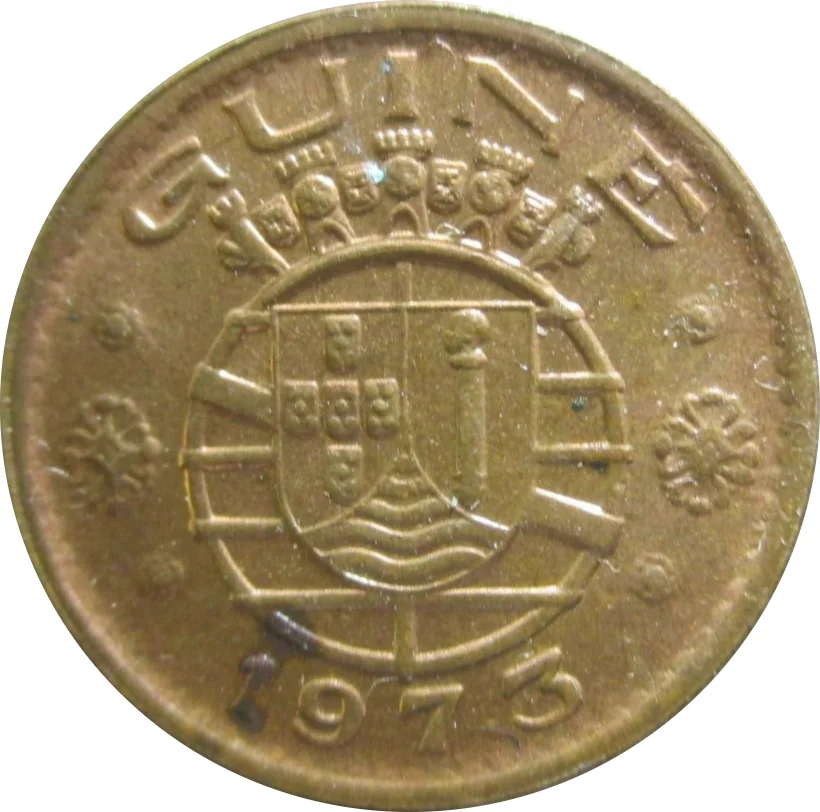
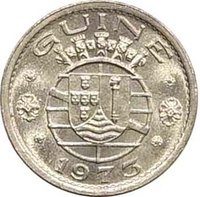
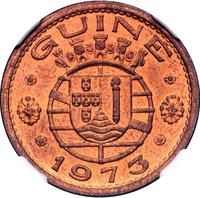
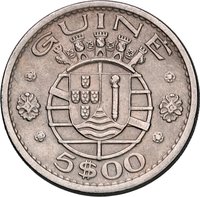
Portuguese Guinea coat of arms with date.
Inscription:
GUINÉ
1973
1973
Translation:
Guinea
1973
1973
Script: Latin
Language: Portuguese
Reverse
Description:
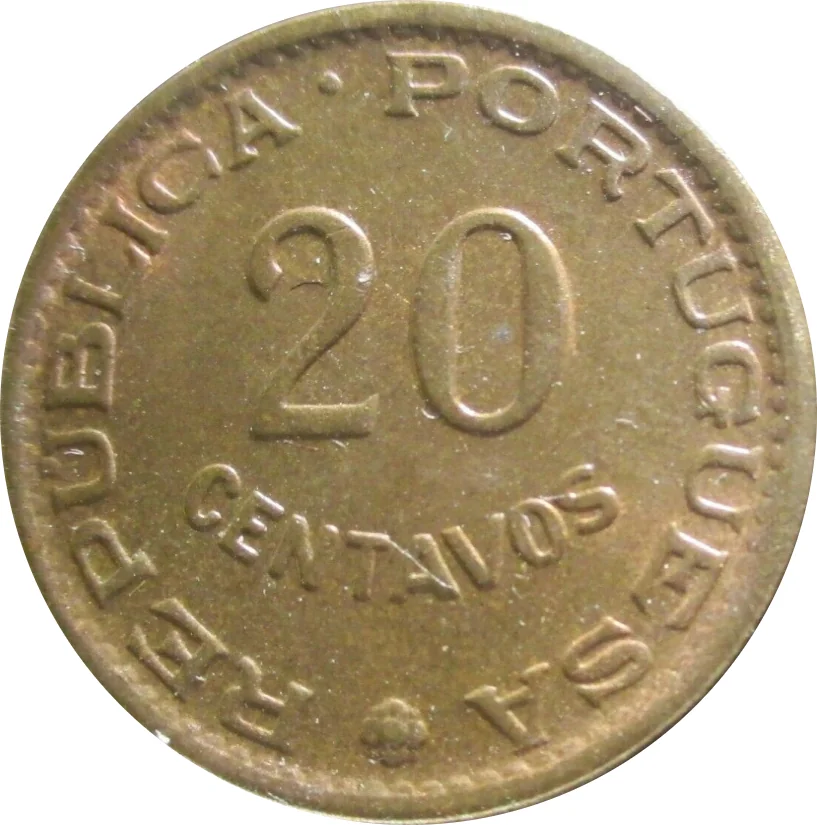
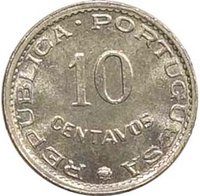
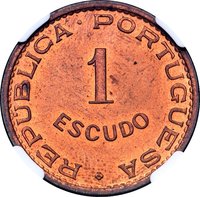
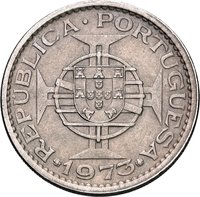
Center denomination, encircled legend.
Inscription:
REPUBLICA · PORTUGUESA
20
CENTAVOS
20
CENTAVOS
Translation:
Portuguese Republic
20
Cents
20
Cents
Script: Latin
Language: Portuguese
Edge
Reeded
Categories
| Symbols> Coat of Arms |
Mints
| Name | Mark |
|---|---|
| Imprensa Nacional - Casa da Moeda | — |
Mintings
| Year | Mint Mark | Mintage | Quality | Collection |
|---|---|---|---|---|
| 1973 | — | 100,000 |
Historical background
In 1973, the currency situation in Portuguese Guinea (present-day Guinea-Bissau) was a direct reflection of the intense guerrilla war for independence being waged against Portuguese colonial rule. The territory officially used the Portuguese Guinea escudo, which was pegged to and issued by the Banco Nacional Ultramarino (BNU) in Lisbon. This currency was intended to facilitate colonial trade and integration with Portugal's economy, but its effective circulation was largely confined to the major urban centers and areas under firm Portuguese military control.
Beyond these fortified towns and garrisons, the revolutionary authority, the Partido Africano para a Independência da Guiné e Cabo Verde (PAIGC), had established significant administrative control over vast rural areas. In these "liberated zones," the PAIGC had begun to implement its own governance structures, which included a move toward financial autonomy. While not yet issuing a formal currency, the PAIGC leadership, notably under Amílcar Cabral until his assassination in January 1973, was actively planning for a future independent state and its monetary system, laying the groundwork for the eventual creation of the Guinea-Bissau peso.
Thus, the monetary landscape was deeply fractured and symbolic of the conflict itself. The colonial escudo represented the fading, but still forceful, administrative control of Lisbon, while the embryonic plans for a national currency in the liberated zones embodied the political and economic aspirations of the imminent independence, which would be unilaterally declared by the PAIGC in September 1973. The situation was one of competing sovereignties, with currency serving as a key battleground for economic legitimacy.
Beyond these fortified towns and garrisons, the revolutionary authority, the Partido Africano para a Independência da Guiné e Cabo Verde (PAIGC), had established significant administrative control over vast rural areas. In these "liberated zones," the PAIGC had begun to implement its own governance structures, which included a move toward financial autonomy. While not yet issuing a formal currency, the PAIGC leadership, notably under Amílcar Cabral until his assassination in January 1973, was actively planning for a future independent state and its monetary system, laying the groundwork for the eventual creation of the Guinea-Bissau peso.
Thus, the monetary landscape was deeply fractured and symbolic of the conflict itself. The colonial escudo represented the fading, but still forceful, administrative control of Lisbon, while the embryonic plans for a national currency in the liberated zones embodied the political and economic aspirations of the imminent independence, which would be unilaterally declared by the PAIGC in September 1973. The situation was one of competing sovereignties, with currency serving as a key battleground for economic legitimacy.
🌟 Uncommon