

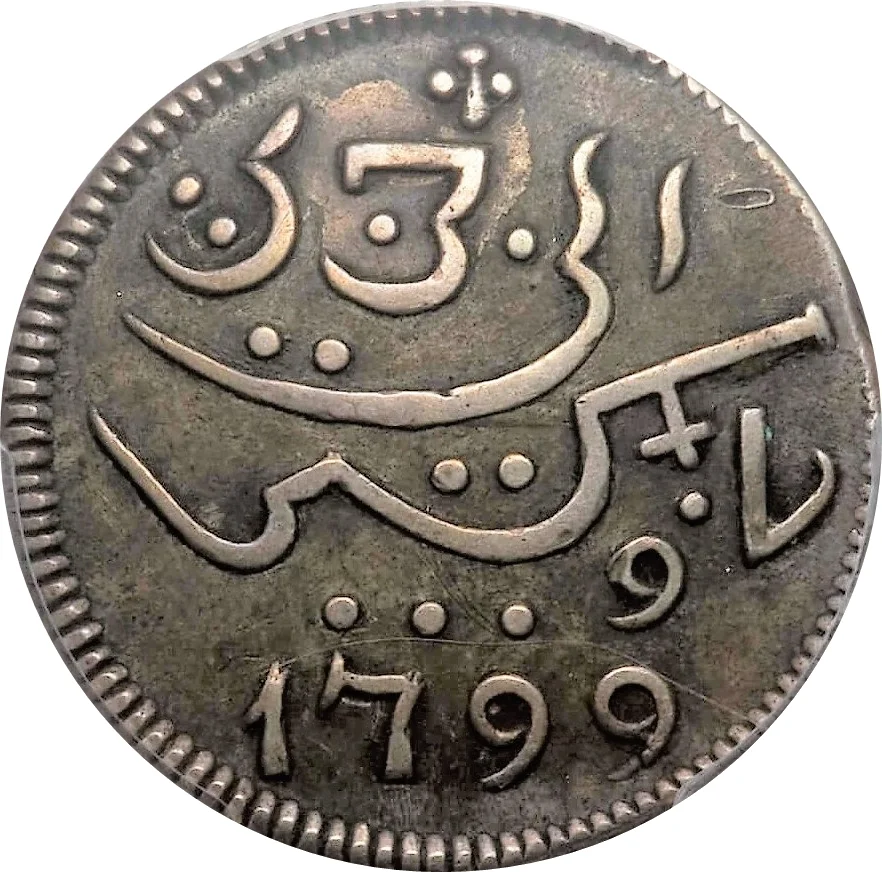
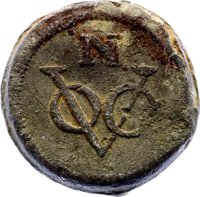
Obverse
Description:
Crude Arabic script, Gregorian date.
Inscription:
إلى جزيرة
جوى الكبير
1799
جوى الكبير
1799
Script: Arabic
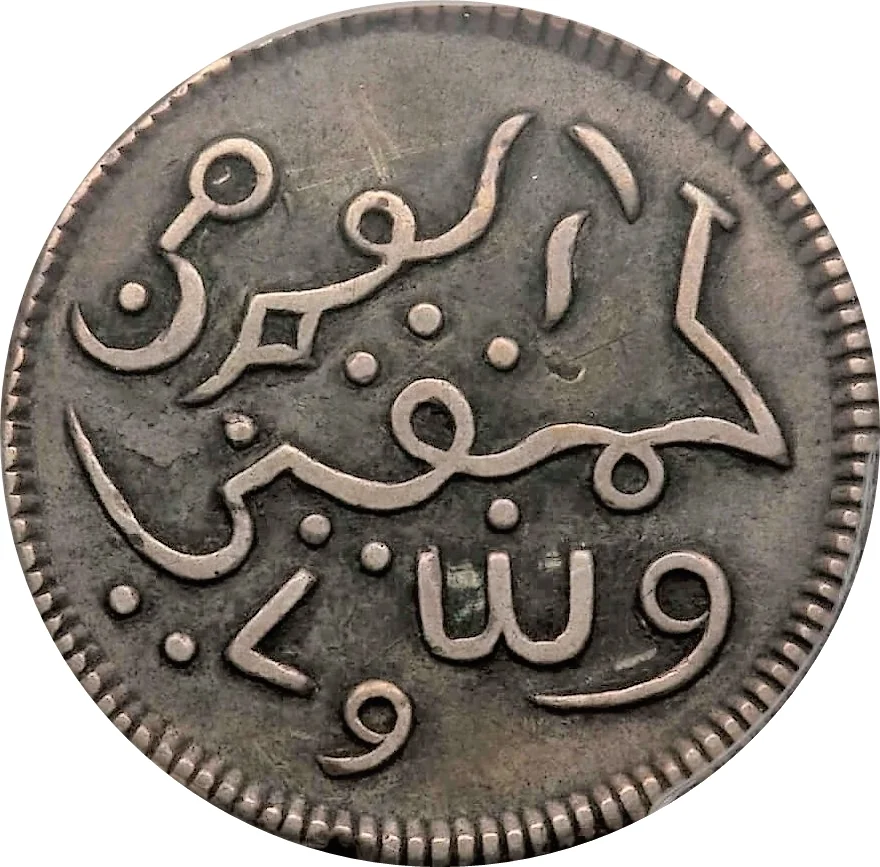
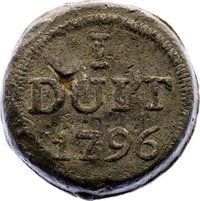
Reverse
Description:
Three lines of rough Arabic script.
Inscription:
درهام مين
كومباني
ولنداوي
كومباني
ولنداوي
Script: Arabic
Edge
Mintings
| Year | Mint Mark | Mintage | Quality | Collection |
|---|---|---|---|---|
| 1790 | — | — | ||
| 1796 | — | — | ||
| 1798 | — | — | ||
| 1799 | — | — |
Historical background
In 1790, Java's currency situation was a complex and fragmented reflection of its political divisions, primarily split between the Dutch East India Company (VOC) territories and the remaining autonomous Javanese kingdoms. In the VOC-controlled areas, such as Batavia and the Priangan Regencies, the official currency was the Dutch guilder, but the reality was a chaotic mix. The VOC, perpetually short of specie, heavily relied on a wide array of foreign coins that circulated by weight and intrinsic value, including Spanish American silver reales (often cut into pieces), Japanese koban, and various Indian and Chinese coins. This created a cumbersome system where merchants needed scales as much as ledgers.
In the interior Javanese courts, like those of Surakarta and Yogyakarta, a separate traditional monetary system persisted. The primary unit was the pitji or picis, a low-value tin coin often strung together in large quantities. Higher-value transactions were conducted in real (from the Spanish real), with a rough exchange rate of 120 pitji to one real. However, the quality and acceptance of these locally minted coins varied greatly, and they were often heavily debased, leading to inflation and distrust, especially in border markets where Javanese and Dutch economies met.
This monetary fragmentation severely hampered trade and economic stability across the island. The VOC's financial decline only exacerbated the problem, as it increasingly issued paper credit and copper duit coins of low intrinsic value, which further eroded trust. The situation created a thriving business for Chinese and Arab money changers, who acted as essential intermediaries. Thus, on the eve of the VOC's bankruptcy and subsequent takeover by the Dutch state in 1796, Java's currency landscape was not unified but a contested and inefficient patchwork of metallic values, symbolic authority, and commercial necessity.
In the interior Javanese courts, like those of Surakarta and Yogyakarta, a separate traditional monetary system persisted. The primary unit was the pitji or picis, a low-value tin coin often strung together in large quantities. Higher-value transactions were conducted in real (from the Spanish real), with a rough exchange rate of 120 pitji to one real. However, the quality and acceptance of these locally minted coins varied greatly, and they were often heavily debased, leading to inflation and distrust, especially in border markets where Javanese and Dutch economies met.
This monetary fragmentation severely hampered trade and economic stability across the island. The VOC's financial decline only exacerbated the problem, as it increasingly issued paper credit and copper duit coins of low intrinsic value, which further eroded trust. The situation created a thriving business for Chinese and Arab money changers, who acted as essential intermediaries. Thus, on the eve of the VOC's bankruptcy and subsequent takeover by the Dutch state in 1796, Java's currency landscape was not unified but a contested and inefficient patchwork of metallic values, symbolic authority, and commercial necessity.
✨ Legendary