

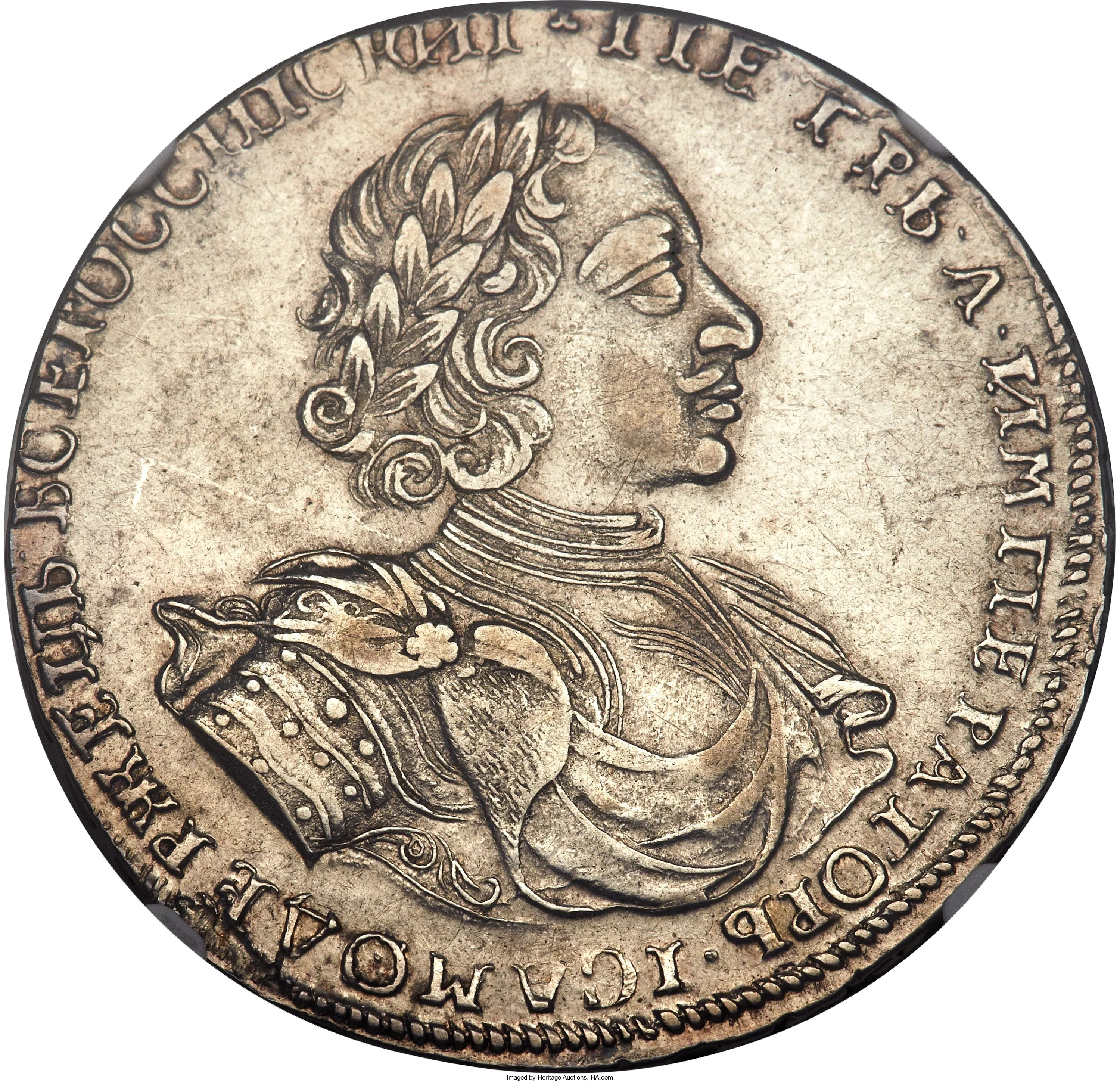
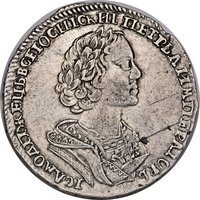
Obverse
Description:
Peter I bust with encircling legend.
Inscription:
ПЕТРЬ · А · ИМПЕРАТОРЬ · I САМОДЕРЖЕЦЬ · ВСЕРОССИIСКИI ·
Script: Cyrillic
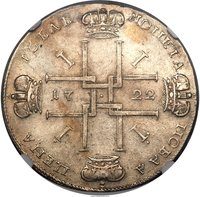
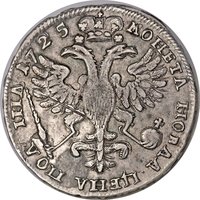
Reverse
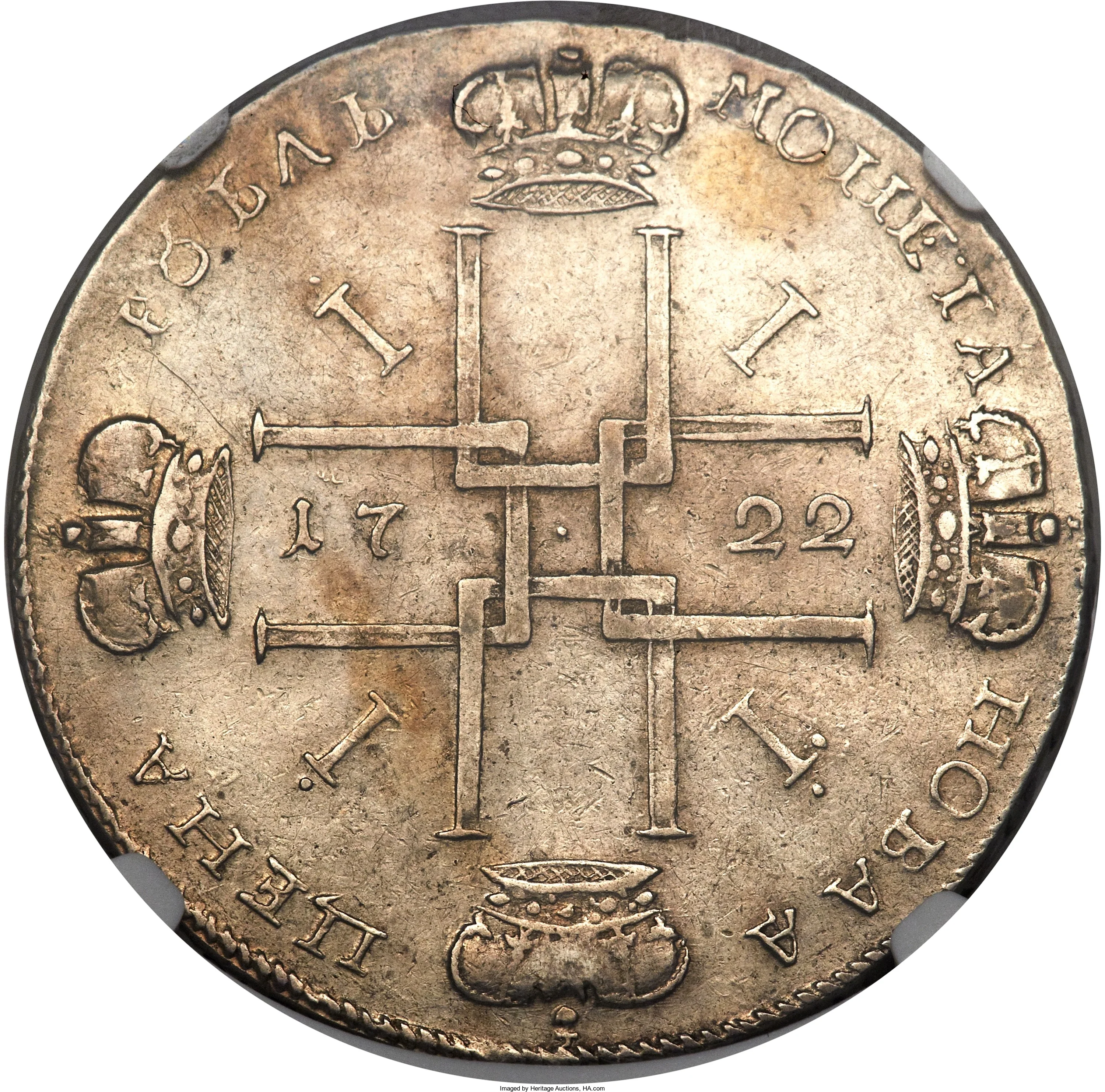
Description:
Cross of four "П" letters, "I" at corners. Side crowns. Denomination and date.
Inscription:
МОНЕТА НОВАѦ ЦЕНА РƔБЛЬ
17 22
17 22
Script: Cyrillic
Edge
Smooth with inscription
Legend:
МОСКОВЬСКИ УКАЗНЫ РƔБЛЕВИКЪ МАНЕТНАГО ДЕНЕЖНАГО ДВОРА
Mints
| Name | Mark |
|---|---|
| Kadashevsky Mint | — |
Mintings
| Year | Mint Mark | Mintage | Quality | Collection |
|---|---|---|---|---|
| 1722 | — | — |
Historical background
In 1722, the currency system of the Russian Empire was in a state of profound transition, heavily shaped by the fiscal demands of the Great Northern War (1700-1721). Tsar Peter the Great, having just secured victory and a "window to the West," faced a treasury drained by decades of conflict. To finance his military and ambitious modernization projects, the state had resorted to drastic monetary debasement since 1700, reducing the silver content of kopecks by over half. This resulted in a dual system: old, high-silver yefimki (foreign coins) circulated alongside new, lightweight copper and silver coins, causing inflation, public distrust, and complex exchange rates.
The primary circulating coin was the silver kopeck, a small, hand-hammered denga or polushka, but its value was unstable. More significantly, Peter was in the early stages of implementing a radical decimal reform. In 1704, he had introduced the silver ruble and copper kopeck as larger, machine-milled coins, establishing the 100-kopeck-to-1-ruble standard that endures today. However, by 1722, the full transition was incomplete; the old pre-Petrine wire money and the new Western-style coinage circulated together, creating a chaotic and inefficient monetary environment that hampered commerce and state revenue collection.
This unstable currency situation directly informed Peter's governance in 1722. The same year, he established the Berg-Kollegiya (Mining Collegium) to centralize control over mining and minting, seeking to secure domestic sources of precious metals. Furthermore, the financial strain underscored the need for more efficient taxation, leading to the preparation for the landmark Poll Tax reform, which would be implemented in 1724. Thus, the currency of 1722 reflects an empire struggling to modernize its economy, using monetary policy as a tool for state-building while grappling with the immediate consequences of inflation and a fragmented monetary space.
The primary circulating coin was the silver kopeck, a small, hand-hammered denga or polushka, but its value was unstable. More significantly, Peter was in the early stages of implementing a radical decimal reform. In 1704, he had introduced the silver ruble and copper kopeck as larger, machine-milled coins, establishing the 100-kopeck-to-1-ruble standard that endures today. However, by 1722, the full transition was incomplete; the old pre-Petrine wire money and the new Western-style coinage circulated together, creating a chaotic and inefficient monetary environment that hampered commerce and state revenue collection.
This unstable currency situation directly informed Peter's governance in 1722. The same year, he established the Berg-Kollegiya (Mining Collegium) to centralize control over mining and minting, seeking to secure domestic sources of precious metals. Furthermore, the financial strain underscored the need for more efficient taxation, leading to the preparation for the landmark Poll Tax reform, which would be implemented in 1724. Thus, the currency of 1722 reflects an empire struggling to modernize its economy, using monetary policy as a tool for state-building while grappling with the immediate consequences of inflation and a fragmented monetary space.
💎 Extremely Rare