

¼ Ducat – Sweden
Sweden
Context
Years: 1754–1755
Issuer: Sweden 
Ruler: Adolphus Frederick
Currency:
(1719—1798)
Demonetized: Yes
Total mintage: 889
Material
References
KM: #Click to copy to clipboard474
Numista: #102413
Value
Bullion value: $141.57
Obverse
Description:
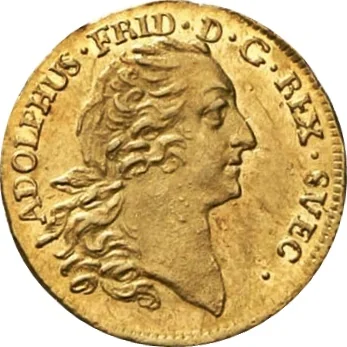
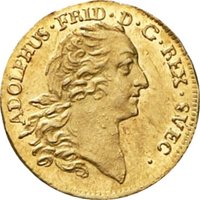
King Adolf Fredrick facing right, long hair, legend encircling.
Inscription:
ADOLPHUS • FRID • D • G • REX • SVECIAE •
Script: Latin
Reverse
Description:
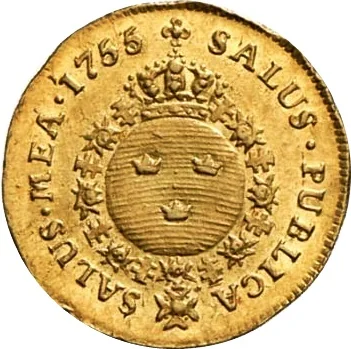
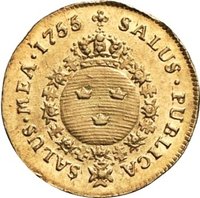
A crowned, lined orb featuring Sweden’s Three Crowns within the Seraphim Order chain. The chain’s pendant interrupts the mintmark below. The rim bears the King’s motto and date, ending with a rosette above the crown’s tip.
Inscription:
SALUS • PUBLICA • SALUS • MEA • 1755 *
H • M •
H • M •
Script: Latin
Edge
Diagonal milling
Categories
| Symbols> Coat of Arms |
Mintings
| Year | Mint Mark | Mintage | Quality | Collection |
|---|---|---|---|---|
| 1754 | HM | 597 | ||
| 1755 | HM | 292 |
Historical background
In 1754, Sweden was operating under a complex and strained monetary system, a legacy of its failed "Age of Liberty" experiments and the Great Northern War. The official currency was the silver riksdaler, but the economy was flooded with two types of depreciated paper money: riksdaler specie (backed by silver) and the nearly worthless riksdaler banco, issued by the Riksens Ständers Bank (precursor to the Riksbank). The value of these currencies fluctuated wildly against each other and against silver, causing confusion, inflation, and hindering trade.
The root of the crisis lay in decades of excessive paper money printing to finance war and state deficits. By 1754, the public had lost confidence in the banknotes, leading to a severe shortage of physical coinage as people hoarded silver. This created a dual circulation where commodities often had two prices: one in silver and a much higher one in paper. The government's attempts to fix exchange rates between the monetary units were largely ineffective in the face of market realities.
Consequently, 1754 fell within a period of intense monetary debate and gradual reform. The Caps (Mössorna) political faction, then in power, pursued a deflationary policy aimed at restoring the value of the paper banco to parity with silver. This policy, while intended to create stability, often exacerbated short-term economic hardship by restricting credit and liquidity. The situation would eventually lead to more decisive action, culminating in the major monetary reform of 1776, which aimed to finally unify and stabilize the currency system.
The root of the crisis lay in decades of excessive paper money printing to finance war and state deficits. By 1754, the public had lost confidence in the banknotes, leading to a severe shortage of physical coinage as people hoarded silver. This created a dual circulation where commodities often had two prices: one in silver and a much higher one in paper. The government's attempts to fix exchange rates between the monetary units were largely ineffective in the face of market realities.
Consequently, 1754 fell within a period of intense monetary debate and gradual reform. The Caps (Mössorna) political faction, then in power, pursued a deflationary policy aimed at restoring the value of the paper banco to parity with silver. This policy, while intended to create stability, often exacerbated short-term economic hardship by restricting credit and liquidity. The situation would eventually lead to more decisive action, culminating in the major monetary reform of 1776, which aimed to finally unify and stabilize the currency system.
✨ Legendary