

4 Daler SM – Sweden
Sweden
Context
Years: 1753–1768
Issuer: Sweden 
Ruler: Adolphus Frederick
Subdivision: 4 Daler SM = 4⁄3 Riksdaler
Demonetized: Yes
Material
References
KM: #Click to copy to clipboardPM75
Numista: #101983
Obverse
Description:
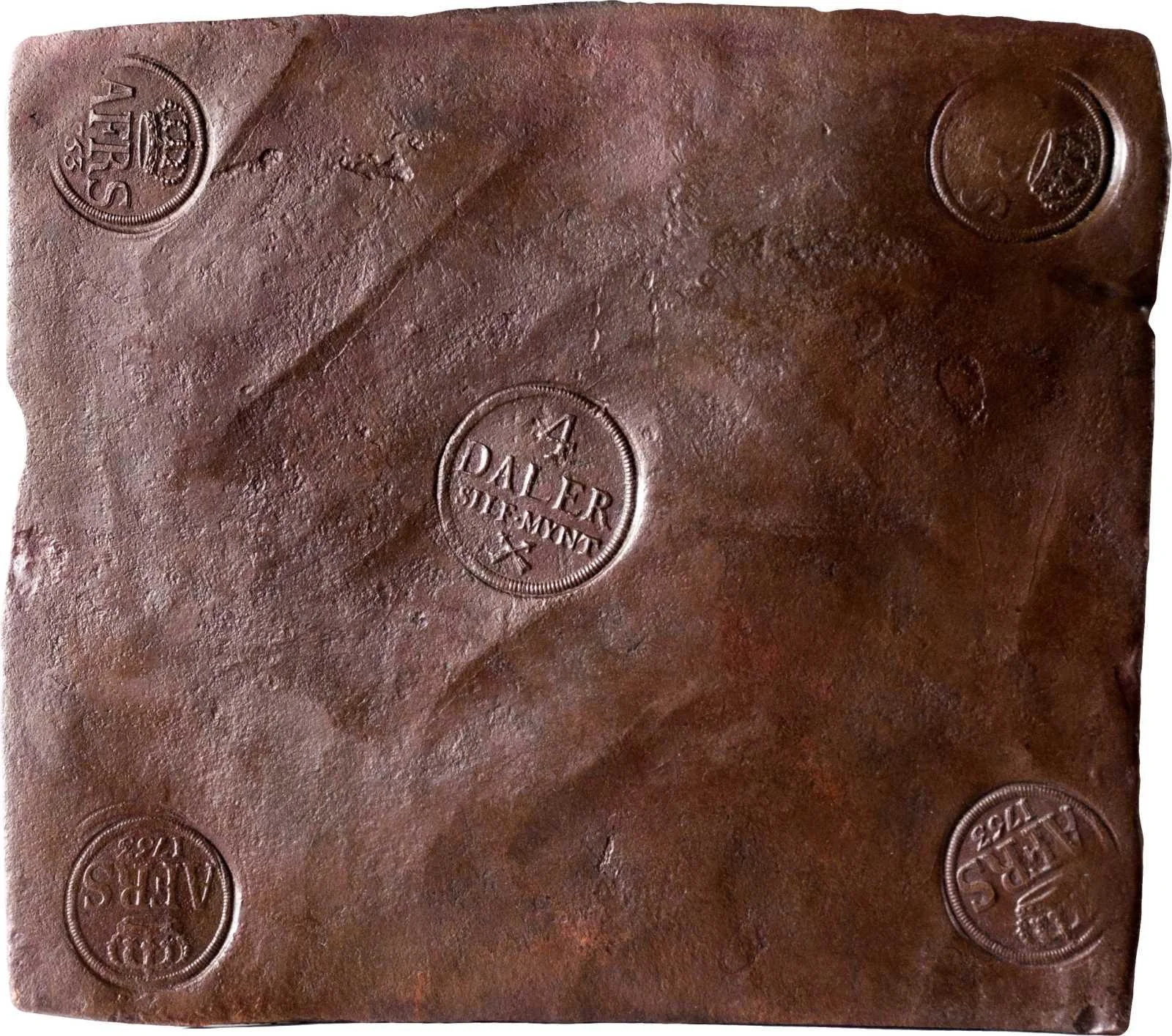
Five stamps: center shows value over crossed arrows; corners feature crowned "AFRS" with dates.
Inscription:
4
DALER
SILF · MYNT
AFRS
1753
DALER
SILF · MYNT
AFRS
1753
Script: Latin
Reverse
Description:
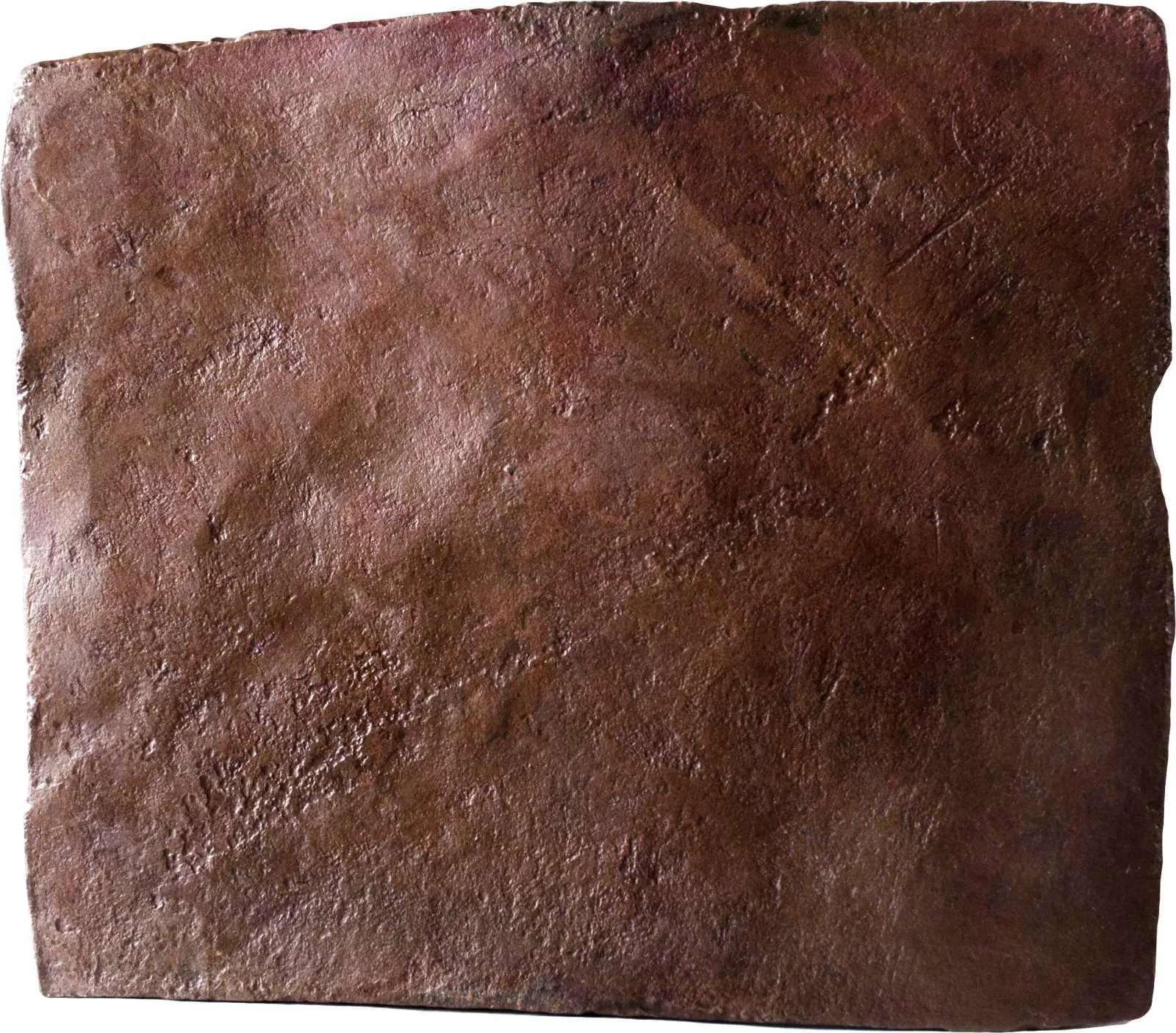
Blank.
Edge
Mintings
| Year | Mint Mark | Mintage | Quality | Collection |
|---|---|---|---|---|
| 1753 | — | — | ||
| 1754 | — | — | ||
| 1755 | — | — | ||
| 1756 | — | — | ||
| 1757 | — | — | ||
| 1758 | — | — | ||
| 1759 | — | — | ||
| 1768 | — | — |
Historical background
In 1753, Sweden was navigating a complex and unstable monetary system, a legacy of its failed "Age of Liberty" experiments and the Great Northern War. The dominant currency was the riksdaler specie, a silver-based coin intended as a stable unit of account. However, decades of war financing had led to the rampant issuance of depreciated paper money, notably the riksdaler banco issued by the Riksens Ständers Bank (precursor to the Riksbank). This created a chaotic dual system where the paper banco traded at a significant discount to the silver specie, causing confusion in trade and public finances.
The situation was further complicated by the widespread circulation of foreign coins, particularly the German reichsthaler, and a chronic shortage of small change for everyday transactions. This scarcity hampered commerce and led to the use of makeshift solutions like privately issued tokens and promissory notes. The state's repeated attempts to rectify the system, including a major recoinage in 1745, had provided only temporary relief and failed to establish lasting confidence.
Against this backdrop, the year 1753 itself was not one of dramatic reform but of ongoing strain within this flawed structure. The Riksens Ständers Bank continued to operate, managing the problematic paper money, while the government and mercantile classes functioned within an environment of uncertain exchange rates. The unresolved currency issues underscored the broader economic and political challenges of the era, setting the stage for future, more decisive monetary reforms that would seek to unify and stabilize the Swedish currency later in the 18th century.
The situation was further complicated by the widespread circulation of foreign coins, particularly the German reichsthaler, and a chronic shortage of small change for everyday transactions. This scarcity hampered commerce and led to the use of makeshift solutions like privately issued tokens and promissory notes. The state's repeated attempts to rectify the system, including a major recoinage in 1745, had provided only temporary relief and failed to establish lasting confidence.
Against this backdrop, the year 1753 itself was not one of dramatic reform but of ongoing strain within this flawed structure. The Riksens Ständers Bank continued to operate, managing the problematic paper money, while the government and mercantile classes functioned within an environment of uncertain exchange rates. The unresolved currency issues underscored the broader economic and political challenges of the era, setting the stage for future, more decisive monetary reforms that would seek to unify and stabilize the Swedish currency later in the 18th century.
✨ Legendary