

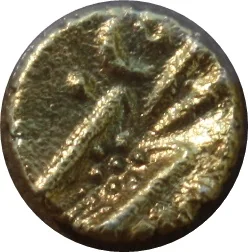

Obverse
Description:
Kali, facing forward, abstract form.
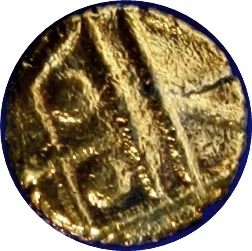
Reverse
Description:
Rama Raya, a fallen nagari hero.
Edge
Plain
Mintings
| Year | Mint Mark | Mintage | Quality | Collection |
|---|---|---|---|---|
| — | — | — |
Historical background
In 1747, the currency situation in Dutch India, centered on the Coromandel Coast and Ceylon, was characterized by chronic instability and a complex multiplicity of circulating media. The primary unit of account was the Dutch guilder, but the actual coinage in circulation was a chaotic mix. This included the company's own minted coins, such as silver duiten and stuivers, but also a vast array of foreign silver coins—most notably Spanish American silver reales (pieces of eight) and their fractional parts, alongside various Indian gold pagodas, silver rupees, and even copper coins from local rulers. This proliferation created constant challenges for trade and administration, requiring official conversion lists that were frequently updated as metal values fluctuated.
The root of this monetary chaos lay in the Dutch East India Company's (VOC) persistent trade deficit with the Indian subcontinent. The VOC exported vast quantities of Indian textiles, spices, and other goods to the archipelago and Europe, but had few European products that were in demand locally to offer in return. Consequently, the Company was forced to finance its purchases almost entirely with imported bullion and coin, primarily silver from the Americas and Japan. This made the entire monetary system dependent on the unpredictable inflow of specie, leading to frequent shortages, hoarding, and the clipping or debasement of coins, which further eroded public trust.
Facing these pressures, the VOC authorities in Batavia and the local councils in places like Colombo and Nagapatnam engaged in continual but largely ineffective attempts to impose order. They issued ordinances to fix exchange rates between the various coins, often setting them above their intrinsic market value to attract silver, a practice that frequently led to arbitrage and smuggling. The year 1747 falls within a period where the Company's financial and military position was increasingly strained due to conflicts with local powers and European rivals, making comprehensive monetary reform impossible. Thus, the currency situation remained a persistent weakness, reflecting the VOC's broader commercial decline and its inability to fully control the economic environment of its Indian possessions.
The root of this monetary chaos lay in the Dutch East India Company's (VOC) persistent trade deficit with the Indian subcontinent. The VOC exported vast quantities of Indian textiles, spices, and other goods to the archipelago and Europe, but had few European products that were in demand locally to offer in return. Consequently, the Company was forced to finance its purchases almost entirely with imported bullion and coin, primarily silver from the Americas and Japan. This made the entire monetary system dependent on the unpredictable inflow of specie, leading to frequent shortages, hoarding, and the clipping or debasement of coins, which further eroded public trust.
Facing these pressures, the VOC authorities in Batavia and the local councils in places like Colombo and Nagapatnam engaged in continual but largely ineffective attempts to impose order. They issued ordinances to fix exchange rates between the various coins, often setting them above their intrinsic market value to attract silver, a practice that frequently led to arbitrage and smuggling. The year 1747 falls within a period where the Company's financial and military position was increasingly strained due to conflicts with local powers and European rivals, making comprehensive monetary reform impossible. Thus, the currency situation remained a persistent weakness, reflecting the VOC's broader commercial decline and its inability to fully control the economic environment of its Indian possessions.


💎 Very Rare