

1 ducat – Sweden
Add to wishlist
Sweden
Context
Years: 1771–1792
Issuer: Sweden
Ruler: Gustav III
Currency:
(1719—1798)
Demonetized: Yes
Total mintage: 116,008
Material
References
KM: #
Numista: #101863
Value
Bullion value: $523.92
Obverse
Description:
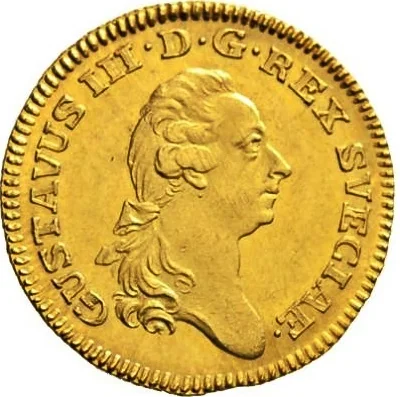
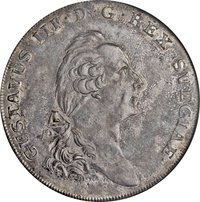
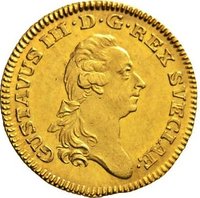
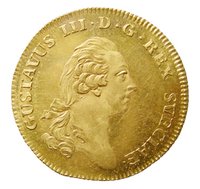
Bust of Gustav III facing right, encircled by legend.
Inscription:
GUSTAVUS III · D · G · REX SVECIAE ·
Script: Latin
Reverse
Description:
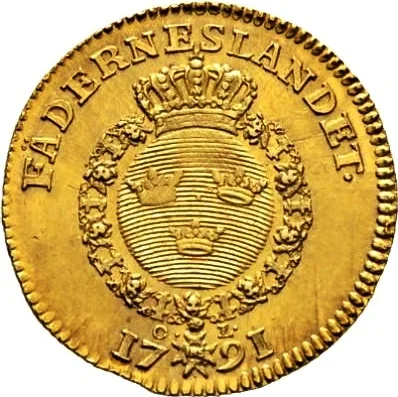
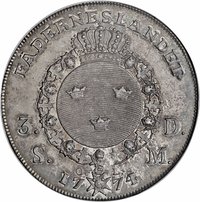
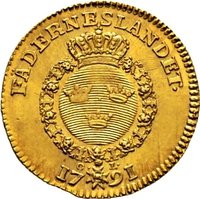
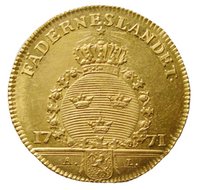
Sweden’s Three Crowns within the Seraphim Order chain, pendant dividing date and mintmark. The King’s motto is above the crown.
Inscription:
FÄDERNESLANDET·
O. L.
17 90
O. L.
17 90
Script: Latin
Edge
Diagonal milling
Categories
| Symbols> Coat of Arms |
Mintings
| Year | Mint Mark | Mintage | Quality | Collection |
|---|---|---|---|---|
| 1771 | AL | 2,255 | ||
| 1772 | AL | 4,536 | ||
| 1773 | AL | 3,636 | ||
| 1774 | OL | 6,827 | ||
| 1775 | OL | 4,088 | ||
| 1776 | OL | 14,768 | ||
| 1777 | OL | 10,198 | ||
| 1778 | OL | — | ||
| 1779 | OL | 4,496 | ||
| 1780 | OL | 2,585 | ||
| 1781 | OL | 6,096 | ||
| 1782 | OL | 16,352 | ||
| 1783 | OL | 7,488 | ||
| 1784 | OL | 2,422 | ||
| 1785 | OL | 1,245 | ||
| 1786 | OL | 6,787 | ||
| 1787 | OL | 5,009 | ||
| 1788 | OL | 804 | ||
| 1789 | OL | 8,198 | ||
| 1790 | OL | 3,643 | ||
| 1791 | OL | 1,160 | ||
| 1792 | OL | 3,415 |
Historical background
In 1771, Sweden found itself in a precarious monetary crisis, the direct consequence of the Riksdag of the Estates' prolonged and expensive political conflict known as the "Age of Liberty." For decades, the competing "Hat" and "Cap" parties had financed their ambitions and a costly war against Russia (the Hats' disastrous war of 1741-43) not through taxation, but by printing vast quantities of paper money through the state-owned Riksens Ständers Bank. This unbacked currency, known as riksdaler riksgälds, had steadily depreciated, leading to inflation and a severe lack of public confidence.
The situation reached a critical point following the 1765-66 Riksdag, where the Caps took power and attempted a drastic deflationary policy. They decided to call in and destroy the devalued notes to restore the currency's value. However, this sudden contraction of the money supply triggered a severe economic depression, crippling commerce and industry. By 1771, the nation was deeply divided, suffering from falling prices, bankruptcies, high unemployment, and widespread social distress, all exacerbated by a poor harvest.
This economic turmoil set the stage for a major political shift. The unpopularity of the Caps' harsh monetary policy, combined with the general misery, eroded support for the parliamentary system itself. It created a powerful wave of disillusionment with the faction-ridden Estates, which the young King Gustav III would skillfully exploit. Upon his return to Sweden in 1771, he found a nation ripe for change, and the currency crisis became a central justification for his coup d'état in 1772, which re-established strong royal authority and ended the Age of Liberty.
The situation reached a critical point following the 1765-66 Riksdag, where the Caps took power and attempted a drastic deflationary policy. They decided to call in and destroy the devalued notes to restore the currency's value. However, this sudden contraction of the money supply triggered a severe economic depression, crippling commerce and industry. By 1771, the nation was deeply divided, suffering from falling prices, bankruptcies, high unemployment, and widespread social distress, all exacerbated by a poor harvest.
This economic turmoil set the stage for a major political shift. The unpopularity of the Caps' harsh monetary policy, combined with the general misery, eroded support for the parliamentary system itself. It created a powerful wave of disillusionment with the faction-ridden Estates, which the young King Gustav III would skillfully exploit. Upon his return to Sweden in 1771, he found a nation ripe for change, and the currency crisis became a central justification for his coup d'état in 1772, which re-established strong royal authority and ended the Age of Liberty.
Series: 1771 Sweden circulation coins
✨ Legendary