

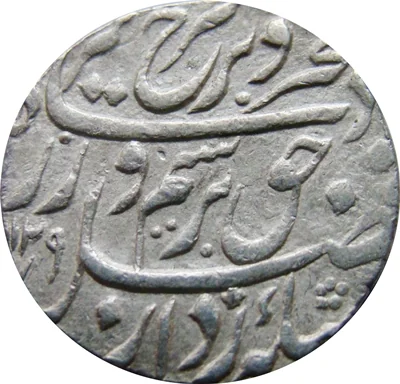
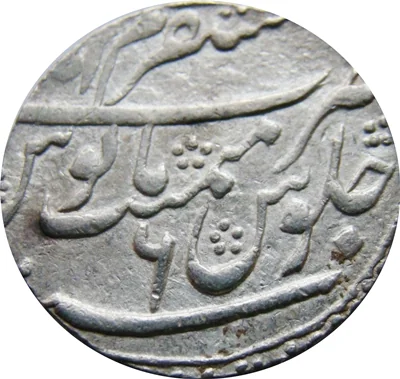
1 Rupee – Mughal Empire
India
Context
Years: 1714–1719
Country: India 
Issuer: Mughal Empire
Ruler: Farrukhsiyar
Currency:
(1540—1842)
Demonetized: Yes
Material
References
KM: #Click to copy to clipboard377.14
Numista: #101814
Value
Bullion value: $33.48
Obverse
Description:
Inscription: Badshah-e-Barr couplet. Sikka struck by divine favor on silver and gold. Badshah Bahar-o-Barr Farrukhsiyar.
Reverse
Description:
Mustagir-ul-Mulk mint.
Edge
Mints
| Name | Mark |
|---|---|
| Azimabad | — |
Mintings
| Year | Mint Mark | Mintage | Quality | Collection |
|---|---|---|---|---|
| — | — | — | ||
| 1714 | — | — | ||
| 1715 | — | — | ||
| 1716 | — | — | ||
| 1717 | — | — | ||
| 1719 | — | — |
Historical background
By 1714, the Mughal Empire's currency system, once a pillar of its economic strength, was under severe strain. The standard silver rupee, established by Emperor Sher Shah Suri and meticulously maintained by Akbar, remained the primary circulating coin, but its integrity was being compromised. Decades of continuous warfare under Aurangzeb had drained the imperial treasury, leading to a critical shortage of silver bullion, the lifeblood of the coinage. This scarcity forced regional mints to produce coins with varying purity and weight, eroding the uniform standard that had facilitated empire-wide trade.
The political decentralization following Aurangzeb's death in 1707 directly impacted the monetary system. Powerful regional governors and newly assertive successor states like Hyderabad and Bengal began striking their own rupees, often imitating the imperial design but with reduced silver content. While the official Mughal rupee from the major mints at Delhi, Lahore, and Ahmadabad still commanded respect, its circulation was becoming increasingly regional. The system was fragmenting, with older, purer coins being hoarded (Gresham's Law in practice) and a confusing variety of newer, debased coins entering the markets, creating uncertainty for merchants and taxpayers alike.
Furthermore, the global inflow of silver, which had once sustained the Mughal economy, was becoming less reliable. European trading companies were now diverting more American and Japanese silver to their own colonial ventures and to China for tea and porcelain, reducing the volume reaching Mughal India. Consequently, by 1714, the empire faced a tightening monetary squeeze: a weakening central authority unable to enforce coinage standards, a fragmented system of issue, and a diminishing supply of precious metal. This financial instability was both a symptom and a cause of the broader political decline, undermining commerce and the state's ability to pay its armies and administration.
The political decentralization following Aurangzeb's death in 1707 directly impacted the monetary system. Powerful regional governors and newly assertive successor states like Hyderabad and Bengal began striking their own rupees, often imitating the imperial design but with reduced silver content. While the official Mughal rupee from the major mints at Delhi, Lahore, and Ahmadabad still commanded respect, its circulation was becoming increasingly regional. The system was fragmenting, with older, purer coins being hoarded (Gresham's Law in practice) and a confusing variety of newer, debased coins entering the markets, creating uncertainty for merchants and taxpayers alike.
Furthermore, the global inflow of silver, which had once sustained the Mughal economy, was becoming less reliable. European trading companies were now diverting more American and Japanese silver to their own colonial ventures and to China for tea and porcelain, reducing the volume reaching Mughal India. Consequently, by 1714, the empire faced a tightening monetary squeeze: a weakening central authority unable to enforce coinage standards, a fragmented system of issue, and a diminishing supply of precious metal. This financial instability was both a symptom and a cause of the broader political decline, undermining commerce and the state's ability to pay its armies and administration.

✨ Legendary