

1 Kopeck – Russian Empire
Russia
Context
Material
References
KM: #Click to copy to clipboard141
Numista: #101766
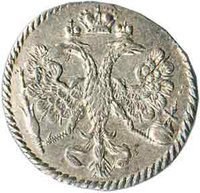
Obverse
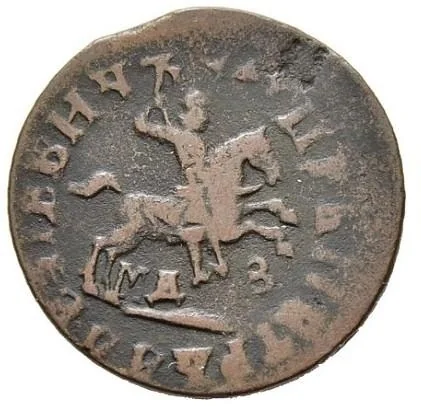
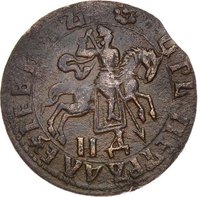
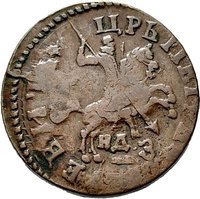
Description:
Saint George slaying the dragon.
Inscription:
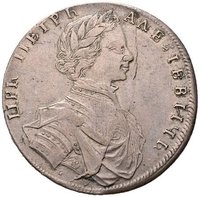
ЦРЬ ПЕТРЪ АЛЕѮIЕВИЧЪ
М Д З
М Д З
Script: Cyrillic
Reverse
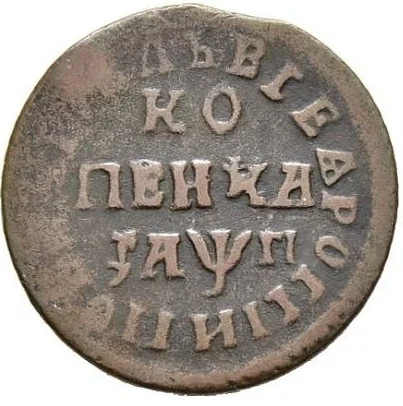
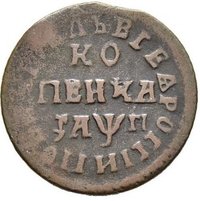
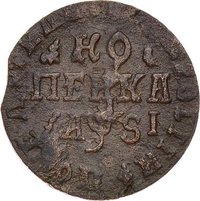
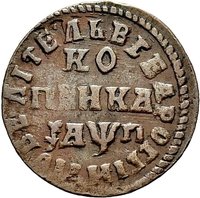
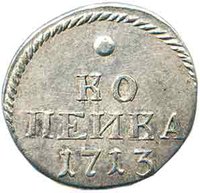
Description:
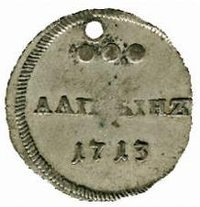
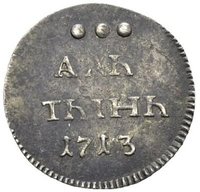
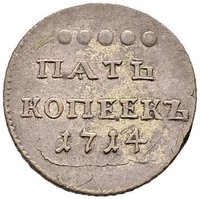
Denomination. Date in Cyrillic numerals.
Inscription:
ВСЕѦ + РОССIИ + ПОВЕЛIТЕЛЬ +
КО
ПЕИКА
҂АΨГI
КО
ПЕИКА
҂АΨГI
Script: Cyrillic
Edge
Plain
Mints
| Name | Mark |
|---|---|
| Kadashevsky Mint | МДЗ |
Historical background
In 1713, the Russian Empire’s currency system was in a state of profound strain and transition, largely due to the immense financial demands of the Great Northern War (1700–1721). Tsar Peter the Great’s ambitious military reforms and the protracted conflict against Sweden had drained the state treasury. To meet these costs, the government resorted to debasement—reducing the silver content in coins while maintaining their face value. The primary silver coin, the kopeck, and its smaller denominations were minted with progressively less precious metal, leading to inflation, a loss of public trust in the coinage, and a thriving black market for older, full-weight coins.
The monetary landscape was further complicated by a chronic shortage of small-denomination coins for everyday trade, a problem Peter attempted to address by expanding minting operations. However, the core issue remained the state’s reliance on copper for smaller coins and degraded silver for higher denominations, creating a disjointed and unstable system. Alongside this, foreign silver coins, particularly German thalers (known in Russia as yefimki), circulated widely, especially in border regions and international trade, as they were seen as more reliable stores of value than the debased domestic currency.
This period of monetary crisis was a direct catalyst for Peter’s comprehensive currency reform, which would culminate a decade later. The experiences of 1713 highlighted the unsustainable nature of war-finance through debasement and underscored the need for a stable, decimal-based system. This ultimately led to the landmark reforms of the early 1720s, which introduced the ruble divided into 100 kopecks, regularized coinage weights, and established a more modern monetary framework for the empire.
The monetary landscape was further complicated by a chronic shortage of small-denomination coins for everyday trade, a problem Peter attempted to address by expanding minting operations. However, the core issue remained the state’s reliance on copper for smaller coins and degraded silver for higher denominations, creating a disjointed and unstable system. Alongside this, foreign silver coins, particularly German thalers (known in Russia as yefimki), circulated widely, especially in border regions and international trade, as they were seen as more reliable stores of value than the debased domestic currency.
This period of monetary crisis was a direct catalyst for Peter’s comprehensive currency reform, which would culminate a decade later. The experiences of 1713 highlighted the unsustainable nature of war-finance through debasement and underscored the need for a stable, decimal-based system. This ultimately led to the landmark reforms of the early 1720s, which introduced the ruble divided into 100 kopecks, regularized coinage weights, and established a more modern monetary framework for the empire.
✨ Legendary