

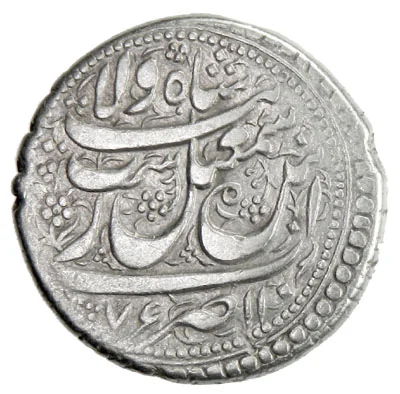
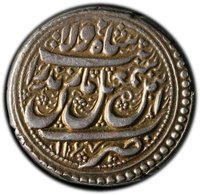
Obverse
Description:
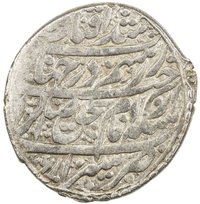
Rasht mint date retrograde to 1167.
Inscription:
بنده شاه ولایت اسمعیل
ضرب رشت
۷۶۱۱
ضرب رشت
۷۶۱۱
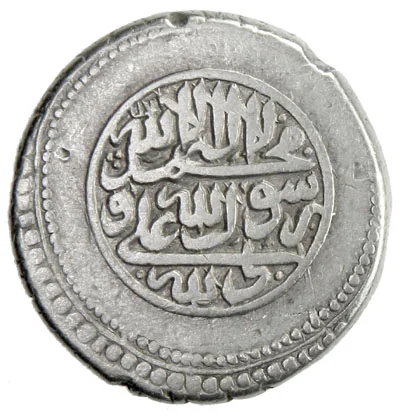
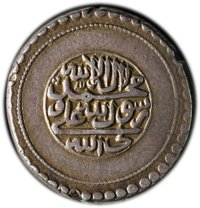
Reverse
Inscription:
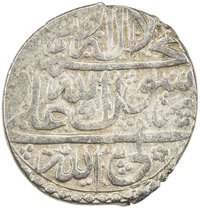
لا اله الا الله
محمد رسول الله
علی ولی الله
محمد رسول الله
علی ولی الله
Edge
Plain
Mints
| Name | Mark |
|---|---|
| Dar al-Marz Rasht | رشت |
Mintings
| Year | Mint Mark | Mintage | Quality | Collection |
|---|---|---|---|---|
| 1753 | — | — | ||
| 1754 | — | — | ||
| 1755 | — | — |
Historical background
In 1753, Iran was under the rule of the Afsharid dynasty, founded by the military conqueror Nader Shah. His reign (1736-1747) had a profound and destabilizing impact on the currency. To finance his vast military campaigns, including the infamous sack of Delhi in 1739, Nader Shah debased the silver coinage, the primary monetary unit. He systematically reduced the silver content of coins like the abbasi and mohammadi, while also striking large quantities of new copper pulis to cover expenses. This created a severe inflation and a crisis of confidence in the currency, as the intrinsic value of coins fell sharply while their nominal value was artificially maintained.
Following Nader Shah's assassination in 1747, the empire fragmented, plunging Iran into a period of civil war and regional strife. By 1753, no single authority controlled the entire country; various Afsharid princes, Karim Khan Zand in the south, and Azad Khan Afghan in the northwest vied for power. This political fragmentation directly translated into monetary chaos. Provincial rulers and tribal khans began minting their own coins, often of highly variable weight and purity, further eroding any standardized monetary system. The concept of a unified national currency had effectively collapsed, with trade often relying on the weight of precious metal rather than the trust in a minting authority.
Consequently, the currency situation in 1753 was one of profound disorder and complexity. The economy operated on a patchwork of debased, locally minted coins, while older, purer coins from Nader's early reign or even the preceding Safavid era were hoarded, removing them from circulation. Long-distance trade and the state's ability to collect taxes efficiently were severely hampered. This monetary instability both reflected and exacerbated the wider political disintegration, marking a low point in Iran's early modern economic history before the gradual consolidation under Karim Khan Zand later in the decade.
Following Nader Shah's assassination in 1747, the empire fragmented, plunging Iran into a period of civil war and regional strife. By 1753, no single authority controlled the entire country; various Afsharid princes, Karim Khan Zand in the south, and Azad Khan Afghan in the northwest vied for power. This political fragmentation directly translated into monetary chaos. Provincial rulers and tribal khans began minting their own coins, often of highly variable weight and purity, further eroding any standardized monetary system. The concept of a unified national currency had effectively collapsed, with trade often relying on the weight of precious metal rather than the trust in a minting authority.
Consequently, the currency situation in 1753 was one of profound disorder and complexity. The economy operated on a patchwork of debased, locally minted coins, while older, purer coins from Nader's early reign or even the preceding Safavid era were hoarded, removing them from circulation. Long-distance trade and the state's ability to collect taxes efficiently were severely hampered. This monetary instability both reflected and exacerbated the wider political disintegration, marking a low point in Iran's early modern economic history before the gradual consolidation under Karim Khan Zand later in the decade.
Series: 1753 Iran circulation coins
✨ Legendary