

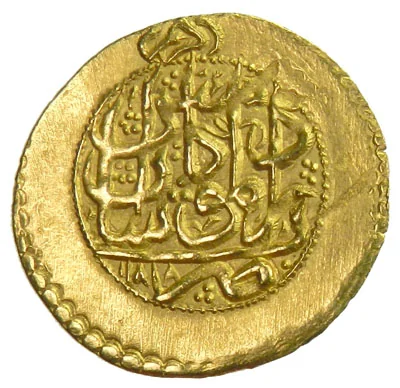
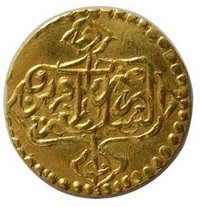
Obverse
Description:
Kashan mint.
Inscription:
یا کریم
ضرب دارالمؤمنین کاشان
۱۱۸۸
ضرب دارالمؤمنین کاشان
۱۱۸۸
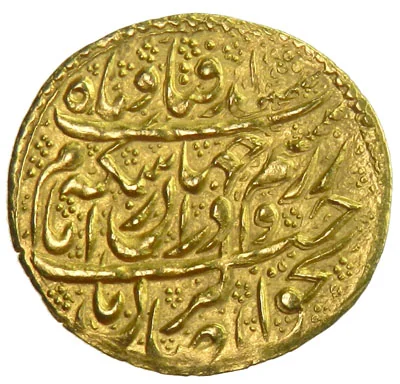
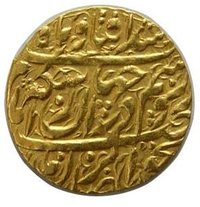
Reverse
Inscription:
شد آفتاب و ماه زر و سیم در جهان
از سکه امام بحق صاحب الزمان
از سکه امام بحق صاحب الزمان
Edge
Plain
Mints
| Name | Mark |
|---|---|
| Kashan | کاشان |
Mintings
| Year | Mint Mark | Mintage | Quality | Collection |
|---|---|---|---|---|
| 1765 | — | — | ||
| 1766 | — | — | ||
| 1767 | — | — | ||
| 1769 | — | — | ||
| 1771 | — | — | ||
| 1772 | — | — | ||
| 1773 | — | — | ||
| 1773 | — | — | ||
| 1774 | — | — | ||
| 1775 | — | — | ||
| 1776 | — | — | ||
| 1777 | — | — | ||
| 1778 | — | — |
Historical background
In 1765, Iran was under the rule of the Zand dynasty, founded by Karim Khan Zand, who had established his capital in Shiraz. The period was one of relative stability and recovery following decades of civil war and chaos after the collapse of the Safavid Empire and the brief, destructive invasion of Nader Shah Afshar. Karim Khan, who notably took the title Vakil al-Ra'āyā (Representative of the People) rather than king, focused on justice, economic rehabilitation, and domestic prosperity. This peaceful interlude allowed for a degree of monetary consistency, with the silver toman (a unit of account) and the rial (a coin) serving as the basis of the currency system, though the economy remained highly regionalized.
The currency itself was primarily silver-based, with coins minted in major cities like Shiraz, Isfahan, and Tabriz. The most important coin was the silver rial, but its weight and purity could vary between mints, leading to complexities in trade. The gold toman was not commonly minted but was used as a high-value accounting unit equal to 10,000 dinars or 10 silver rials. Copper coins (fulus) were used for small, everyday transactions. A significant challenge was the chronic shortage of precious metals, exacerbated by Nader Shah's earlier costly wars and the subsequent outflow of bullion, which limited the state's ability to mint sufficient quantities of uniform, high-quality coinage.
Furthermore, Iran's monetary system in 1765 was not isolated but deeply affected by foreign trade. The country was a key link in Eurasian commerce, and European trading companies, particularly the English and Dutch East India Companies, were active in the Persian Gulf. Their trade, especially the export of Iranian silk and the import of Indian goods and European silver, directly influenced the money supply. The influx of foreign silver coins, such as the Spanish dollar and Indian rupees, circulated alongside domestic issues, creating a de facto multi-currency environment. While Karim Khan's administration provided stability, the system remained vulnerable to the vagaries of international bullion flows and the inherent difficulties of centralizing mint operations across a vast, diverse empire.
The currency itself was primarily silver-based, with coins minted in major cities like Shiraz, Isfahan, and Tabriz. The most important coin was the silver rial, but its weight and purity could vary between mints, leading to complexities in trade. The gold toman was not commonly minted but was used as a high-value accounting unit equal to 10,000 dinars or 10 silver rials. Copper coins (fulus) were used for small, everyday transactions. A significant challenge was the chronic shortage of precious metals, exacerbated by Nader Shah's earlier costly wars and the subsequent outflow of bullion, which limited the state's ability to mint sufficient quantities of uniform, high-quality coinage.
Furthermore, Iran's monetary system in 1765 was not isolated but deeply affected by foreign trade. The country was a key link in Eurasian commerce, and European trading companies, particularly the English and Dutch East India Companies, were active in the Persian Gulf. Their trade, especially the export of Iranian silk and the import of Indian goods and European silver, directly influenced the money supply. The influx of foreign silver coins, such as the Spanish dollar and Indian rupees, circulated alongside domestic issues, creating a de facto multi-currency environment. While Karim Khan's administration provided stability, the system remained vulnerable to the vagaries of international bullion flows and the inherent difficulties of centralizing mint operations across a vast, diverse empire.
✨ Legendary