

100 escudos – Cape Verde
Add to wishlist
Cape Verde
Obverse
Description:
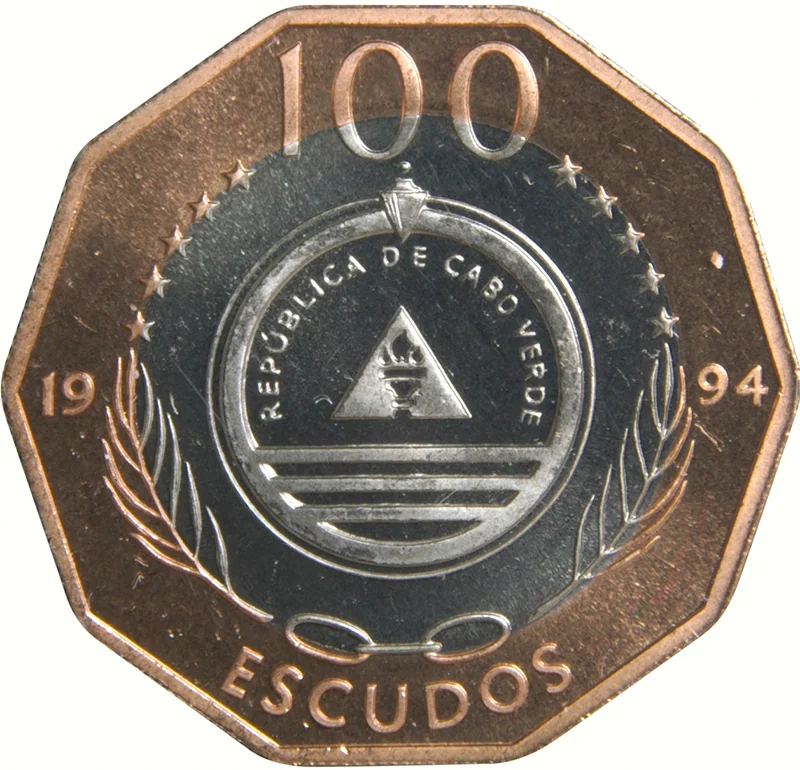
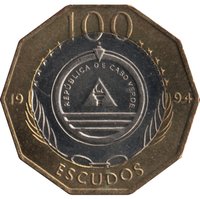
National emblem divides date and denomination above, value below.
Inscription:
100
19 94
ESCUDOS
REPÚBLICA DE CABO VERDE
19 94
ESCUDOS
REPÚBLICA DE CABO VERDE
Translation:
One Hundred
19 94
Escudos
Republic of Cape Verde
19 94
Escudos
Republic of Cape Verde
Script: Latin
Languages: Spanish, Portuguese
Reverse
Edge
Reeded
Mintings
| Year | Mint Mark | Mintage | Quality | Collection |
|---|---|---|---|---|
| 1994 | — | — | ||
| 1994 | — | — | In sets |
Historical background
In 1994, the currency situation in Cape Verde was defined by stability and a firm peg to an international basket, a notable achievement for a small, resource-scarce island nation. The country's currency, the Cape Verdean escudo (CVE), was not freely convertible and its value was officially fixed by the Banco de Cabo Verde. This peg was not to a single currency but to a weighted basket of currencies belonging to its main trading partners, with the Portuguese escudo holding a predominant share. This linkage provided a crucial anchor for prices and trade, fostering macroeconomic stability in an economy heavily dependent on imports, tourism, and remittances.
This monetary framework was a legacy of the country's historical ties to Portugal and a deliberate policy choice following independence in 1975. The fixed exchange rate regime required disciplined fiscal and monetary policies to maintain, as the central bank had to hold sufficient foreign exchange reserves to defend the peg. By 1994, this approach had largely succeeded in controlling inflation and building confidence, both domestically and with international financial institutions. However, it also meant Cape Verde relinquished independent monetary policy, and its economy remained vulnerable to external shocks affecting its anchor currencies and trade flows.
The context of 1994 was one of cautious economic liberalization and engagement with the global community. The currency peg was seen as a cornerstone for attracting foreign investment and development aid, which were vital for growth. While the system provided stability, it also imposed constraints, implicitly setting the stage for future discussions about monetary policy flexibility. Within a decade, these discussions would lead to a significant shift, as Cape Verde would later move to peg the escudo solely to the euro, reflecting Portugal's own adoption of the single European currency and the deepening of EU-Cape Verde relations.
This monetary framework was a legacy of the country's historical ties to Portugal and a deliberate policy choice following independence in 1975. The fixed exchange rate regime required disciplined fiscal and monetary policies to maintain, as the central bank had to hold sufficient foreign exchange reserves to defend the peg. By 1994, this approach had largely succeeded in controlling inflation and building confidence, both domestically and with international financial institutions. However, it also meant Cape Verde relinquished independent monetary policy, and its economy remained vulnerable to external shocks affecting its anchor currencies and trade flows.
The context of 1994 was one of cautious economic liberalization and engagement with the global community. The currency peg was seen as a cornerstone for attracting foreign investment and development aid, which were vital for growth. While the system provided stability, it also imposed constraints, implicitly setting the stage for future discussions about monetary policy flexibility. Within a decade, these discussions would lead to a significant shift, as Cape Verde would later move to peg the escudo solely to the euro, reflecting Portugal's own adoption of the single European currency and the deepening of EU-Cape Verde relations.
🌱 Common