

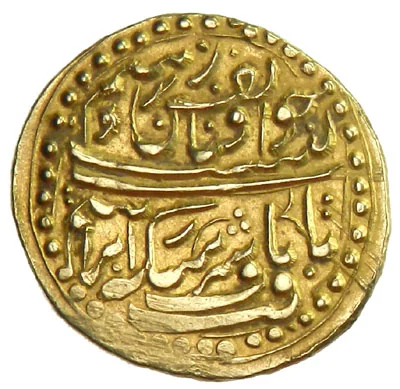
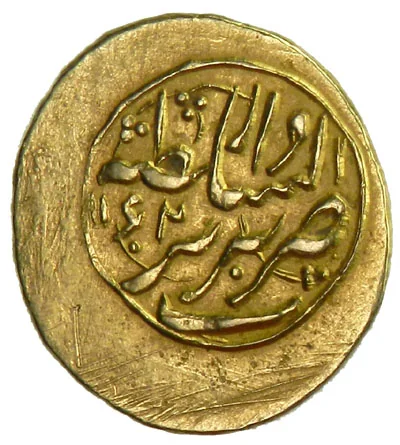
¼ Mohur – Iran
Iran
Context
Year: 1749
Islamic (Hijri) Year: 1162
Issuer: Iran 
Ruler: Ebrahim Afshar
Currency:
(1501—1798)
Demonetization: 1749
Material
Weight: 2.76 g
Gold weight: 2.76 g
Shape: Irregular round
Composition: Gold
Magnetic: No
Alignment: Coin alignment
flip
References
KM: #Click to copy to clipboard417
Numista: #61661
Value
Bullion value: $460.18
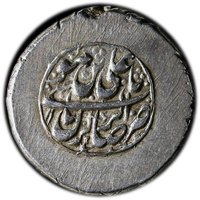
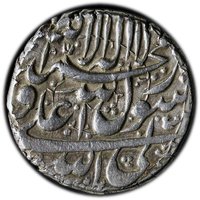
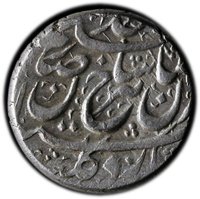
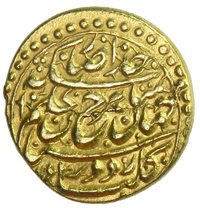
Obverse
Inscription:
بنشست چو آفتاب نقش زر و سیم
تا یافت شرف ز سکه ابراهیم
تا یافت شرف ز سکه ابراهیم
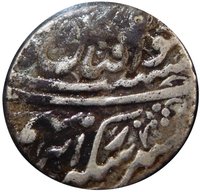
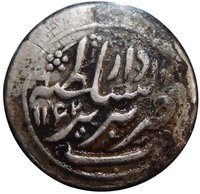
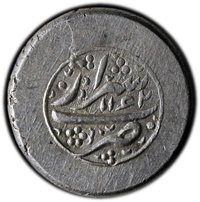
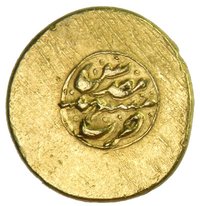
Reverse
Description:
Tabriz mint.
Inscription:
ضرب دارالسلطنه تبریز
۱۱۶۲
۱۱۶۲
Edge
Plain
Mints
| Name | Mark |
|---|---|
| Tebriz | تبریز |
Mintings
| Year | Mint Mark | Mintage | Quality | Collection |
|---|---|---|---|---|
| 1749 | — | — |
Historical background
In 1749, Iran was under the rule of Nader Shah Afshar, a period marked by immense military conquest and profound economic strain. Nader Shah’s relentless campaigns, most notably his 1739 sack of Delhi, had flooded the empire with plundered gold, jewels, and specie. However, this sudden influx of wealth did not translate into economic stability. Instead, the treasury was exhausted by the colossal cost of maintaining a vast standing army and funding further military expeditions, creating a severe fiscal crisis. The state's financial administration was chaotic, with corruption rampant and efficient tax collection failing to meet the empire's bloated expenditures.
The currency system itself was in a state of debasement and confusion. While the primary silver coin remained the abbasi (theoretical value of 200 dinars), Nader Shah had introduced new gold coins, the naderi, and a double-abbasi, but their values were unstable. More critically, to finance his endless wars, the government increasingly resorted to debasing the silver coinage—reducing its precious metal content while maintaining its face value. This practice, combined with the irregular minting of coins in various provincial mints, led to a proliferation of coins of inconsistent weight and purity, severely undermining public trust in the currency.
Consequently, by 1749, the Iranian economy was experiencing significant inflation and commercial disruption. Merchants and the general population faced uncertainty in everyday transactions, as the real value of coins fluctuated. This monetary instability was a direct symptom of a state that prioritized military expansion over sustainable economic governance. The situation would only deteriorate further; Nader Shah was assassinated just eight months later, in June 1749, plunging the empire into a succession crisis that would accelerate the complete fragmentation of the currency system and the broader economy in the decades of civil war that followed.
The currency system itself was in a state of debasement and confusion. While the primary silver coin remained the abbasi (theoretical value of 200 dinars), Nader Shah had introduced new gold coins, the naderi, and a double-abbasi, but their values were unstable. More critically, to finance his endless wars, the government increasingly resorted to debasing the silver coinage—reducing its precious metal content while maintaining its face value. This practice, combined with the irregular minting of coins in various provincial mints, led to a proliferation of coins of inconsistent weight and purity, severely undermining public trust in the currency.
Consequently, by 1749, the Iranian economy was experiencing significant inflation and commercial disruption. Merchants and the general population faced uncertainty in everyday transactions, as the real value of coins fluctuated. This monetary instability was a direct symptom of a state that prioritized military expansion over sustainable economic governance. The situation would only deteriorate further; Nader Shah was assassinated just eight months later, in June 1749, plunging the empire into a succession crisis that would accelerate the complete fragmentation of the currency system and the broader economy in the decades of civil war that followed.
Series: 1749 Iran circulation coins
✨ Legendary