

⅓ Speciedaler – Norway
Norway
Context

Material
References
KM: #Click to copy to clipboard273
Numista: #119228
Value
Bullion value: $23.95
Obverse
Description:
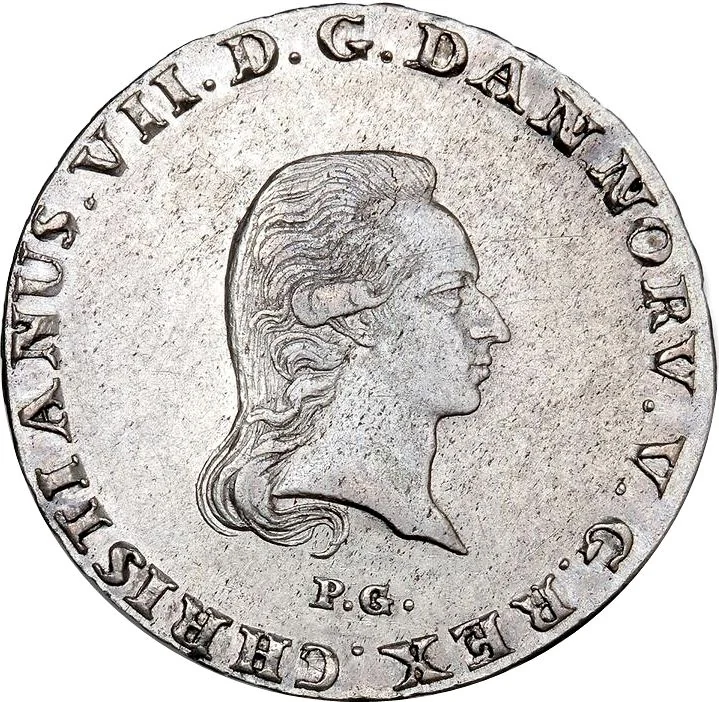
Bust of King Christian VII facing right, with long hair and surrounding inscription. Engraver's initials below.
Inscription:
CHRISTIANUS.VII.D.G.DAN.NORV.V.G.REX.
P.G.
P.G.
Translation:
Christian VII, by the Grace of God, of the Danes and Norwegians, Vandals and Goths, King.
By the Grace of God.
By the Grace of God.
Script: Latin
Language: Latin
Engraver: Peter Leonhard Gianelli
Reverse
Edge
Mints
| Name | Mark |
|---|---|
| Norwegian Mint | — |
Mintings
| Year | Mint Mark | Mintage | Quality | Collection |
|---|---|---|---|---|
| 1803 | — | — |
Historical background
In 1803, Norway was part of the dual monarchy of Denmark-Norway, and its currency system was complex and strained. The official currency was the Danish rigsdaler, divided into 96 skilling. However, the system was not unified; a parallel Norwegian riksdaler also existed, valued at 120 skilling, creating constant confusion and requiring meticulous conversion. Furthermore, a severe shortage of official coinage in circulation led to widespread use of fragmented and worn coins, as well as various forms of credit and promissory notes issued by merchants and local authorities to facilitate everyday trade.
This monetary instability was exacerbated by the broader geopolitical context. Denmark-Norway, attempting to maintain neutrality in the Napoleonic Wars, was under immense economic pressure from the British blockade and continental strife. The state's finances were heavily burdened by the costs of maintaining an armed neutrality, leading to inflationary pressures. The limited and debased physical coinage in Norway struggled to reflect real economic value, hindering commerce and creating uncertainty for both businesses and the population.
Consequently, the year 1803 fell within a period of growing recognition that monetary reform was urgently needed. Discussions about establishing a separate Norwegian bank to issue stable notes and manage currency were gaining traction among merchants and officials in Christiania (Oslo) and Bergen. These efforts would culminate just a few years later: following the Treaty of Kiel in 1814, which transferred Norway to Swedish rule, the newly independent Norwegian state would prioritize financial sovereignty by founding Norges Bank in 1816 and introducing a new, stable currency, the speciedaler.
This monetary instability was exacerbated by the broader geopolitical context. Denmark-Norway, attempting to maintain neutrality in the Napoleonic Wars, was under immense economic pressure from the British blockade and continental strife. The state's finances were heavily burdened by the costs of maintaining an armed neutrality, leading to inflationary pressures. The limited and debased physical coinage in Norway struggled to reflect real economic value, hindering commerce and creating uncertainty for both businesses and the population.
Consequently, the year 1803 fell within a period of growing recognition that monetary reform was urgently needed. Discussions about establishing a separate Norwegian bank to issue stable notes and manage currency were gaining traction among merchants and officials in Christiania (Oslo) and Bergen. These efforts would culminate just a few years later: following the Treaty of Kiel in 1814, which transferred Norway to Swedish rule, the newly independent Norwegian state would prioritize financial sovereignty by founding Norges Bank in 1816 and introducing a new, stable currency, the speciedaler.
✨ Legendary