

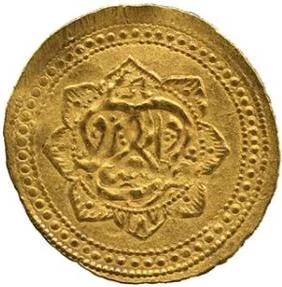
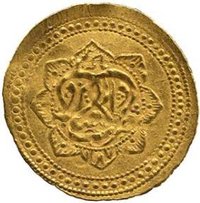
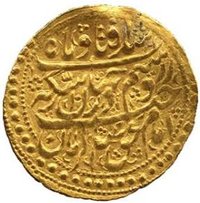
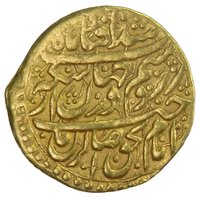
Obverse
Inscription:
یا کریم
ضرب دارالایمان یزد
۱۱۸۷
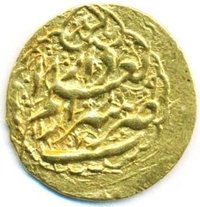
ضرب دارالایمان یزد
۱۱۸۷
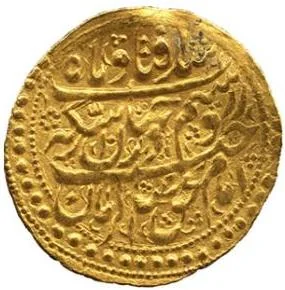
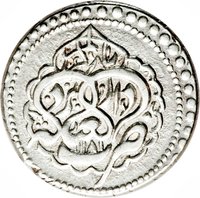
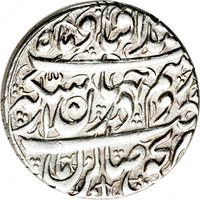
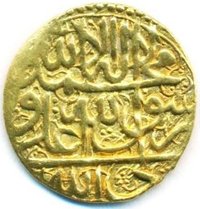
Reverse
Description:
Yazd mint.
Inscription:
شد آفتاب و ماه زر و سیم در جهان / از سکه امام بحق صاحب زمان
Edge
Plain
Mints
| Name | Mark |
|---|---|
| Yazd | — |
Mintings
| Year | Mint Mark | Mintage | Quality | Collection |
|---|---|---|---|---|
| 1766 | — | — | ||
| 1767 | — | — | ||
| 1768 | — | — | ||
| 1773 | — | — | ||
| 1773 | — | — | ||
| 1774 | — | — | ||
| 1775 | — | — | ||
| 1776 | — | — | ||
| 1777 | — | — | ||
| 1778 | — | — | ||
| 1779 | — | — |
Historical background
In 1766, Iran was under the rule of the Zand dynasty, founded by Karim Khan Zand, who had established his capital in Shiraz. The period was one of relative stability and recovery following decades of civil war and fragmentation after the collapse of the Safavid Empire in 1722. Karim Khan, who notably refused the title of Shah, ruling as Vakil al-Raʿāyā (Representative of the People), focused on restoring economic order and promoting trade. His policies of relative tolerance and investment in infrastructure, including caravanserais and bazaars, created a more favourable environment for commerce and, by extension, for the currency system to function.
The currency situation was complex, reflecting Iran's historical position on trade routes and its recent political turmoil. The primary circulating coins were silver tomans (a unit of account) and qirans, as well as copper dinars for small-scale transactions. However, the coinage was often debased, and a significant variety of older Safavid, Afsharid (from Nader Shah's reign), and even foreign coins—particularly Ottoman and Mughal rupees—remained in circulation. This created a heterogeneous monetary environment where the value and acceptance of coins depended heavily on their weight, purity, and place of origin, requiring money changers (ṣarrāf) to play a crucial role in daily commerce.
Karim Khan sought to standardize the currency to bolster the economy and central authority. He minted new silver coins, known as qirans or riyals, bearing his title "Vakil" in Shiraz and other mints like Isfahan and Tabriz. These coins were of reliable purity and helped facilitate trade, both within his domains and with European trading companies like the British and Dutch East India Companies, which had established factories on the Persian Gulf coast. Nevertheless, the Zand control was not absolute over all of Iran, and regional khans in areas like Khorasan or the Caucasus often issued their own coinage, preventing full monetary unification. Thus, in 1766, Iran's currency system was in a state of cautious repair, moving from chaotic multiplicity toward greater standardization under a pragmatic ruler, yet still bearing the marks of a fractured past.
The currency situation was complex, reflecting Iran's historical position on trade routes and its recent political turmoil. The primary circulating coins were silver tomans (a unit of account) and qirans, as well as copper dinars for small-scale transactions. However, the coinage was often debased, and a significant variety of older Safavid, Afsharid (from Nader Shah's reign), and even foreign coins—particularly Ottoman and Mughal rupees—remained in circulation. This created a heterogeneous monetary environment where the value and acceptance of coins depended heavily on their weight, purity, and place of origin, requiring money changers (ṣarrāf) to play a crucial role in daily commerce.
Karim Khan sought to standardize the currency to bolster the economy and central authority. He minted new silver coins, known as qirans or riyals, bearing his title "Vakil" in Shiraz and other mints like Isfahan and Tabriz. These coins were of reliable purity and helped facilitate trade, both within his domains and with European trading companies like the British and Dutch East India Companies, which had established factories on the Persian Gulf coast. Nevertheless, the Zand control was not absolute over all of Iran, and regional khans in areas like Khorasan or the Caucasus often issued their own coinage, preventing full monetary unification. Thus, in 1766, Iran's currency system was in a state of cautious repair, moving from chaotic multiplicity toward greater standardization under a pragmatic ruler, yet still bearing the marks of a fractured past.
Series: 1766 Iran circulation coins
✨ Legendary