


Obverse
Description:
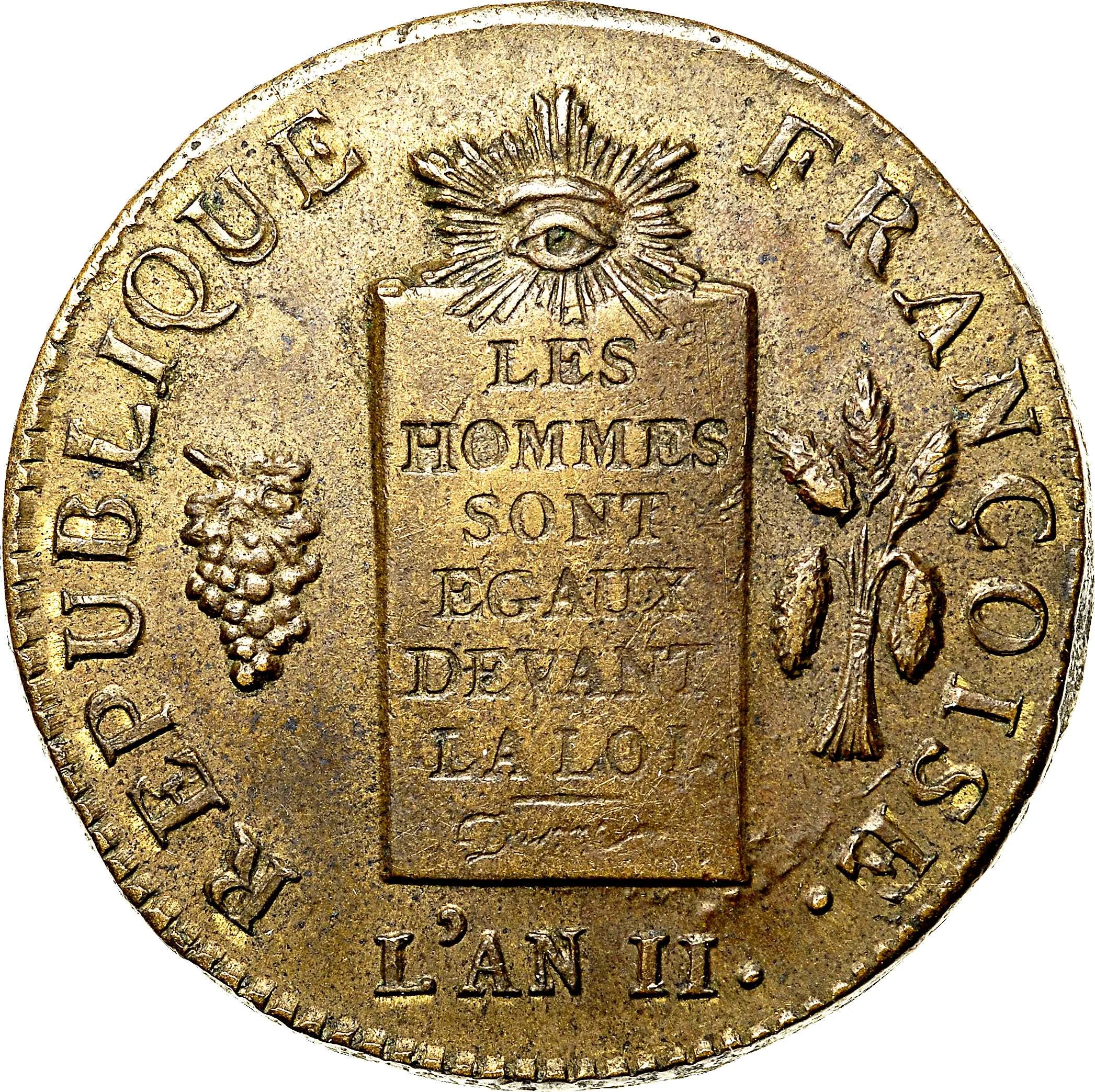
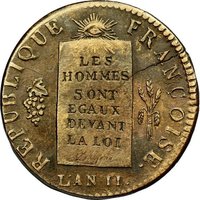
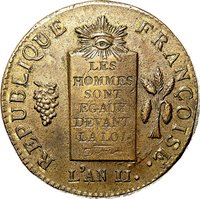
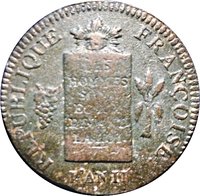
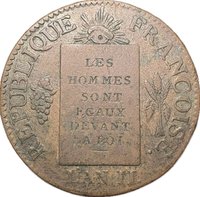
Table depicting the Order of Human Rights: "All men are equal before the law." It shows a figure with grapes in his left hand, a dati in his right, and an all-seeing eye above.
Inscription:
REPUBLIQUE FRANÇOISE
LES
HOMMES
SONT
EGAUX
DEVANT
LA LOI.
L'AN II.
LES
HOMMES
SONT
EGAUX
DEVANT
LA LOI.
L'AN II.
Script: Latin
Engraver: Augustin Dupré
Reverse
Description:
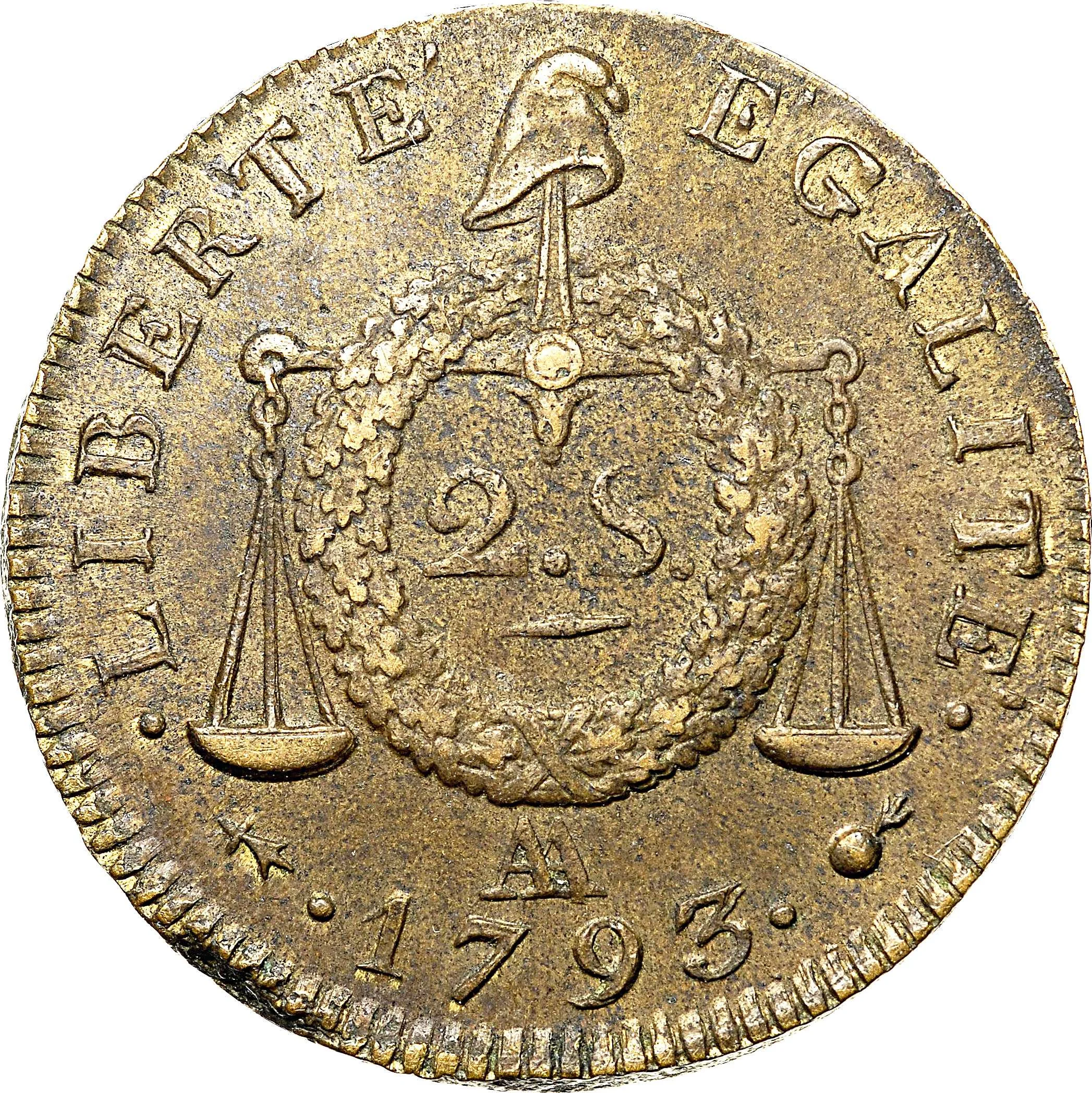
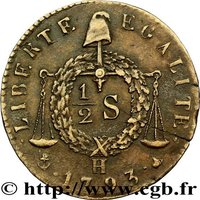
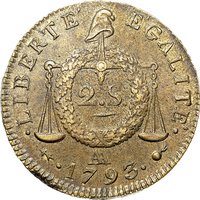
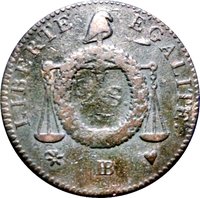
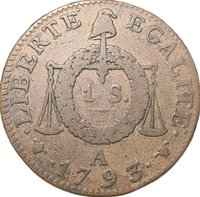
Oak crown crossing a balance with trays, topped by a Phrygian cap. Mintmark between wreath and date.
Inscription:
LIBERTE EGALITE
2.S.
AA
.1793.
2.S.
AA
.1793.
Script: Latin
Engraver: Augustin Dupré
Edge
Slick
Categories
| Human rights |
| Symbol> Phrygian cap |
| Symbol> Scale |
| Symbol> Wreath |
| Plant> Fruit |
Mints
| Name | Mark |
|---|---|
| Metz | AA |
| Rouen | B |
| Strasbourg | BB |
| La Rochelle | H |
| Limoges | I |
| Bayonne | L |
| Marseille | MA |
| Montpellier | N |
| Orléans | R |
| Nantes | T |
| Pau | Vache |
| Lille | W |
| Saint-Omer | W* |
| Arras | W° |
Mintings
Historical background
In 1793, France was in the throes of the radical phase of its Revolution, facing existential threats from foreign monarchies and internal civil war. To finance these immense conflicts and the revolutionary government itself, the National Convention had exhausted the nation's traditional revenue streams. In response, it aggressively expanded the use of the assignat, a paper currency originally backed by the value of confiscated Church lands. Initially successful, this system was now under catastrophic strain. The government, desperate for funds, resorted to printing vast quantities of assignats to pay for armies, supplies, and services, flooding the economy with paper money not matched by real economic output or the underlying land assets.
This massive over-issuance triggered a vicious cycle of hyperinflation. As the quantity of assignats soared, their value plummeted, leading to soaring prices for basic necessities like bread and fuel. Wages failed to keep pace, causing immense hardship for the urban poor and soldiers' families. A widespread loss of public confidence set in, with many merchants and peasants refusing to accept assignats at their face value or hoarding goods instead. The currency crisis became a social and political crisis, fueling the anger of the sans-culottes and contributing to the pervasive fear and instability that characterized the Terror.
The revolutionary government responded with coercive and ultimately futile measures. The Convention passed the Law of the Maximum in September 1793, imposing price controls on essential goods and fixed wages in an attempt to curb inflation. Harsh penalties, including death, were decreed for those who refused assignats or engaged in speculation. While these draconian laws provided temporary relief, they disrupted markets and encouraged black-market activities. The fundamental problem—the unchecked printing of currency—remained unaddressed, ensuring that the assignat continued its steep decline, eroding the economic foundation of the revolutionary state even as its armies began to achieve military victories.
This massive over-issuance triggered a vicious cycle of hyperinflation. As the quantity of assignats soared, their value plummeted, leading to soaring prices for basic necessities like bread and fuel. Wages failed to keep pace, causing immense hardship for the urban poor and soldiers' families. A widespread loss of public confidence set in, with many merchants and peasants refusing to accept assignats at their face value or hoarding goods instead. The currency crisis became a social and political crisis, fueling the anger of the sans-culottes and contributing to the pervasive fear and instability that characterized the Terror.
The revolutionary government responded with coercive and ultimately futile measures. The Convention passed the Law of the Maximum in September 1793, imposing price controls on essential goods and fixed wages in an attempt to curb inflation. Harsh penalties, including death, were decreed for those who refused assignats or engaged in speculation. While these draconian laws provided temporary relief, they disrupted markets and encouraged black-market activities. The fundamental problem—the unchecked printing of currency—remained unaddressed, ensuring that the assignat continued its steep decline, eroding the economic foundation of the revolutionary state even as its armies began to achieve military victories.
Series: 1793 France circulation coins
🌟 Uncommon