

½ Rider – Scotland
United Kingdom
Context
Years: 1593–1601
Country: United Kingdom 
Issuer: Scotland 
Ruler: James VI
Currency:
(1136—1707)
Demonetized: Yes
Material
Diameter: 21 mm
Weight: 2.54 g
Gold weight: 2.33 g
Shape: Irregular round
Composition: 91.6% Gold
Magnetic: No
Technique: Hammered
References
KM: #Click to copy to clipboard17
Numista: #60047
Value
Bullion value: $387.59
Obverse
Description:
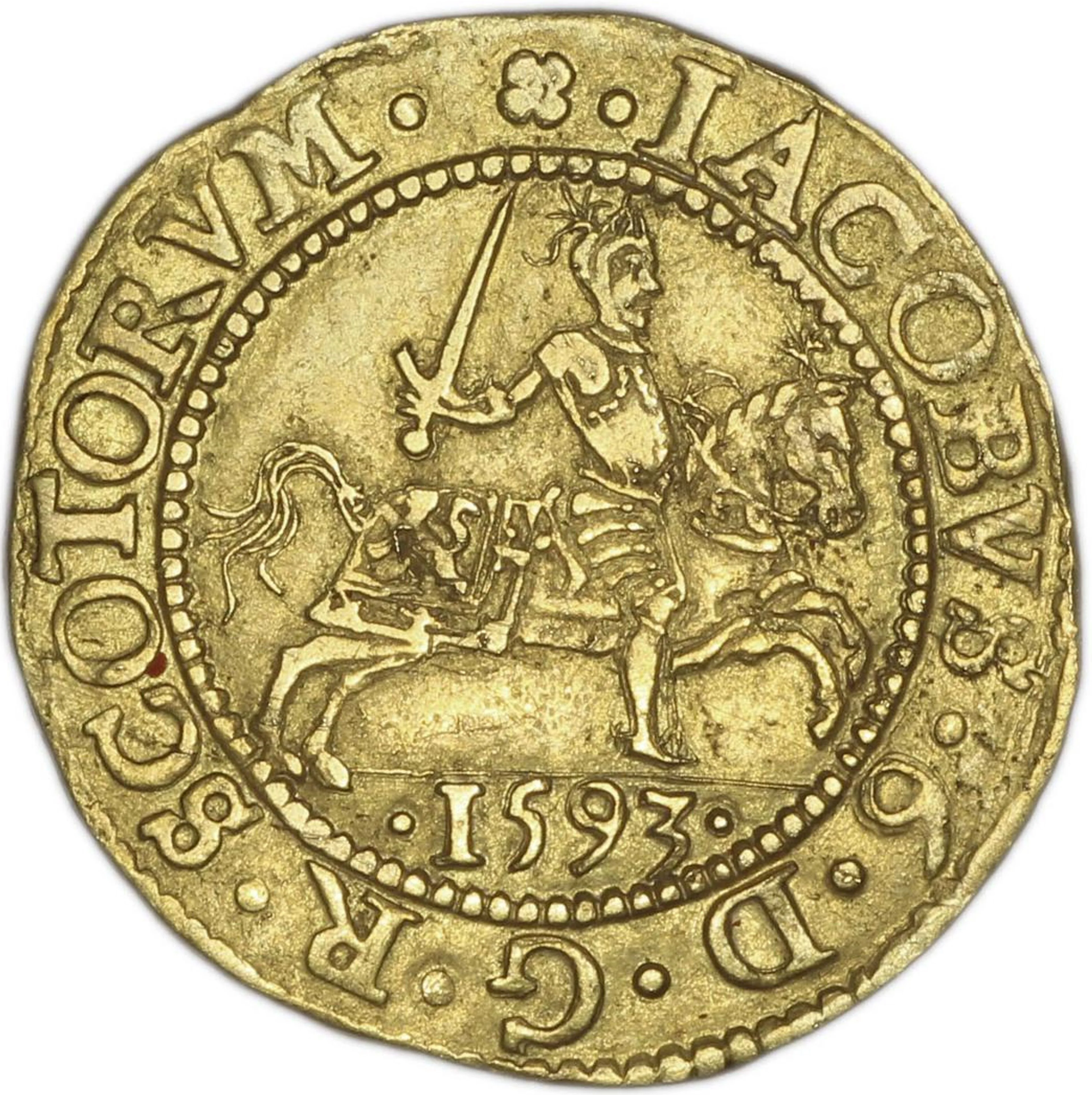
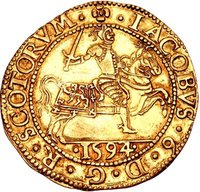
King James VI in armor, sword raised, on horseback.
Inscription:
· IACOBVS · 6 · D · G · R · SCOTORVM ·
· 1593 ·
· 1593 ·
Script: Latin
Reverse
Edge
Mints
| Name | Mark |
|---|---|
| Edinburgh | — |
Mintings
| Year | Mint Mark | Mintage | Quality | Collection |
|---|---|---|---|---|
| 1593 | — | — | ||
| 1594 | — | — | ||
| 1595 | — | — | ||
| 1598 | — | — | ||
| 1599 | — | — | ||
| 1601 | — | — |
Historical background
In 1593, Scotland operated under a complex and often chaotic monetary system, a legacy of centuries of economic strain and monarchical policy. The official currency was the Scottish pound (or pound Scots), which had been deliberately devalued over time and stood at an exchange rate of roughly 12:1 against the English pound sterling. The coinage in circulation was a mixture of domestic issues—including gold rider nobles, silver testoons, and billon (debased silver) turners—and a significant influx of foreign coins, particularly Spanish reales and French écus, which were essential for foreign trade. This proliferation of different coins, each with fluctuating intrinsic values, created a confusing and unstable marketplace.
The reign of James VI had seen repeated attempts at monetary reform, but by the 1590s, the system was under severe pressure. Decades of "crying up" or "crying down" the value of coins (officially altering their legal tender value) to fund crown expenses, especially during the civil wars of his minority, had eroded public trust. A critical problem was the widespread practice of clipping and counterfeiting, which further reduced the precious metal content in circulation. Consequently, good coin was often hoarded or exported, leaving the economy to function with a degraded and unreliable medium of exchange, hindering both domestic commerce and international transactions.
This monetary instability reflected and exacerbated the broader economic challenges of the period. Scotland was a predominantly agrarian society with a limited export economy based on wool, hides, and fish, and its weak currency made importing essential goods more expensive. The situation in 1593 was one of entrenched fragility, setting the stage for more decisive, though only partially successful, reforms later in James's reign, particularly following the Union of the Crowns in 1603. The currency chaos thus stood as a significant obstacle to national prosperity and effective royal governance.
The reign of James VI had seen repeated attempts at monetary reform, but by the 1590s, the system was under severe pressure. Decades of "crying up" or "crying down" the value of coins (officially altering their legal tender value) to fund crown expenses, especially during the civil wars of his minority, had eroded public trust. A critical problem was the widespread practice of clipping and counterfeiting, which further reduced the precious metal content in circulation. Consequently, good coin was often hoarded or exported, leaving the economy to function with a degraded and unreliable medium of exchange, hindering both domestic commerce and international transactions.
This monetary instability reflected and exacerbated the broader economic challenges of the period. Scotland was a predominantly agrarian society with a limited export economy based on wool, hides, and fish, and its weak currency made importing essential goods more expensive. The situation in 1593 was one of entrenched fragility, setting the stage for more decisive, though only partially successful, reforms later in James's reign, particularly following the Union of the Crowns in 1603. The currency chaos thus stood as a significant obstacle to national prosperity and effective royal governance.
✨ Legendary