

1 Teston – Papal States
Vatican City
Context
Years: 1770–1773
Country: Vatican City 
Issuer: Papal States
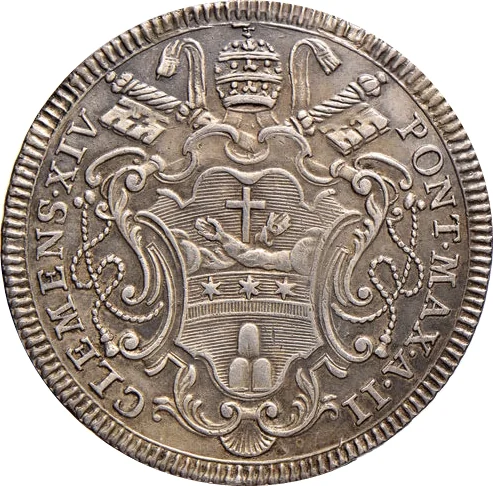
Ruler: Clement XIV
Currency:
(1534—1835)
Demonetized: Yes
Material
Diameter: 30.5 mm
Weight: 7.93 g
Silver weight: 7.27 g
Shape: Round
Composition: 91.7% Silver
Standard: Silver quarter ounce
Magnetic: No
Technique: Milled
References
KM: #Click to copy to clipboard1020
Numista: #59911
Value
Bullion value: $21.09
Obverse
Reverse
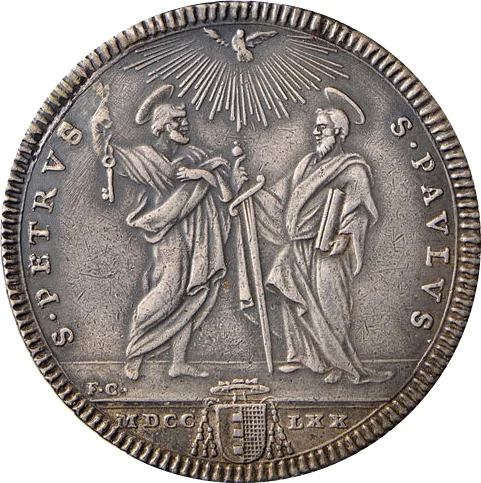
Description:
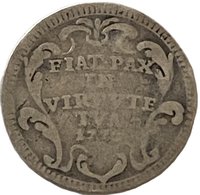
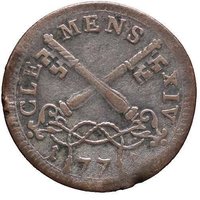
Saints Peter and Paul with a radiant dove above.
Inscription:
S.PETRVUS S.PAVLVS
F.C.
MDCC LXX
F.C.
MDCC LXX
Script: Latin
Edge
Mintings
| Year | Mint Mark | Mintage | Quality | Collection |
|---|---|---|---|---|
| 1770 | — | — | ||
| 1773 | — | — |
Historical background
In 1770, the Papal States' monetary system was a complex and fragmented relic of medieval and early modern practices, reflecting the temporal power's decentralized administration. There was no single, unified papal currency; instead, multiple minting authorities across the territories issued coins. The primary mint in Rome produced the most authoritative coins, such as the scudo (divided into 100 baiochi or 10 paoli), but other major cities like Bologna and Ancona operated their own mints, issuing coins of the same name but with slight variations in weight, fineness, and design. This created a confusing environment for commerce, where exchange rates between different regional issues fluctuated and were a source of constant friction.
The system was further complicated by the widespread circulation of foreign coins, particularly from other Italian states and major European powers, which were often preferred for large-scale trade. Internally, the value of coins was also tied to their precious metal content (silver and gold), making the economy vulnerable to debasement and the inflow or outflow of bullion. The papal government, under Pope Clement XIV (elected 1769), faced chronic budgetary deficits, which tempted authorities to occasionally reduce the silver content in coins to generate seigniorage revenue, a practice that eroded public trust and spurred inflation.
Overall, the monetary situation in 1770 was one of institutional weakness and inefficiency, hindering economic integration and modernization within the Papal States. It was a system managed more for the fiscal needs of the sovereign and various local powers than for the smooth functioning of a regional economy. This fragmented and archaic structure would persist until the Napoleonic invasions of the late 1790s, which abruptly swept away the old order and imposed a more standardized, decimal-based currency system.
The system was further complicated by the widespread circulation of foreign coins, particularly from other Italian states and major European powers, which were often preferred for large-scale trade. Internally, the value of coins was also tied to their precious metal content (silver and gold), making the economy vulnerable to debasement and the inflow or outflow of bullion. The papal government, under Pope Clement XIV (elected 1769), faced chronic budgetary deficits, which tempted authorities to occasionally reduce the silver content in coins to generate seigniorage revenue, a practice that eroded public trust and spurred inflation.
Overall, the monetary situation in 1770 was one of institutional weakness and inefficiency, hindering economic integration and modernization within the Papal States. It was a system managed more for the fiscal needs of the sovereign and various local powers than for the smooth functioning of a regional economy. This fragmented and archaic structure would persist until the Napoleonic invasions of the late 1790s, which abruptly swept away the old order and imposed a more standardized, decimal-based currency system.
💎 Extremely Rare