

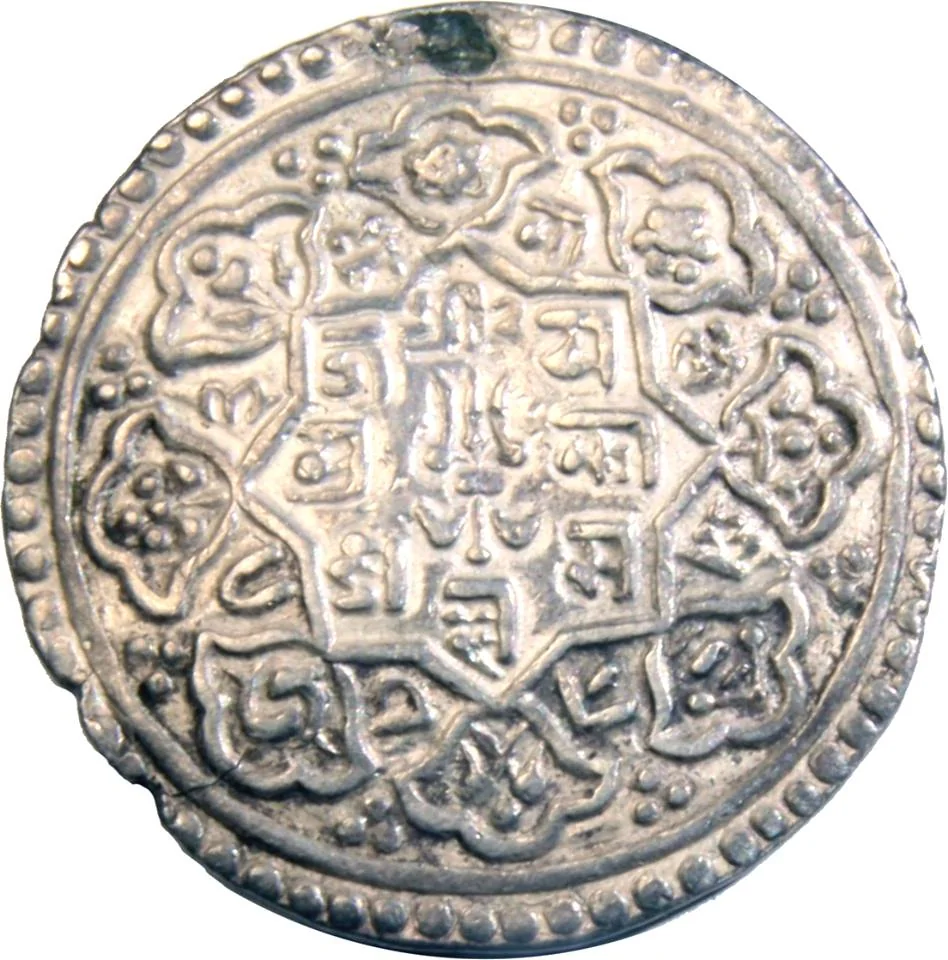
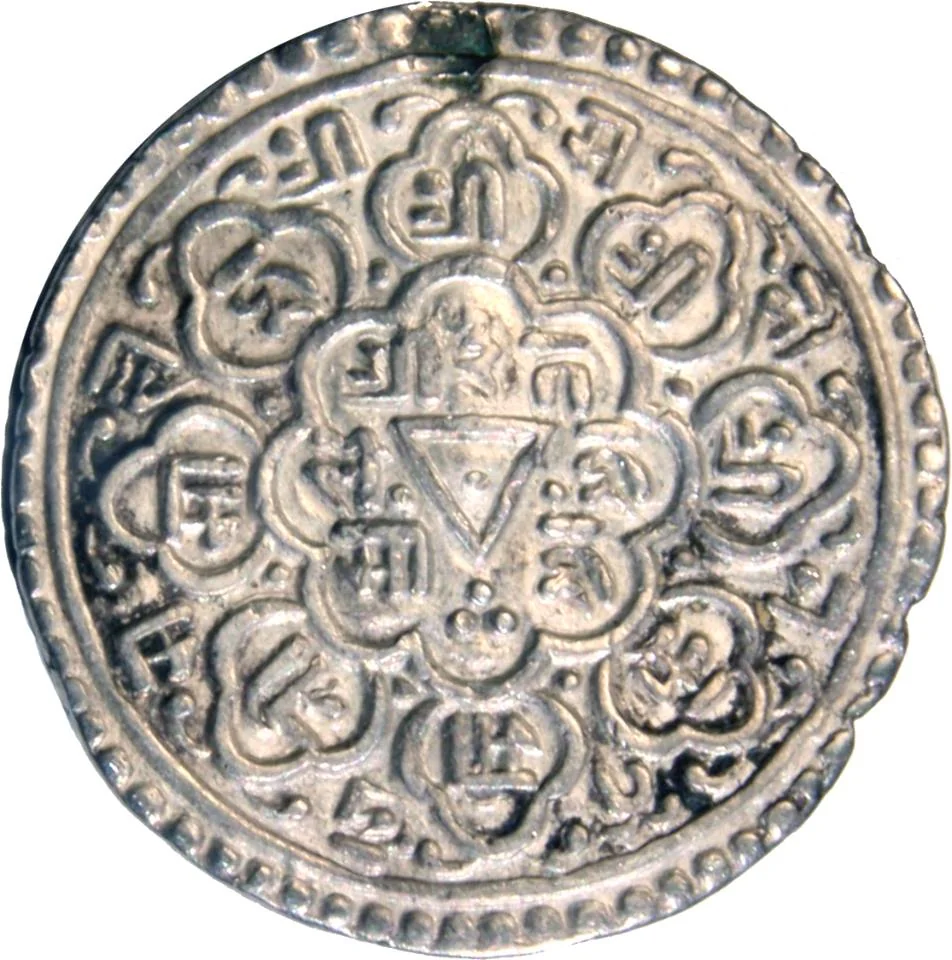
1 Mohar – Kathmandu Kingdom
Nepal
Context
Years: 1750–1758
Country: Nepal 
Issuer: Kathmandu Kingdom
Ruler: Jaya Prakash Malla
Currency:
(1546—1932)
Demonetized: Yes
Material
References
KM: #Click to copy to clipboard261
Numista: #57963
Value
Bullion value: $16.20
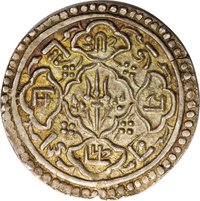
Obverse
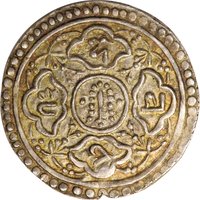
Reverse
Edge
Mintings
| Year | Mint Mark | Mintage | Quality | Collection |
|---|---|---|---|---|
| 1750 | — | — | ||
| 1751 | — | — | ||
| 1752 | — | — | ||
| 1753 | — | — | ||
| 1754 | — | — | ||
| 1755 | — | — | ||
| 1756 | — | — | ||
| 1757 | — | — | ||
| 1758 | — | — |
Historical background
In 1750, the Kathmandu Valley was not a single kingdom but a confederation of three rival city-states: Kathmandu, Patan, and Bhaktapur, each ruled by its own Malla king. This political fragmentation was directly reflected in the monetary system. While they shared a common economic and cultural space, each kingdom issued its own distinct silver coinage, known as mahendramalli or dam, often stamped with the symbols and inscriptions of their respective rulers. This created a complex, multi-currency environment where coins from all three kingdoms circulated simultaneously, their values and acceptance relying on their intrinsic silver content and the stability of the issuing authority.
The primary currency was silver, measured in the weight standard of the mohar (approximately 5.4 grams of silver). Coins were hammer-struck, irregular in shape, and of varying purity, leading to a reliance on money-changers (sarrafs) in marketplaces. These experts assessed weight and fineness, facilitating trade not only within the valley but also with important external partners. The period saw significant trade with Tibet (using silver to buy gold, wool, and salt) and with the Mughal territories to the south, where broader Indian rupee currencies also influenced local practices.
Despite the political rivalries, the mid-18th century was a period of relative economic prosperity fueled by the valley's strategic location on trans-Himalayan trade routes. However, the monetary system was on the cusp of dramatic change. Within a few decades, the rising Gorkha kingdom under Prithvi Narayan Shah would begin its conquest of the valley, culminating in 1768-69. One of his first acts after unification was to standardize the coinage, replacing the three Malla currencies with a single, new Nepali rupee, thereby centralizing monetary authority and ending the era of competing currencies in Kathmandu.
The primary currency was silver, measured in the weight standard of the mohar (approximately 5.4 grams of silver). Coins were hammer-struck, irregular in shape, and of varying purity, leading to a reliance on money-changers (sarrafs) in marketplaces. These experts assessed weight and fineness, facilitating trade not only within the valley but also with important external partners. The period saw significant trade with Tibet (using silver to buy gold, wool, and salt) and with the Mughal territories to the south, where broader Indian rupee currencies also influenced local practices.
Despite the political rivalries, the mid-18th century was a period of relative economic prosperity fueled by the valley's strategic location on trans-Himalayan trade routes. However, the monetary system was on the cusp of dramatic change. Within a few decades, the rising Gorkha kingdom under Prithvi Narayan Shah would begin its conquest of the valley, culminating in 1768-69. One of his first acts after unification was to standardize the coinage, replacing the three Malla currencies with a single, new Nepali rupee, thereby centralizing monetary authority and ending the era of competing currencies in Kathmandu.
💎 Extremely Rare