

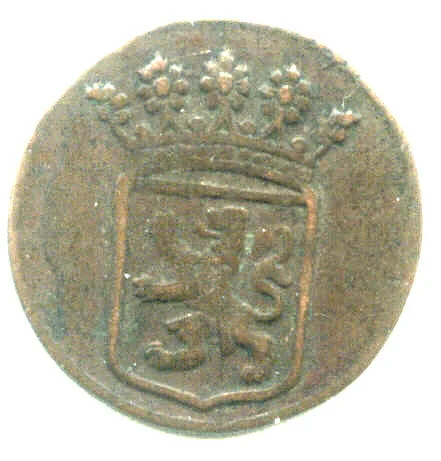
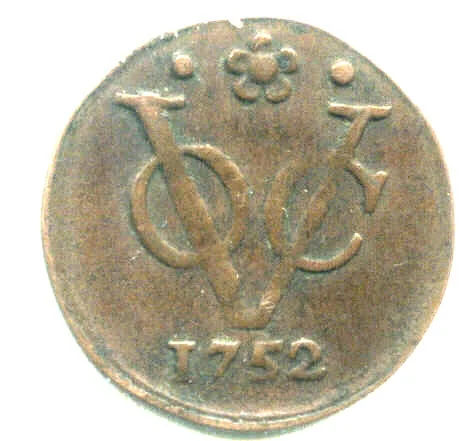
½ duit – Netherlands East Indies
Add to wishlist
Indonesia
Context
Years: 1749–1770
Country: Indonesia
Issuer: Netherlands East Indies
Period:
(1602—1800)
Currency:
(1726—1854)
Demonetized: Yes
Material
References
KM: #
Numista: #57853
Obverse
Description:
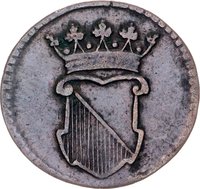
Crowned Dutch coat of arms.
Reverse
Description:
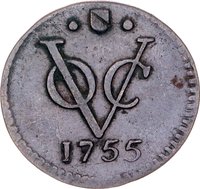
VOC monogram centered, rosette mintmark above between dots, date below.
Inscription:
VOC
1752
1752
Script: Latin
Edge
Categories
| Symbols> Coat of Arms |
| Symbols> Monogram |
Mints
| Name | Mark |
|---|---|
| Dordrecht | — |
Mintings
| Year | Mint Mark | Mintage | Quality | Collection |
|---|---|---|---|---|
| 1749 | — | — | ||
| 1750 | — | — | ||
| 1751 | — | — | ||
| 1752 | — | — | ||
| 1753 | — | — | ||
| 1754 | — | — | ||
| 1769 | — | — | ||
| 1770 | — | — |
Historical background
In 1749, the currency system of the Netherlands East Indies (NEI) was a complex and often chaotic mosaic of coins from across the globe, reflecting its position as the hub of the Dutch East India Company’s (VOC) Asian trade. The official currency was the Dutch guilder, but in practice, a multitude of silver coins—most notably the Spanish-American silver real (minted into "pieces of eight") and the Mexican peso—formed the backbone of large transactions. These were supplemented by a plethora of other coins in circulation, including Japanese koban, Indian rupees, and various local copper coins (doits), creating a challenging environment for merchants and administrators who constantly dealt with fluctuating exchange rates and metal purity.
This monetary jungle was a direct result of the VOC's primary focus: extracting profit from the spice trade and intra-Asian commerce. The Company consistently exported more silver from Europe to finance its purchases than it imported goods back, leading to a perpetual silver drain. To mitigate this, the VOC attempted to control the money supply by setting official exchange rates for the myriad of coins, a system known as the bataafse valuation. However, these official rates often diverged from market reality, fueling widespread smuggling, clipping, and counterfeiting. The system was further strained by the VOC's own practice of issuing paper credit (assignations) in Batavia, which frequently depreciated in value.
Consequently, the year 1749 fell within a period of significant monetary instability and experimentation. The VOC authorities in Batavia struggled to assert control, repeatedly issuing ordinances to ban certain undervalued coins or adjust official rates, with limited success. The lack of a standardized, trusted coinage hampered local economies and the Company's own accounting. This persistent crisis would ultimately lead, decades later, to more decisive reforms, but in 1749, the currency situation remained a fragmented and problematic cornerstone of the colonial economy.
This monetary jungle was a direct result of the VOC's primary focus: extracting profit from the spice trade and intra-Asian commerce. The Company consistently exported more silver from Europe to finance its purchases than it imported goods back, leading to a perpetual silver drain. To mitigate this, the VOC attempted to control the money supply by setting official exchange rates for the myriad of coins, a system known as the bataafse valuation. However, these official rates often diverged from market reality, fueling widespread smuggling, clipping, and counterfeiting. The system was further strained by the VOC's own practice of issuing paper credit (assignations) in Batavia, which frequently depreciated in value.
Consequently, the year 1749 fell within a period of significant monetary instability and experimentation. The VOC authorities in Batavia struggled to assert control, repeatedly issuing ordinances to ban certain undervalued coins or adjust official rates, with limited success. The lack of a standardized, trusted coinage hampered local economies and the Company's own accounting. This persistent crisis would ultimately lead, decades later, to more decisive reforms, but in 1749, the currency situation remained a fragmented and problematic cornerstone of the colonial economy.
🌟 Limited