

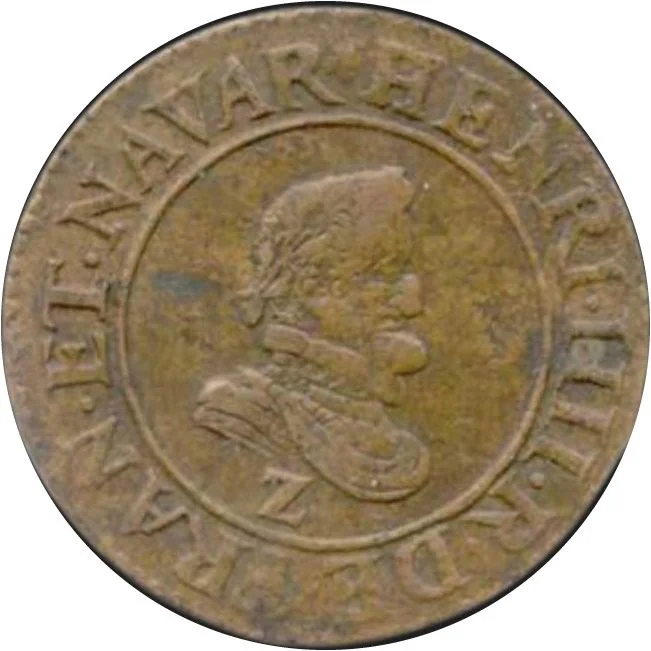

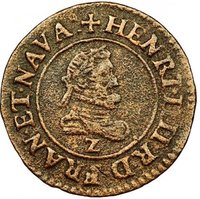
Obverse
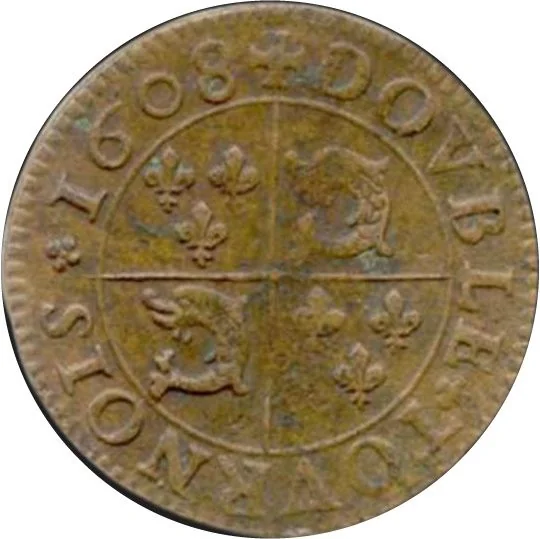
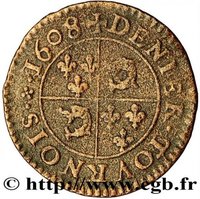
Reverse
Edge
Categories
| Object> Armour |
| Symbols> Coat of Arms |
Mints
| Name | Mark |
|---|---|
| Grenoble | Z |
Mintings
| Year | Mint Mark | Mintage | Quality | Collection |
|---|---|---|---|---|
| 1608 | Z | — |
Historical background
In 1608, France operated under a complex and often chaotic monetary system, a legacy of the late medieval period. The nation lacked a single, unified currency. Instead, circulation was dominated by two parallel systems: actual gold and silver coins (specie) and an abstract system of accounting in livres tournois, sous, and deniers. The livre tournois was a money of account—a notional unit used for bookkeeping, contracts, and setting prices—but no physical "livre" coin existed. Everyday transactions used a bewildering array of physical coins, including the gold écu and the silver franc, but also numerous foreign coins and older issues, all with values officially set and frequently adjusted by royal decree.
This period fell within the reign of Henry IV, who, with his minister Sully, was actively working to restore royal finances after the Wars of Religion. A key monetary problem was the recurrent practice of augmentation and diminution—the official manipulation of coin values. The crown would periodically call in coins, re-mint them with altered precious metal content, and re-issue them at a different face value in livres. This was often done to generate seigniorage revenue for the treasury, but it eroded public trust, caused price instability, and facilitated widespread fraud and clipping of coins.
Consequently, France in 1608 was in a transitional phase. While Henry IV's policies promoted economic recovery and stability, the underlying monetary framework remained fragile and archaic. The disconnect between the stable accounting system (livres) and the fluctuating physical coinage created confusion for merchants and peasants alike. This system would persist until the later 17th century, when Louis XIV's minister, Colbert, would implement more comprehensive reforms aimed at standardizing the coinage and asserting stronger royal control over the monetary supply.
This period fell within the reign of Henry IV, who, with his minister Sully, was actively working to restore royal finances after the Wars of Religion. A key monetary problem was the recurrent practice of augmentation and diminution—the official manipulation of coin values. The crown would periodically call in coins, re-mint them with altered precious metal content, and re-issue them at a different face value in livres. This was often done to generate seigniorage revenue for the treasury, but it eroded public trust, caused price instability, and facilitated widespread fraud and clipping of coins.
Consequently, France in 1608 was in a transitional phase. While Henry IV's policies promoted economic recovery and stability, the underlying monetary framework remained fragile and archaic. The disconnect between the stable accounting system (livres) and the fluctuating physical coinage created confusion for merchants and peasants alike. This system would persist until the later 17th century, when Louis XIV's minister, Colbert, would implement more comprehensive reforms aimed at standardizing the coinage and asserting stronger royal control over the monetary supply.
✨ Legendary