

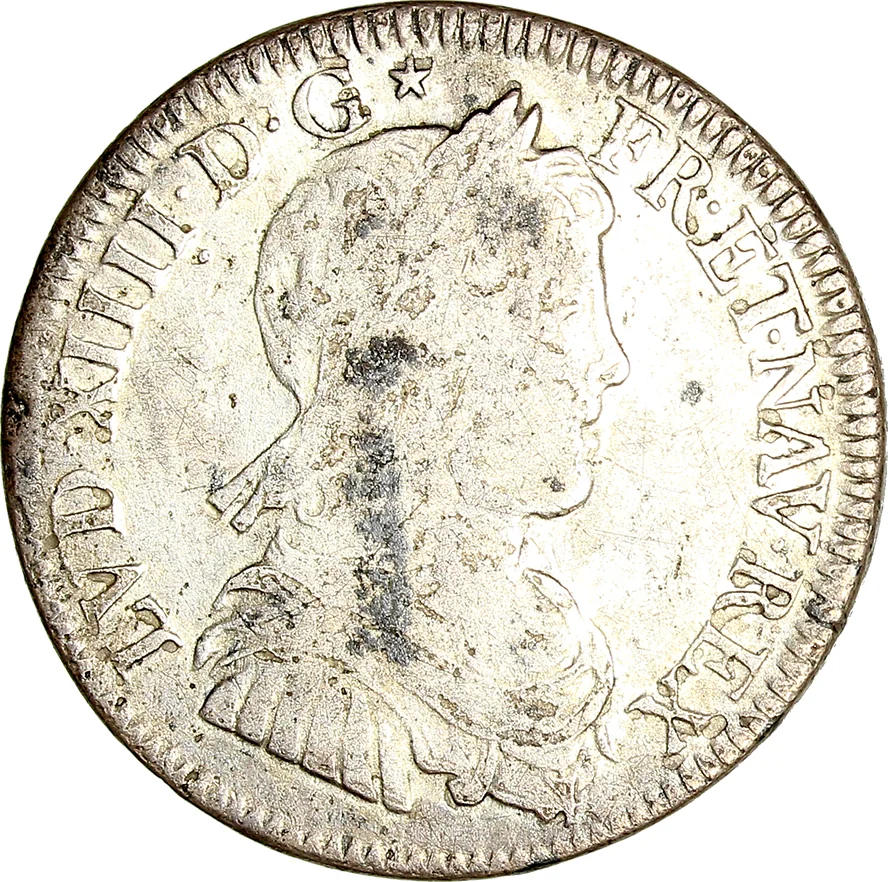
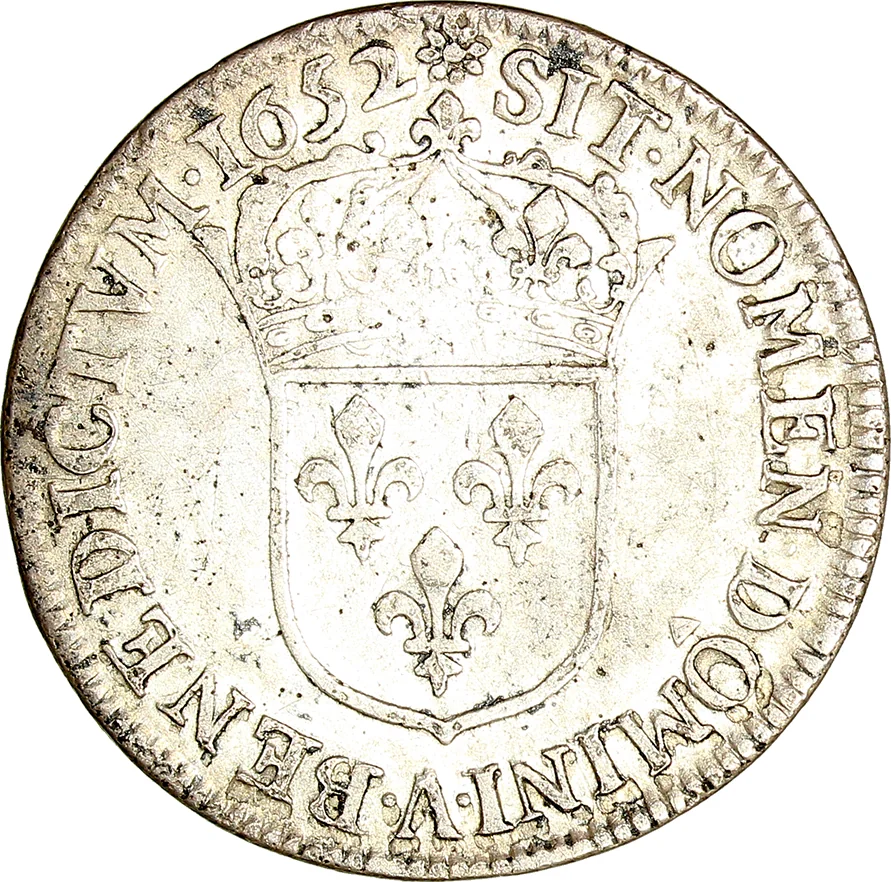
¼ silver ecu – France
Add to wishlist
France
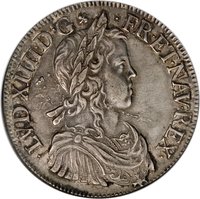
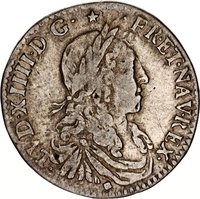
Obverse
Description:
Young Louis XIV in right-facing bust portrait.
Inscription:
LVD · XIIII · D · G · FR · ET · NAV · REX
Script: Latin
Engraver: Jean Warin
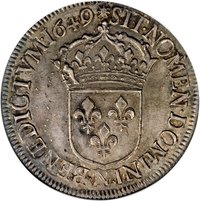
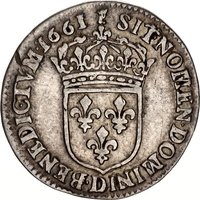
Reverse
Description:
Arms with a crown.
Inscription:
SIT · NOMEN · DOMINI · A · BENEDICTVM · 1652 ·
Script: Latin
Engraver: Jean Warin
Edge
Plain
Categories
| Symbol> Fleur-de-lis |
| Symbols> Coat of Arms |
| Person> Monarch |
| Symbol> Wreath |
Mints
| Name | Mark |
|---|---|
| Aix-en-Provence | & |
| Rennes | 9 |
| Monnaie de Paris | A |
| Arras | AR |
| Rouen | B |
| Angers | F |
| La Rochelle | H |
| Bordeaux | K |
| Toulouse | M |
| Montpellier | N |
| Nantes | T |
| Amiens | X |
Mintings
| Year | Mint Mark | Mintage | Quality | Collection |
|---|---|---|---|---|
| 1646 | & | 59,238 | ||
| 1646 | A | — | ||
| 1646 | F | — | ||
| 1646 | H | — | ||
| 1646 | N | — | ||
| 1647 | A | — | ||
| 1647 | AR | — | ||
| 1647 | F | — | ||
| 1647 | K | — | ||
| 1647 | M | — | ||
| 1648 | A | — | ||
| 1648 | K | — | ||
| 1648 | M | 10,300 | ||
| 1648 | Y | 14,765 | ||
| 1649 | 9 | 82,170 | ||
| 1649 | B | 79,709 | ||
| 1649 | M | 84,744 | ||
| 1649 | T | 30,493 | ||
| 1650 | 9 | 84,737 | ||
| 1650 | T | 30,493 | ||
| 1651 | 9 | 157,920 | ||
| 1652 | A | 367,837 | ||
| 1652 | AR | 59,238 | ||
| 1653 | 9 | — | ||
| 1653 | M | — | ||
| 1654 | T | 175,894 | ||
| 1654 | 9 | 417,267 | ||
| 1655 | M | — | ||
| 1655 | X | 20,542 | ||
| 1655 | 9 | 183,598 |
Historical background
In 1646, France was in the midst of the long and costly Franco-Spanish War (1635–1659), a conflict that placed immense strain on the royal treasury. To finance the war, the Crown, under the regency of Anne of Austria and Chief Minister Cardinal Mazarin for the young Louis XIV, resorted to a series of desperate financial measures. These included the creation and sale of new offices, heavy borrowing at high interest, and, most critically for the currency, the repeated manipulation of the coinage. The government engaged in practices like augmentation (officially raising the face value of coins) and diminution (lowering it), as well as debasing the metal content, to generate seigniorage profits and meet immediate fiscal demands.
This period was characterized by a chaotic and unstable monetary system. The livre tournois was a unit of account, but the actual circulating coins—écus, louis d'or, and liards—saw their metallic values and official ratings change frequently by royal decree. These manipulations created widespread confusion in commerce, as the intrinsic value of a coin (its worth in precious metal) often diverged sharply from its nominal value. Savvy merchants and foreign bankers engaged in arbitrage, hoarding or exporting full-weight coins and returning debased ones, which further disrupted the economy and drove good money out of circulation, a phenomenon described by Gresham's Law.
The monetary instability exacerbated social and economic hardship, contributing to rising discontent that would erupt in the Fronde parlementaire (1648-1649), the first phase of the civil wars known as the Fronde. The Parlement of Paris and the people alike blamed the Crown's financial ministers, including the much-despised traitants (tax farmers), for the economic distress. Thus, the currency situation of 1646 was not merely a technical fiscal issue but a central political grievance, undermining confidence in the regency's government and foreshadowing the profound political crises that would challenge the absolute monarchy in the years to come.
This period was characterized by a chaotic and unstable monetary system. The livre tournois was a unit of account, but the actual circulating coins—écus, louis d'or, and liards—saw their metallic values and official ratings change frequently by royal decree. These manipulations created widespread confusion in commerce, as the intrinsic value of a coin (its worth in precious metal) often diverged sharply from its nominal value. Savvy merchants and foreign bankers engaged in arbitrage, hoarding or exporting full-weight coins and returning debased ones, which further disrupted the economy and drove good money out of circulation, a phenomenon described by Gresham's Law.
The monetary instability exacerbated social and economic hardship, contributing to rising discontent that would erupt in the Fronde parlementaire (1648-1649), the first phase of the civil wars known as the Fronde. The Parlement of Paris and the people alike blamed the Crown's financial ministers, including the much-despised traitants (tax farmers), for the economic distress. Thus, the currency situation of 1646 was not merely a technical fiscal issue but a central political grievance, undermining confidence in the regency's government and foreshadowing the profound political crises that would challenge the absolute monarchy in the years to come.
Series: 1646 France circulation coins
💎 Extremely Rare