

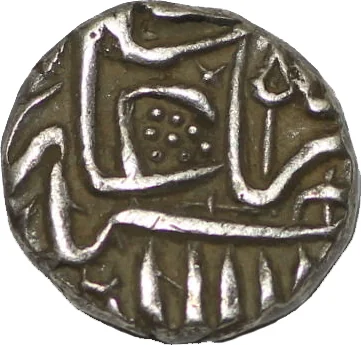
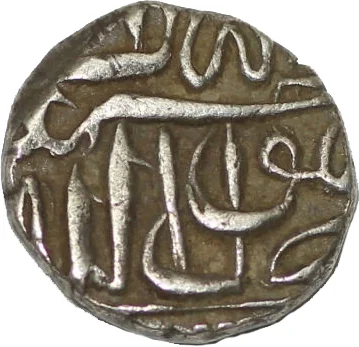
½ Mahmudi – Mughal Empire
India
Context
Years: 1578–1810
Islamic (Hijri) Year: 1205
Country: India 
Issuer: Mughal Empire
Ruler: Akbar
Currency:
(1540—1842)
Demonetized: Yes
Material
Diameter: 12 mm
Weight: 2.8 g
Silver weight: 2.80 g
Shape: Irregular round
Composition: Silver
Magnetic: No
References
KM: #Click to copy to clipboard71.1
Numista: #57058
Value
Bullion value: $8.14
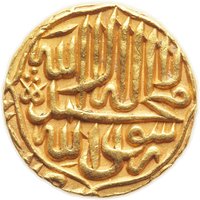
Obverse
Description:
Akbar the Great
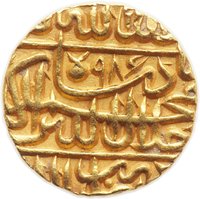
Reverse
Description:
One word.
Edge
Mintings
| Year | Mint Mark | Mintage | Quality | Collection |
|---|---|---|---|---|
| — | — | — | ||
| 1791 | — | — |
Historical background
By 1578, the Mughal Empire under Emperor Akbar was in the midst of a profound monetary and administrative transformation. The empire's currency system was a complex tapestry, inheriting a mix of pre-existing Afghan, Sultanate, and regional coinages. Silver was the dominant metal for high-value trade, with the rupiya, a pure silver coin of approximately 11 grams, established as the empire's standard currency unit by Akbar's predecessor, Sher Shah Suri. However, in practice, a bimetallic system operated, with a vast array of gold mohurs, silver rupaiyas, and copper dams circulating alongside older, often debased, regional coins, leading to inconsistencies in weight and purity across the realm.
Recognizing that a uniform currency was essential for centralized control, efficient taxation, and economic integration, Akbar had already begun aggressive reforms. In 1577, he had established a strict imperial monopoly over coinage, centralizing mints (dar al-zarb) and standardizing designs to feature Islamic inscriptions and the emperor's name. The year 1578 fell within a critical period of consolidation of these policies. Akbar’s administration was actively suppressing local minting rights, recalling old coins for reminting, and enforcing stringent quality control. The copper dam (valued at 1/40 of a rupiya) was being systematically promoted as the standard for everyday transactions and revenue assessment, a move that brought stability to the peasant economy and streamlined the empire's vast land revenue system.
Thus, the currency situation in 1578 was one of dynamic centralization. While older coins still circulated, the imperial machinery was decisively shifting towards a unified, trimetallic system under strict state supervision. This financial overhaul was not merely economic; it was a cornerstone of Akbar's broader project of imperial integration, providing the fiscal foundation for his military campaigns, architectural projects, and the elaborate mansabdari administrative structure that would define the high Mughal era.
Recognizing that a uniform currency was essential for centralized control, efficient taxation, and economic integration, Akbar had already begun aggressive reforms. In 1577, he had established a strict imperial monopoly over coinage, centralizing mints (dar al-zarb) and standardizing designs to feature Islamic inscriptions and the emperor's name. The year 1578 fell within a critical period of consolidation of these policies. Akbar’s administration was actively suppressing local minting rights, recalling old coins for reminting, and enforcing stringent quality control. The copper dam (valued at 1/40 of a rupiya) was being systematically promoted as the standard for everyday transactions and revenue assessment, a move that brought stability to the peasant economy and streamlined the empire's vast land revenue system.
Thus, the currency situation in 1578 was one of dynamic centralization. While older coins still circulated, the imperial machinery was decisively shifting towards a unified, trimetallic system under strict state supervision. This financial overhaul was not merely economic; it was a cornerstone of Akbar's broader project of imperial integration, providing the fiscal foundation for his military campaigns, architectural projects, and the elaborate mansabdari administrative structure that would define the high Mughal era.
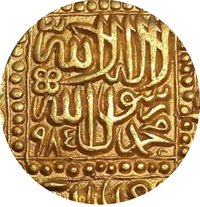
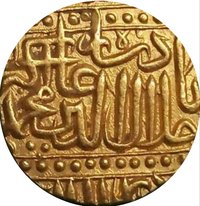
💎 Extremely Rare