

2 Pence – Scotland
United Kingdom
Context
Years: 1632–1639
Country: United Kingdom 
Issuer: Scotland 
Ruler: Charles I
Currency:
(1136—1707)
Demonetization: 20 March 1642
Material
Diameter: 16 mm
Weight: 0.66 g
Shape: Round
Composition: Copper
Magnetic: No
Technique: Roller milled
References
KM: #Click to copy to clipboard65
Numista: #55570
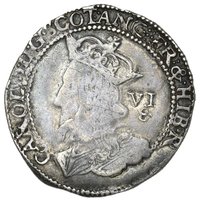
Obverse
Description:
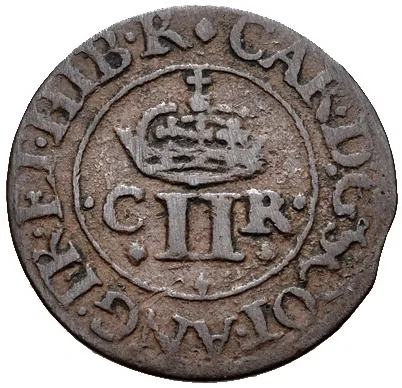
Crowned "CIIR" with English central cross.
Inscription:
CAR·D.G·SCOT·ANG·FR·ET·HIB·R
Script: Latin
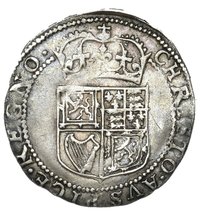
Reverse
Edge
Mints
| Name | Mark |
|---|---|
| Edinburgh | — |
Mintings
| Year | Mint Mark | Mintage | Quality | Collection |
|---|---|---|---|---|
| — | — | — |
Historical background
In 1632, Scotland operated under a distinct monetary system from England, though both realms were under the personal union of the Crown of King Charles I. The official unit of account was the pound Scots (£Scots), which had a fixed exchange rate of 12:1 with the pound Sterling (£Sterling), meaning £12 Scots equalled £1 Sterling. This devalued ratio reflected Scotland's smaller and less developed economy. The physical currency in circulation was a mixture of domestic and foreign coin. Scotland minted its own silver coins, such as the merk (worth 13 shillings and 4 pence Scots, or 160 pence Scots), the half-merk, and the sixty-six shilling piece, but these were often in short supply and subject to clipping and wear.
The scarcity of high-quality Scottish coinage led to the widespread use of foreign specie, a common practice in early modern Europe. Spanish reales (pieces of eight), French écus, Dutch rijksdaalders, and English Sterling coins all circulated freely within the Scottish economy, their value determined by their precious metal content rather than their face value. This created a complex and sometimes chaotic marketplace where merchants had to be experts in assessing the weight and fineness of numerous coin types. The Scottish government periodically issued proclamations to set the legal value of these foreign coins in an attempt to standardise trade and prevent the export of bullion.
This monetary environment existed within a tense political climate. Charles I, focused on English affairs and revenue, showed little interest in reforming or strengthening the Scottish currency system. The scarcity of reliable coin hindered commerce and contributed to economic grievances among the merchant and landowning classes. Furthermore, the King's later attempts to impose religious changes and extend royal prerogatives, without due regard for Scottish law or the Parliament in Edinburgh, would soon culminate in the National Covenant of 1638 and the Bishops' Wars. Thus, the currency situation of 1632, while functioning, was a symptom of a wider strain in the regal union, characterised by economic disadvantage, monetary instability, and growing political alienation from the Crown.
The scarcity of high-quality Scottish coinage led to the widespread use of foreign specie, a common practice in early modern Europe. Spanish reales (pieces of eight), French écus, Dutch rijksdaalders, and English Sterling coins all circulated freely within the Scottish economy, their value determined by their precious metal content rather than their face value. This created a complex and sometimes chaotic marketplace where merchants had to be experts in assessing the weight and fineness of numerous coin types. The Scottish government periodically issued proclamations to set the legal value of these foreign coins in an attempt to standardise trade and prevent the export of bullion.
This monetary environment existed within a tense political climate. Charles I, focused on English affairs and revenue, showed little interest in reforming or strengthening the Scottish currency system. The scarcity of reliable coin hindered commerce and contributed to economic grievances among the merchant and landowning classes. Furthermore, the King's later attempts to impose religious changes and extend royal prerogatives, without due regard for Scottish law or the Parliament in Edinburgh, would soon culminate in the National Covenant of 1638 and the Bishops' Wars. Thus, the currency situation of 1632, while functioning, was a symptom of a wider strain in the regal union, characterised by economic disadvantage, monetary instability, and growing political alienation from the Crown.
💎 Very Rare