

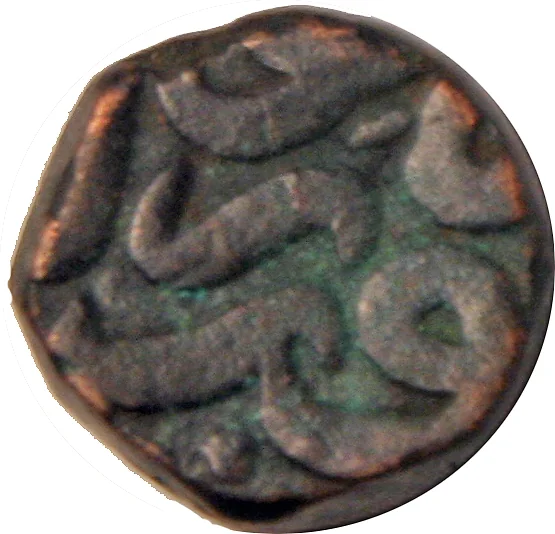
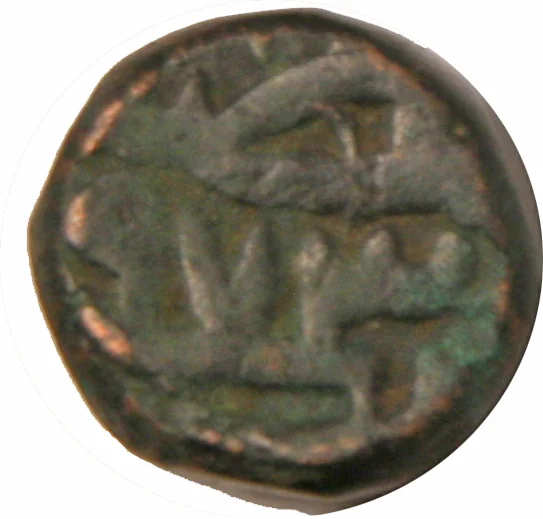
½ Dam – Mughal Empire
India
Context
Years: 1559–1566
Country: India 
Issuer: Mughal Empire
Ruler: Akbar
Currency:
(1540—1842)
Demonetized: Yes
Material
References
KM: #Click to copy to clipboard22.16
Numista: #55358
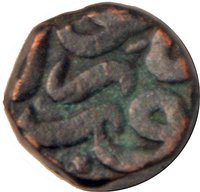
Obverse
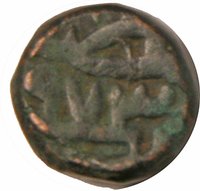
Reverse
Description:
AH Date
Inscription:
۹۷۳
Edge
Plain
Mints
| Name | Mark |
|---|---|
| Narnaul, India | — |
Mintings
| Year | Mint Mark | Mintage | Quality | Collection |
|---|---|---|---|---|
| 1559 | — | — | ||
| 1560 | — | — | ||
| 1561 | — | — | ||
| 1562 | — | — | ||
| 1563 | — | — | ||
| 1564 | — | — | ||
| 1565 | — | — | ||
| 1566 | — | — |
Historical background
In 1559, the Mughal Empire's currency system was in a formative stage under the reign of its second emperor, Humayun, who had recently regained his throne after a period of exile. The monetary landscape was not yet a unified imperial standard but rather a continuation and adaptation of systems inherited from previous rulers, particularly the Sur Empire. The dominant circulating coins were the silver rupee (rupya), the gold mohur, and the copper dam. However, their production and purity were not yet centrally controlled to a high degree, with minting occurring at various regional mints often operating under local authorities or previous standards.
The political context was crucial. Humayun's restoration in 1555 was brief, and his sudden death in 1556 meant that in 1559, the empire was actually under the regency of Bairam Khan, governing for the young Emperor Akbar. This period of transition and consolidation meant that comprehensive fiscal and monetary reforms were not yet a priority. The state's immediate focus was on military campaigns to secure territory, such as the ongoing struggle for control of strategic forts like Gwalior. Consequently, the currency in circulation was a mix of coins struck in the name of the current Mughal ruler, alongside older issues from the Sur rulers Sher Shah and Islam Shah, which remained in use and were trusted for their consistent weight and purity.
Therefore, the currency situation in 1559 was one of relative heterogeneity and transition. It laid the groundwork for the profound reforms that would come under Akbar's direct rule. Within the next decade, Akbar would initiate a centralized and standardized coinage system, establishing strict imperial control over mints, enforcing uniform weights and high purity, and eventually introducing a sophisticated system of date marks and mint marks. The year 1559 thus represents a prelude to the classic Mughal monetary system, where the empire still relied on a patchwork of currencies awaiting the strong, centralized administration that would soon follow.
The political context was crucial. Humayun's restoration in 1555 was brief, and his sudden death in 1556 meant that in 1559, the empire was actually under the regency of Bairam Khan, governing for the young Emperor Akbar. This period of transition and consolidation meant that comprehensive fiscal and monetary reforms were not yet a priority. The state's immediate focus was on military campaigns to secure territory, such as the ongoing struggle for control of strategic forts like Gwalior. Consequently, the currency in circulation was a mix of coins struck in the name of the current Mughal ruler, alongside older issues from the Sur rulers Sher Shah and Islam Shah, which remained in use and were trusted for their consistent weight and purity.
Therefore, the currency situation in 1559 was one of relative heterogeneity and transition. It laid the groundwork for the profound reforms that would come under Akbar's direct rule. Within the next decade, Akbar would initiate a centralized and standardized coinage system, establishing strict imperial control over mints, enforcing uniform weights and high purity, and eventually introducing a sophisticated system of date marks and mint marks. The year 1559 thus represents a prelude to the classic Mughal monetary system, where the empire still relied on a patchwork of currencies awaiting the strong, centralized administration that would soon follow.
💎 Extremely Rare