

1 Rupee – Mughal Empire
India
Context
Years: 1593–1606
Country: India 
Issuer: Mughal Empire
Ruler: Akbar
Currency:
(1540—1842)
Demonetized: Yes
Material
Diameter: 18 mm
Weight: 11.3 g
Silver weight: 11.30 g
Shape: Irregular round
Composition: Silver
Magnetic: No
References
KM: #Click to copy to clipboard93.7
Numista: #53784
Value
Bullion value: $32.83
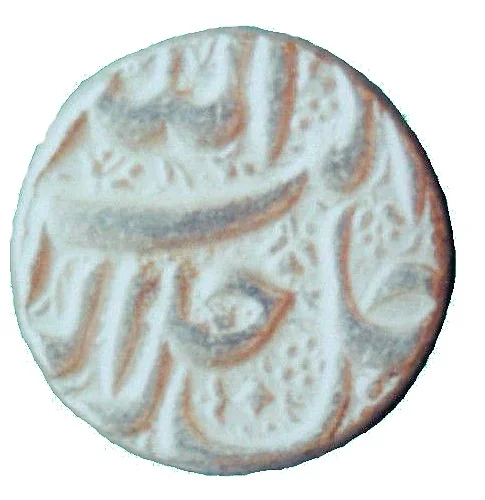
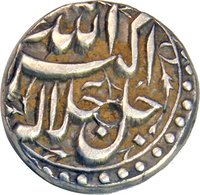
Obverse
Inscription:
.....Jalalhu
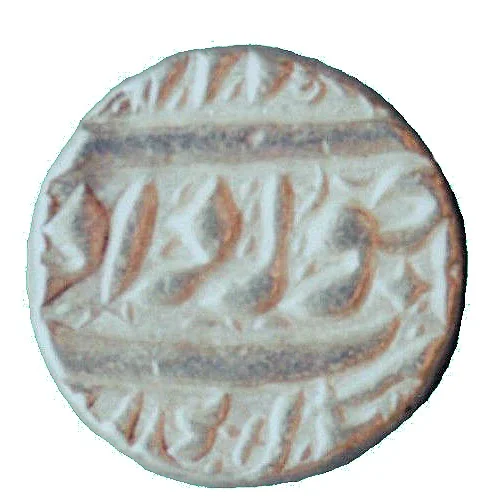
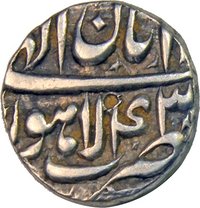
Reverse
Description:
Mint and Persian Month
Inscription:
Month: Khurdad
Mint: Burhanpur
Mint: Burhanpur
Edge
Plain
Mintings
| Year | Mint Mark | Mintage | Quality | Collection |
|---|---|---|---|---|
| — | — | — |
Historical background
In 1593, during the reign of Akbar the Great, the Mughal Empire's currency system was a model of centralized authority and economic sophistication. The empire operated on a trimetallic system, with coins minted from gold (mohur), silver (rupiya), and copper (dam). The silver rupiya, of high and consistent purity, was the primary unit for large-scale trade and revenue assessment, while copper dams facilitated everyday local transactions. This system was underpinned by Akbar’s radical monetary reforms, which included closing hundreds of irregular local mints and establishing a strict imperial monopoly over coinage production in major urban centers like Delhi, Agra, and Lahore.
The stability and uniformity of the currency were direct results of Akbar’s administrative genius. His finance minister, Raja Todar Mal, had recently standardized the empire's land revenue system (zabt), which demanded a reliable currency for assessment and collection. Coins from this period bore intricate Persian calligraphy, featuring the ruler's name, mint mark, and the Islamic calendar year, allowing for precise dating and origin tracing. The strict quality control, particularly of the silver rupee, gave Mughal currency immense credibility, making it a preferred medium of exchange not only within the empire but also in international trade across the Indian Ocean.
This robust monetary environment was a key pillar of the empire's "Pax Mughalica," fueling unprecedented economic growth and commercial integration. A vast network of trade routes, both overland and maritime, saw goods like textiles, spices, and bullion flow freely, facilitated by trusted Mughal coinage. However, the system's health was inherently tied to the empire's access to precious metals, particularly silver from the New World, which began flowing into India in greater volumes via European traders. Thus, in 1593, the Mughal currency stood at a peak of integrity, centrally administered and crucial for sustaining the empire's expanding economy and complex administrative machinery.
The stability and uniformity of the currency were direct results of Akbar’s administrative genius. His finance minister, Raja Todar Mal, had recently standardized the empire's land revenue system (zabt), which demanded a reliable currency for assessment and collection. Coins from this period bore intricate Persian calligraphy, featuring the ruler's name, mint mark, and the Islamic calendar year, allowing for precise dating and origin tracing. The strict quality control, particularly of the silver rupee, gave Mughal currency immense credibility, making it a preferred medium of exchange not only within the empire but also in international trade across the Indian Ocean.
This robust monetary environment was a key pillar of the empire's "Pax Mughalica," fueling unprecedented economic growth and commercial integration. A vast network of trade routes, both overland and maritime, saw goods like textiles, spices, and bullion flow freely, facilitated by trusted Mughal coinage. However, the system's health was inherently tied to the empire's access to precious metals, particularly silver from the New World, which began flowing into India in greater volumes via European traders. Thus, in 1593, the Mughal currency stood at a peak of integrity, centrally administered and crucial for sustaining the empire's expanding economy and complex administrative machinery.
✨ Legendary