

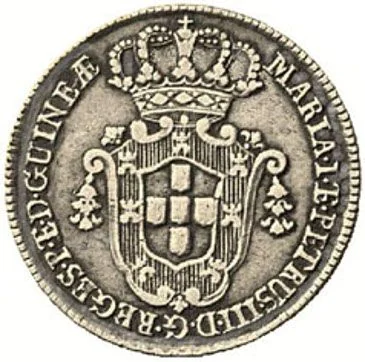
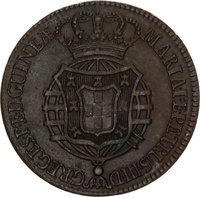
Obverse
Inscription:
MARIA·I·E·PETRUS·III·D·G·REGENTES··P·E·D·GUINEÆ·
Script: Latin
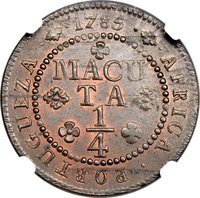
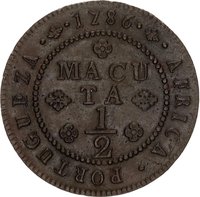
Reverse
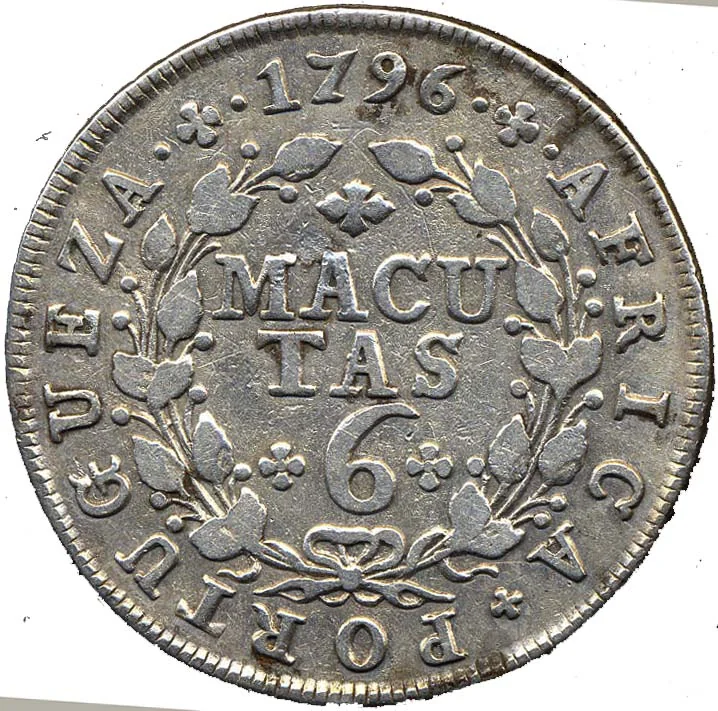
Description:
Laurel wreath encircling denomination.
Inscription:
AFRICA·PORTUGUEZA·1784
MACUTAS
6
MACUTAS
6
Script: Latin
Edge
Milled
Mintings
| Year | Mint Mark | Mintage | Quality | Collection |
|---|---|---|---|---|
| 1784 | — | 10,000 |
Historical background
In 1784, Angola was not a sovereign nation but a Portuguese colony, and its currency situation was intrinsically tied to the economic and slave-trading systems imposed by Lisbon. The official currency was the Portuguese real, but its circulation was limited primarily to administrative centers, the coastal port of Luanda, and among Portuguese traders and colonial officials. The broader economy, especially inland, operated on a complex system of commodity monies and trade goods, reflecting both pre-existing African practices and the demands of the Atlantic slave trade.
The most significant and tragic "currency" in Angola at this time was human beings. Enslaved people were the colony's primary export and functioned as the de facto standard of value. Prices for imported goods—such as Brazilian cachaça (rum), Portuguese textiles, and guns—were often quoted in terms of how many healthy adult slaves they could purchase. This system created a brutal feedback loop where the demand for trade goods fueled further raiding and wars to capture more people, who were then used to acquire more goods. Other commodity monies included rolos (rolls of tobacco), bares of cloth, and cowrie shells, which were used for smaller, local transactions.
This monetary duality highlighted the colony's extractive nature. While Lisbon attempted to impose a formal currency system to regulate taxation and official commerce, the reality on the ground was a fragmented and violent economy centered on human trafficking. The scarcity of coinage for the general population and the reliance on slave-backed credit for large transactions meant Angola's "currency situation" in 1784 was less a unified financial system and more a direct manifestation of its role as the engine of the Portuguese Atlantic slave trade.
The most significant and tragic "currency" in Angola at this time was human beings. Enslaved people were the colony's primary export and functioned as the de facto standard of value. Prices for imported goods—such as Brazilian cachaça (rum), Portuguese textiles, and guns—were often quoted in terms of how many healthy adult slaves they could purchase. This system created a brutal feedback loop where the demand for trade goods fueled further raiding and wars to capture more people, who were then used to acquire more goods. Other commodity monies included rolos (rolls of tobacco), bares of cloth, and cowrie shells, which were used for smaller, local transactions.
This monetary duality highlighted the colony's extractive nature. While Lisbon attempted to impose a formal currency system to regulate taxation and official commerce, the reality on the ground was a fragmented and violent economy centered on human trafficking. The scarcity of coinage for the general population and the reliance on slave-backed credit for large transactions meant Angola's "currency situation" in 1784 was less a unified financial system and more a direct manifestation of its role as the engine of the Portuguese Atlantic slave trade.
💎 Extremely Rare