

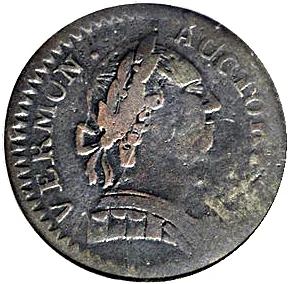
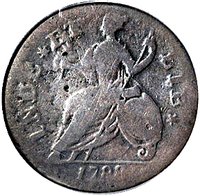
Obverse
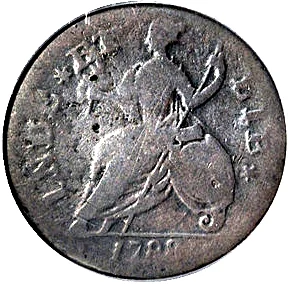
Reverse
Edge
Mints
| Name | Mark |
|---|---|
| Rupert, Vermont | — |
Mintings
| Year | Mint Mark | Mintage | Quality | Collection |
|---|---|---|---|---|
| 1788 | — | — |
Historical background
In 1788, the Republic of Vermont, operating as an independent nation since 1777, faced a complex and challenging currency situation. Its economy was strained by the dual pressures of paying off debts from the Revolutionary War and funding its own government and militia. To meet these obligations, Vermont, like the neighboring states and the struggling United States under the Articles of Confederation, heavily relied on printing its own paper money. This currency, often authorized by acts of the Vermont General Assembly, was primarily intended for settling public debts and paying soldiers, but it inevitably entered the broader circulation.
The value of this paper currency was unstable and prone to depreciation. Its worth was not backed by specie (gold or silver) but by the state's promise to accept it for taxes and land payments. This led to a classic problem of oversupply and lack of confidence; as more bills were printed to cover deficits, their value fell sharply in relation to hard currency and even to the currencies of other states. Merchants and traders, particularly those engaged in cross-border commerce with New York, New Hampshire, and British Canada, often preferred these more stable currencies or specie, creating a multi-currency marketplace where Vermont's notes traded at a significant discount.
This monetary instability was a significant political and economic vulnerability for the young republic. It complicated trade, eroded public trust, and highlighted the practical benefits of joining a larger union with a more unified financial system. The currency crisis of the 1780s was therefore one of the key pragmatic factors pushing Vermont's leaders toward negotiation for statehood, which would eventually be achieved in 1791, bringing Vermont into the U.S. dollar system and ending its experiment with independent currency.
The value of this paper currency was unstable and prone to depreciation. Its worth was not backed by specie (gold or silver) but by the state's promise to accept it for taxes and land payments. This led to a classic problem of oversupply and lack of confidence; as more bills were printed to cover deficits, their value fell sharply in relation to hard currency and even to the currencies of other states. Merchants and traders, particularly those engaged in cross-border commerce with New York, New Hampshire, and British Canada, often preferred these more stable currencies or specie, creating a multi-currency marketplace where Vermont's notes traded at a significant discount.
This monetary instability was a significant political and economic vulnerability for the young republic. It complicated trade, eroded public trust, and highlighted the practical benefits of joining a larger union with a more unified financial system. The currency crisis of the 1780s was therefore one of the key pragmatic factors pushing Vermont's leaders toward negotiation for statehood, which would eventually be achieved in 1791, bringing Vermont into the U.S. dollar system and ending its experiment with independent currency.
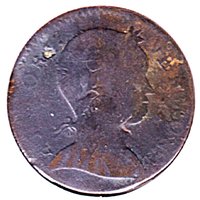
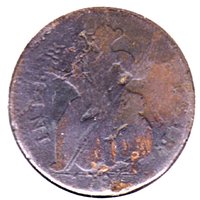
💎 Extremely Rare