

2 Deniers – France
France
Context
Years: 1618–1623
Issuer: France 
Ruler: Louis XIII
Currency:
(1204—1795)
Demonetized: Yes
Total mintage: 1,332,960
Material
References
KM: #Click to copy to clipboard43.3
Numista: #52502
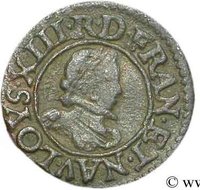
Obverse
Description:
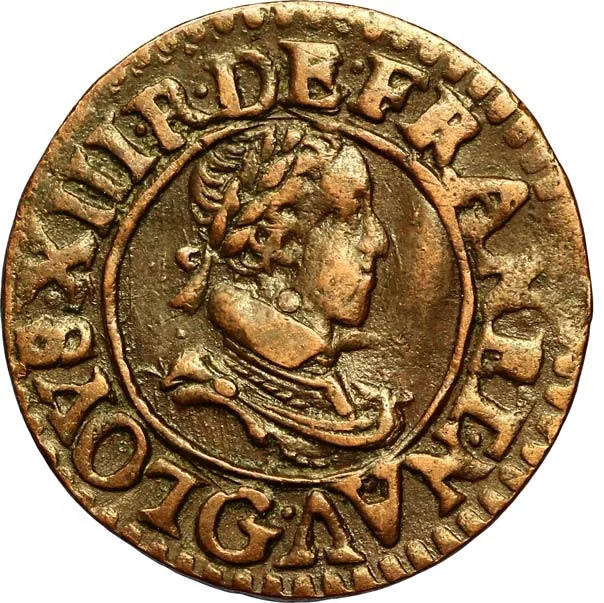
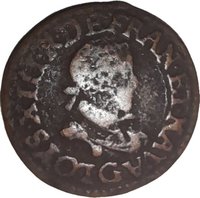
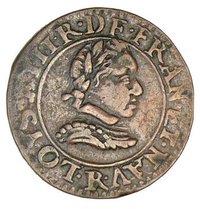
Childish bust of Louis XIII, laureate and draped, facing right in cuirass with broad raised collar.
Inscription:
LOYS.XIII.R.DE.FRAN.ET.NAVA.G. (a)
LOYS.XIII.R.DE.FRAN.ET.NAV.G. (b)
LOYS.XIII.R.DE.FRAN.ET.NA.G. (c)
LOYS.XIII.R.DE.FRAN.ET.NAV.G. (b)
LOYS.XIII.R.DE.FRAN.ET.NA.G. (c)
Script: Latin
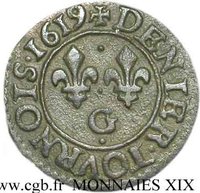
Reverse
Description:
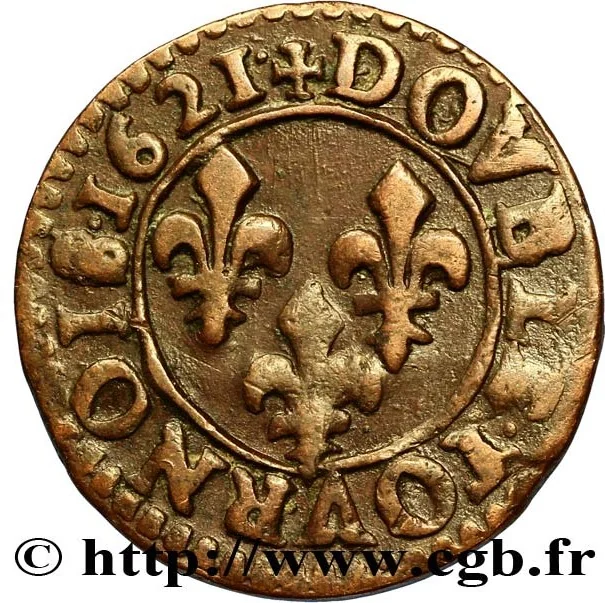
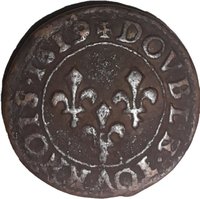
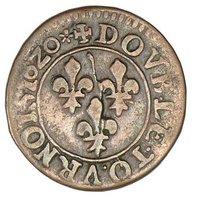
Three lilies arranged two and one.
Inscription:
+ DOVBLE.TOVRNOIS.(millésime) (1)
+.DOVBLE.TOVRNOIS.(millésime) (2)
+ DOVBLE.TOVRNOIS.(millésime). (3)
+.DOVBLE.TOVRNOIS.(millésime) (2)
+ DOVBLE.TOVRNOIS.(millésime). (3)
Script: Latin
Edge
Plain
Mints
| Name | Mark |
|---|---|
| Poitiers | G |
Historical background
In 1618, France operated under a complex and often chaotic monetary system, a legacy of medieval practices that were straining under the pressures of early modern state finance. The official unit of account was the livre tournois (l.t.), a stable notional currency used for bookkeeping, contracts, and setting prices. However, the physical money in circulation consisted of a bewildering array of actual coins, primarily gold écus and silver francs and sous, whose market value in livres fluctuated based on their precious metal content and royal decree. The monarchy held the exclusive right to issue coins and set their official values, a power known as seigniorage.
This system was plagued by instability. France was still recovering from the debts and currency manipulations of the late 16th-century Wars of Religion. To raise short-term revenue, the crown frequently engaged in the practice of mutations monétaires—suddenly altering the official value (the cours) of specific coins or their weight and fineness. This created a climate of uncertainty, confusing trade and enabling speculators to profit. Furthermore, vast quantities of foreign coins, particularly Spanish gold and silver from the New World, circulated alongside domestic issues, further complicating exchange.
The situation reflected the broader weaknesses of French royal finance before the reforms of Cardinal Richelieu and Louis XIV. The currency's instability hampered commerce, eroded public trust, and limited the crown's ability to fund its ambitions. While not yet in a state of acute crisis in 1618, the monetary landscape was fragile, setting the stage for the fiscal challenges that would confront the young King Louis XIII and his ministers as France increasingly engaged in European affairs, culminating in its eventual entry into the Thirty Years' War.
This system was plagued by instability. France was still recovering from the debts and currency manipulations of the late 16th-century Wars of Religion. To raise short-term revenue, the crown frequently engaged in the practice of mutations monétaires—suddenly altering the official value (the cours) of specific coins or their weight and fineness. This created a climate of uncertainty, confusing trade and enabling speculators to profit. Furthermore, vast quantities of foreign coins, particularly Spanish gold and silver from the New World, circulated alongside domestic issues, further complicating exchange.
The situation reflected the broader weaknesses of French royal finance before the reforms of Cardinal Richelieu and Louis XIV. The currency's instability hampered commerce, eroded public trust, and limited the crown's ability to fund its ambitions. While not yet in a state of acute crisis in 1618, the monetary landscape was fragile, setting the stage for the fiscal challenges that would confront the young King Louis XIII and his ministers as France increasingly engaged in European affairs, culminating in its eventual entry into the Thirty Years' War.
🌟 Limited