

1 Denier – France
France
Context

Material
References
KM: #Click to copy to clipboard42.7
Numista: #52453
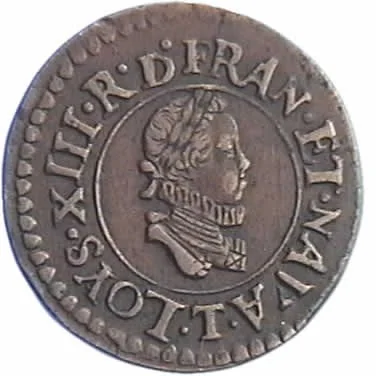
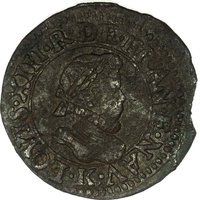
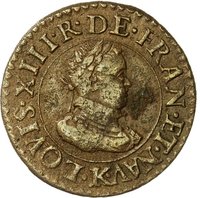
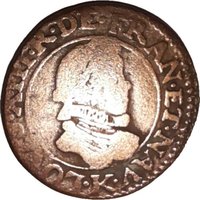
Obverse
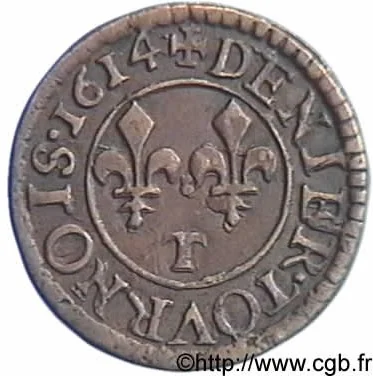
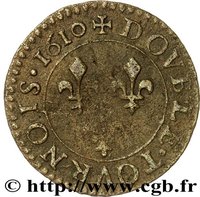
Reverse
Description:
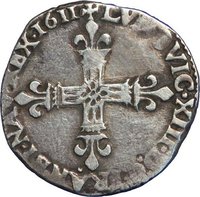
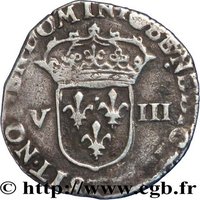
Two lilies.
Inscription:
+ DENIER.TOVNOIS.(rose).(millésime) (1)
+ DENIER.TOURNOIS.(millésime) (2)
+ DENIER.TOURNOIS.(millésime) (2)
Script: Latin
Edge
Plain
Mints
| Name | Mark |
|---|---|
| Nantes | T |
Historical background
In 1610, France's currency system was a complex and fragile patchwork, still reeling from the financial exhaustion of the Wars of Religion. The primary unit of account was the livre tournois (or franc), a stable notional value used for bookkeeping and contracts. However, the actual coins in circulation—the physical écus (gold), francs (silver), and liards (copper)—had their own intrinsic values based on their precious metal content. The monarchy, perpetually short of funds, frequently manipulated this system through the practice of augmentation (raising the official value of coins) or diminution (lowering it), causing severe inflation, confusion in trade, and public distrust.
The situation was directly inherited from the reign of Henry IV, whose assassination in May 1610 created immediate uncertainty. His great minister, the Duc de Sully, had worked to restore fiscal stability by reforming tax collection, reducing the royal debt, and building a treasury surplus. A key part of his policy was maintaining a strong, stable currency. However, his influence waned after Henry's death, as the regency for the young Louis IX began under Marie de' Medici. There were widespread fears that the new regime, facing political pressures and noble demands, would abandon Sully's hard-money policies and resume the destructive practice of coinage manipulation to raise quick revenue.
Thus, the currency situation in 1610 stood at a precarious crossroads. The tangible coins in people's hands were a legacy of past instability, while the system of account provided a veneer of order. The recent political shock threatened to unravel the fragile progress made. Merchants, creditors, and the peasantry all operated in an atmosphere of monetary anxiety, wary that the state's financial needs could suddenly alter the value of their savings and contracts overnight, a constant tension between royal authority and economic reality in early modern France.
The situation was directly inherited from the reign of Henry IV, whose assassination in May 1610 created immediate uncertainty. His great minister, the Duc de Sully, had worked to restore fiscal stability by reforming tax collection, reducing the royal debt, and building a treasury surplus. A key part of his policy was maintaining a strong, stable currency. However, his influence waned after Henry's death, as the regency for the young Louis IX began under Marie de' Medici. There were widespread fears that the new regime, facing political pressures and noble demands, would abandon Sully's hard-money policies and resume the destructive practice of coinage manipulation to raise quick revenue.
Thus, the currency situation in 1610 stood at a precarious crossroads. The tangible coins in people's hands were a legacy of past instability, while the system of account provided a veneer of order. The recent political shock threatened to unravel the fragile progress made. Merchants, creditors, and the peasantry all operated in an atmosphere of monetary anxiety, wary that the state's financial needs could suddenly alter the value of their savings and contracts overnight, a constant tension between royal authority and economic reality in early modern France.
Series: 1610 France circulation coins


💎 Extremely Rare