

1 Denier – France
France
Context

Material
References
KM: #Click to copy to clipboard42.2
Numista: #52328
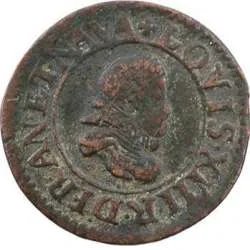
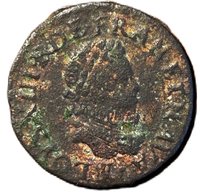
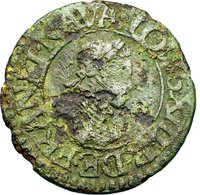
Obverse
Description:
Bust right.
Inscription:
(croix en points)LOVIS.XIII.R.DE.FRAN.ET.NAVA (a)
(croix en points)LOVIS.XIII.R.D.FRAN.ET.NAVA (b)
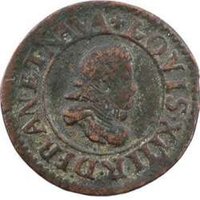
(croix en points)LOVIS.XIII.R.D.FRAN.ET.NAVA (b)
Script: Latin
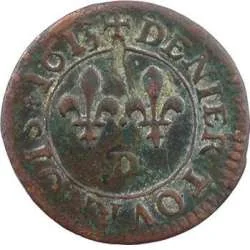
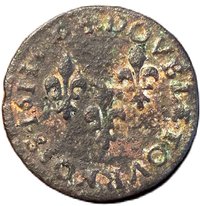
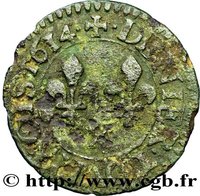
Reverse
Description:
Twin lilies
Inscription:
+ DENIER(croix en points)TOVRNOIS(croix en points)1613 (1)
Script: Latin
Edge
Plain
Mints
| Name | Mark |
|---|---|
| Lyon | D |
Historical background
In 1613, France was navigating a complex and unstable monetary landscape under the regency of Marie de' Medici, ruling on behalf of her young son, Louis XIII. The kingdom operated on a bimetallic system of livres tournois (a unit of account), silver écus, and gold pistoles, but the actual value and weight of these coins were in constant flux. Decades of religious wars had drained the treasury, leading successive monarchs to engage in repeated currency manipulations—debasement, re-evaluations, and the creation of new coin issues—to generate short-term revenue, thereby eroding public trust in the coinage.
This period was marked by the lingering effects of the monetary reforms of Henri IV’s minister, Sully, who had sought to stabilize the currency after the chaos of the Wars of Religion. However, by 1613, the regency government, facing financial pressure and factional court politics, was again resorting to inflationary practices. The intrinsic value of coins (their precious metal content) often fell below their official face value, leading to Gresham’s Law in action: "bad" debased coins drove "good" full-weight coins out of circulation, as people hoarded the latter or used them for foreign trade, further weakening the domestic economy.
Consequently, merchants, peasants, and creditors faced significant uncertainty. Prices and contracts in livres had to account for the shifting agio (exchange premium) between different coin types and their fluctuating official valuations. This monetary instability acted as a drag on commerce and was a source of social tension, contributing to the broader financial weaknesses that would later culminate in the fiscal crises faced by Cardinal Richelieu and, ultimately, Louis XIV. The currency situation of 1613 was thus a symptom of the French monarchy’s persistent struggle to centralize financial authority and establish a reliable monetary standard.
This period was marked by the lingering effects of the monetary reforms of Henri IV’s minister, Sully, who had sought to stabilize the currency after the chaos of the Wars of Religion. However, by 1613, the regency government, facing financial pressure and factional court politics, was again resorting to inflationary practices. The intrinsic value of coins (their precious metal content) often fell below their official face value, leading to Gresham’s Law in action: "bad" debased coins drove "good" full-weight coins out of circulation, as people hoarded the latter or used them for foreign trade, further weakening the domestic economy.
Consequently, merchants, peasants, and creditors faced significant uncertainty. Prices and contracts in livres had to account for the shifting agio (exchange premium) between different coin types and their fluctuating official valuations. This monetary instability acted as a drag on commerce and was a source of social tension, contributing to the broader financial weaknesses that would later culminate in the fiscal crises faced by Cardinal Richelieu and, ultimately, Louis XIV. The currency situation of 1613 was thus a symptom of the French monarchy’s persistent struggle to centralize financial authority and establish a reliable monetary standard.
✨ Legendary