

2 Deniers – France
France
Context

Material
References
KM: #Click to copy to clipboard43.2
Numista: #52209
Obverse
Description:
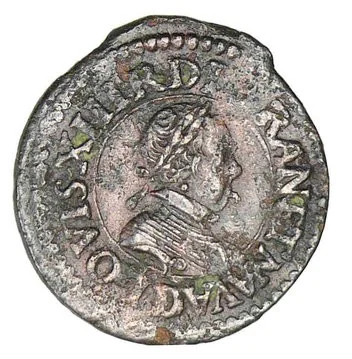
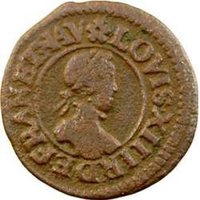
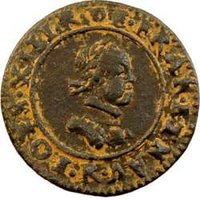
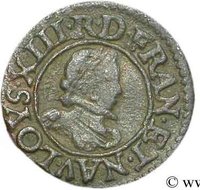
Young laureate Louis XIII, armored and draped with a large ruff.
Inscription:
LOVIS.XIII.R.DE.FRAN.ET.NAVA.D. (a)
LOVIS.XIII.R.DE.FRAN.ET.NAV.D. (b)
LOVIS.XIII.R.DE.FRAN.ET.NAV.D. (b)
Script: Latin
Reverse
Description:
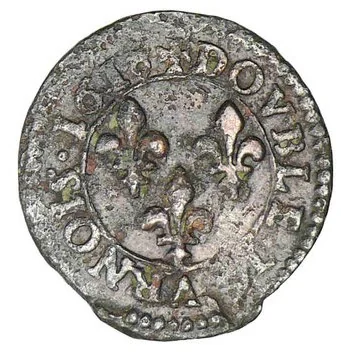
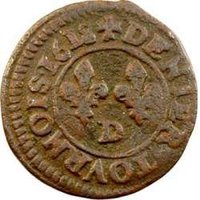
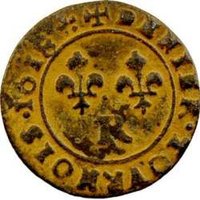
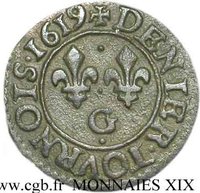
Three lilies arranged two and one.
Inscription:
+ DOVBLE(croix en points)TOVRNOIS(croix en points)(millésime) (1)
+ DOVBLE.TOVRNOIS.(millésime) (2)
+ DOVBLE(fleur)TOVRNOIS(fleur)(millésime) (3)
+ DOVBLE X TOVRNOIS + (millésime) (4)
+ DOVBLE.TOVRNOIS.(millésime) (2)
+ DOVBLE(fleur)TOVRNOIS(fleur)(millésime) (3)
+ DOVBLE X TOVRNOIS + (millésime) (4)
Script: Latin
Edge
Plain
Mints
| Name | Mark |
|---|---|
| Lyon | D |
Historical background
In 1617, France found itself in a precarious monetary situation, a legacy of decades of royal extravagance, foreign wars, and domestic mismanagement. The primary currency, the livre tournois, was a unit of account, but the physical money in circulation was a chaotic mix of gold écus, silver francs and testons, and copper liards. The real problem was severe debasement: to finance the state's chronic deficits, the monarchy repeatedly reduced the precious metal content of its coins while officially maintaining their face value. This created a destructive cycle where "good," full-weight coins were hoarded or exported, while "bad," debased coins flooded the market, causing inflation and eroding public trust.
The situation was exacerbated by the political turmoil following the assassination of King Henry IV in 1610. His widow, Marie de' Medici, acted as regent for the young Louis XIII, and her government, led by the unpopular minister Concino Concini, was widely seen as corrupt and financially irresponsible. The crown resorted to short-term expedients like creating and selling new offices, borrowing at high interest from financiers, and further manipulating the coinage. This fiscal desperation undermined economic stability and fueled resentment among the nobility and commoners alike.
By 1617, the currency crisis was a tangible symptom of a failing regime. The widespread use of underweight coinage disrupted trade, penalized creditors and those on fixed incomes, and created a two-tier monetary system. This financial disorder contributed directly to the political explosion in April of that year, when Louis XIII, asserting his authority, orchestrated the murder of Concini. While this act marked a turning point in royal control, the fundamental currency and fiscal problems remained deeply entrenched, setting the stage for the severe monetary reforms and crises that would characterize the rest of the century.
The situation was exacerbated by the political turmoil following the assassination of King Henry IV in 1610. His widow, Marie de' Medici, acted as regent for the young Louis XIII, and her government, led by the unpopular minister Concino Concini, was widely seen as corrupt and financially irresponsible. The crown resorted to short-term expedients like creating and selling new offices, borrowing at high interest from financiers, and further manipulating the coinage. This fiscal desperation undermined economic stability and fueled resentment among the nobility and commoners alike.
By 1617, the currency crisis was a tangible symptom of a failing regime. The widespread use of underweight coinage disrupted trade, penalized creditors and those on fixed incomes, and created a two-tier monetary system. This financial disorder contributed directly to the political explosion in April of that year, when Louis XIII, asserting his authority, orchestrated the murder of Concini. While this act marked a turning point in royal control, the fundamental currency and fiscal problems remained deeply entrenched, setting the stage for the severe monetary reforms and crises that would characterize the rest of the century.
💎 Very Rare