

3 Pfennigs – Brunswick-Lüneburg-Celle
Germany

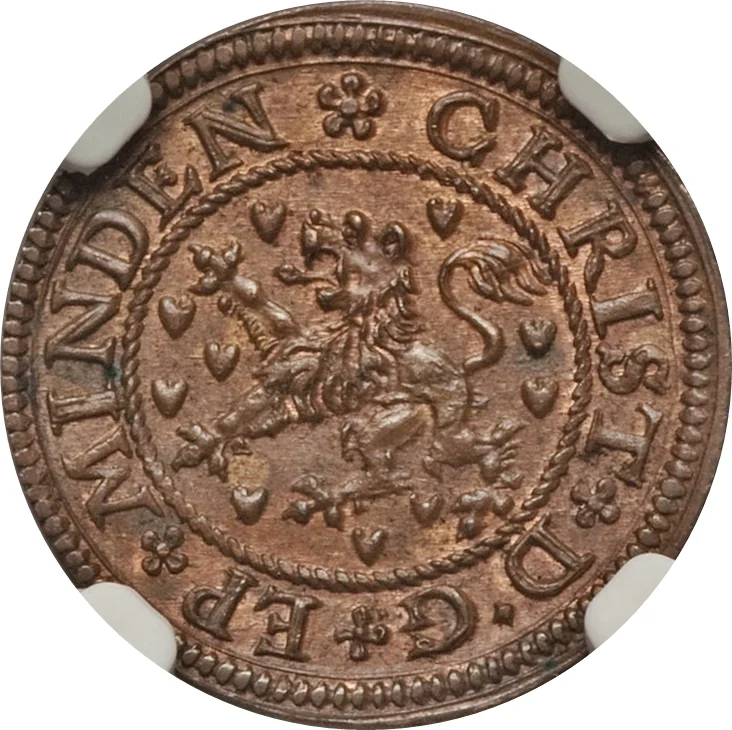
Obverse
Description:
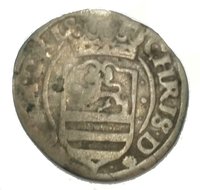
Lion facing left, surrounded by hearts.
Inscription:
*CHRIST*D.G*EP*MINDEN
Script: Latin
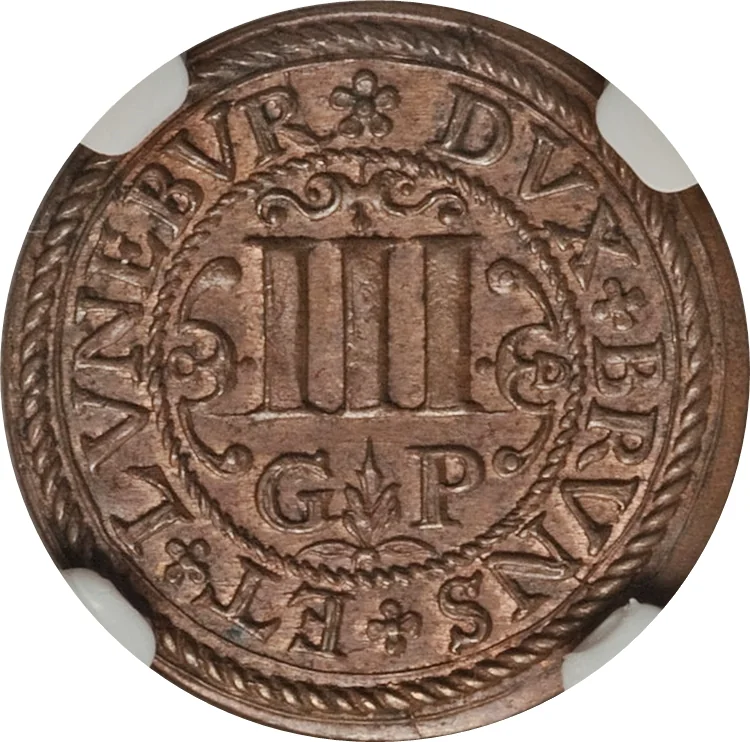
Reverse
Edge
Mints
| Name | Mark |
|---|---|
| Celle | — |
Mintings
| Year | Mint Mark | Mintage | Quality | Collection |
|---|---|---|---|---|
| 1620 | GM | — | ||
| 1621 | GM | — | ||
| 1622 | — | — | ||
| 1622 | h | — | ||
| 1622 | GM | — |
Historical background
In 1620, the Duchy of Brunswick-Lüneburg, with its administrative centre in Celle, operated within the complex and fragmented monetary system of the Holy Roman Empire. The right to mint coins (Münzregal) was a privileged but widely held right, exercised not only by the Emperor and major principalities but also by numerous smaller states, bishoprics, and even cities. This led to a proliferation of circulating coins of varying standards, weights, and metallic content. For Brunswick-Lüneburg-Celle, this meant its currency had to compete and coexist with a flood of foreign coins, particularly the ubiquitous Reichsthaler (Imperial Thaler), which served as an important accounting standard, and countless smaller denominations used in daily trade.
The situation was further strained by the early stages of the Thirty Years' War (1618-1648). While major fighting had not yet reached the region directly by 1620, the political and economic instability caused by the conflict was already felt. War financing pressures across Germany led many minting authorities, including some in the broader Brunswick-Lüneburg territories, to engage in debasement—reducing the precious metal content in coins to produce more currency from the same silver stock. This practice, while profitable for the mint lord, eroded public trust, caused price inflation, and complicated commerce, as merchants had to constantly assess the actual value of hundreds of different coin types.
Duke Christian the Elder of Brunswick-Lüneburg, ruling from Celle, thus faced a dual challenge: maintaining the integrity of his own mint output to ensure stable revenues and domestic trade, while navigating a destabilizing imperial monetary landscape. His duchy’s coins, such as the Thaler and its subdivisions, had to be accepted in regional markets, requiring them to roughly conform to broader, though often violated, imperial ordinances. The currency situation in 1620 was therefore one of precarious balance, caught between traditional imperial structures, the selfish policies of numerous mint lords, and the gathering storm of a war that would soon unleash catastrophic economic chaos across Central Europe.
The situation was further strained by the early stages of the Thirty Years' War (1618-1648). While major fighting had not yet reached the region directly by 1620, the political and economic instability caused by the conflict was already felt. War financing pressures across Germany led many minting authorities, including some in the broader Brunswick-Lüneburg territories, to engage in debasement—reducing the precious metal content in coins to produce more currency from the same silver stock. This practice, while profitable for the mint lord, eroded public trust, caused price inflation, and complicated commerce, as merchants had to constantly assess the actual value of hundreds of different coin types.
Duke Christian the Elder of Brunswick-Lüneburg, ruling from Celle, thus faced a dual challenge: maintaining the integrity of his own mint output to ensure stable revenues and domestic trade, while navigating a destabilizing imperial monetary landscape. His duchy’s coins, such as the Thaler and its subdivisions, had to be accepted in regional markets, requiring them to roughly conform to broader, though often violated, imperial ordinances. The currency situation in 1620 was therefore one of precarious balance, caught between traditional imperial structures, the selfish policies of numerous mint lords, and the gathering storm of a war that would soon unleash catastrophic economic chaos across Central Europe.
✨ Legendary