

2 lariat – Maldives
Add to wishlist
Maldives
Context
Year: 1775
Islamic (Hijri) Year:: 1189
Issuer: Maldives
Ruler: Muhammad Mu'iz ud-din
Currency:
(1660—1947)
Demonetized: Yes
References
KM: #
Numista: #117855
Obverse
Description:
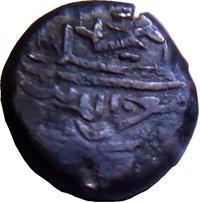
Carved words.
Reverse
Description:
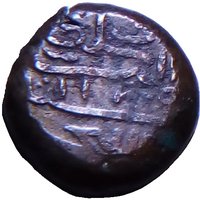
Dated in third line.
Inscription:
١١٨٩
Edge
Mintings
| Year | Mint Mark | Mintage | Quality | Collection |
|---|---|---|---|---|
| 1775 | — | — |
Historical background
In 1775, the Maldives operated within a complex and fragmented monetary system, heavily influenced by its position as a strategic node in the Indian Ocean trade network. The official currency, as decreed by the sultanate in Malé, was the Larín, a silver wire currency bent into a hook shape. However, the reality in the atolls and markets was one of concurrent circulation. Alongside the Larín, a wide variety of foreign silver coins were accepted, most notably the Dutch rixdollar (rijksdaalder) and the Spanish silver dollar (piece of eight), which arrived via European and Arab trading vessels. Cowrie shells, the ancient and enduring currency of the region, also remained in widespread use for smaller, local transactions, creating a multi-tiered system.
This monetary landscape was a direct reflection of the Maldives' economic reality: a dependence on the export of cowrie shells, coir rope, and dried fish, and the import of essential goods like rice, textiles, and metals. The value and supply of coinage were therefore unstable, dictated by the ebb and flow of maritime trade rather than centralized minting. The scarcity of precious metals locally meant the sultanate had limited control over the money supply, often leading to shortages of accepted coin and reinforcing the reliance on barter and cowries in daily life.
Politically, the year 1775 fell within a period of internal consolidation under Sultan Hasan 'Izz ud-din, who had recently unified the archipelago after a phase of division. While his administration sought to assert central authority, the diffuse currency system presented a practical challenge to economic control. The coexistence of Maldivian Larín, multiple foreign silver coins, and cowrie shells underscored a economy that was simultaneously integrated into global trade circuits yet maintained its own traditional structures, a duality that would define Maldivian commerce for decades to come.
This monetary landscape was a direct reflection of the Maldives' economic reality: a dependence on the export of cowrie shells, coir rope, and dried fish, and the import of essential goods like rice, textiles, and metals. The value and supply of coinage were therefore unstable, dictated by the ebb and flow of maritime trade rather than centralized minting. The scarcity of precious metals locally meant the sultanate had limited control over the money supply, often leading to shortages of accepted coin and reinforcing the reliance on barter and cowries in daily life.
Politically, the year 1775 fell within a period of internal consolidation under Sultan Hasan 'Izz ud-din, who had recently unified the archipelago after a phase of division. While his administration sought to assert central authority, the diffuse currency system presented a practical challenge to economic control. The coexistence of Maldivian Larín, multiple foreign silver coins, and cowrie shells underscored a economy that was simultaneously integrated into global trade circuits yet maintained its own traditional structures, a duality that would define Maldivian commerce for decades to come.
✨ Legendary