

½ larin – Maldives
Add to wishlist
Maldives
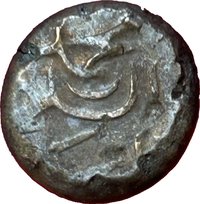
Obverse
Description:
Carved words.
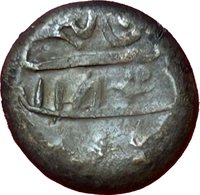
Reverse
Description:
Carved words.
Edge
Mintings
| Year | Mint Mark | Mintage | Quality | Collection |
|---|---|---|---|---|
| 1767 | — | — | ||
| 1771 | — | — |
Historical background
The currency situation in the Maldives in 1767 was defined by a complex and fragmented system, heavily reliant on foreign coinage due to the archipelago's lack of domestic minting capabilities. The primary medium of exchange was the Larín, a silver wire currency bent into a hook or "fishhook" shape, which had circulated across the Indian Ocean for centuries. However, the most significant and practical currency in daily use was the Maldivian Boli, a physical token made from cowrie shells (Cypraea moneta). These shells, imported in vast quantities from the Maldives to global markets, paradoxically returned as a regulated local currency, with specific quantities strung together representing set denominations.
This system operated under the authority of the Sultanate in Malé, but control was often theoretical. Alongside laríns and bolis, a multitude of foreign silver coins circulated freely, particularly Dutch East India Company (VOC) rixdollars, Indian rupees, and various Arab and Persian silver coins. Their value was not fixed by a central authority but fluctuated based on intrinsic silver content and prevailing trade rates established by merchants in the bustling ports. The economy was almost entirely cash-based for trade, while taxes and state revenues were often collected in kind, such as in dried fish (Maldive fish), coir rope, and cowrie shells themselves.
Consequently, the monetary landscape was one of inherent instability and localization. Exchange rates between cowrie bolis, silver laríns, and foreign coins could vary significantly from one atoll to another, creating opportunities for arbitrage but hindering large-scale commerce. The system reflected the Maldives' position as a trade-dependent node in the Indian Ocean, where the very shells it exported formed the bedrock of its internal currency, while external trade demanded the acceptance of a heterogeneous mix of foreign silver, leaving the Sultanate with little direct control over its overall monetary supply.
This system operated under the authority of the Sultanate in Malé, but control was often theoretical. Alongside laríns and bolis, a multitude of foreign silver coins circulated freely, particularly Dutch East India Company (VOC) rixdollars, Indian rupees, and various Arab and Persian silver coins. Their value was not fixed by a central authority but fluctuated based on intrinsic silver content and prevailing trade rates established by merchants in the bustling ports. The economy was almost entirely cash-based for trade, while taxes and state revenues were often collected in kind, such as in dried fish (Maldive fish), coir rope, and cowrie shells themselves.
Consequently, the monetary landscape was one of inherent instability and localization. Exchange rates between cowrie bolis, silver laríns, and foreign coins could vary significantly from one atoll to another, creating opportunities for arbitrage but hindering large-scale commerce. The system reflected the Maldives' position as a trade-dependent node in the Indian Ocean, where the very shells it exported formed the bedrock of its internal currency, while external trade demanded the acceptance of a heterogeneous mix of foreign silver, leaving the Sultanate with little direct control over its overall monetary supply.

✨ Legendary