

1 rupee – Awadh
Add to wishlist
India
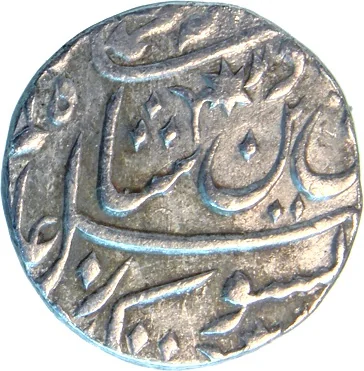
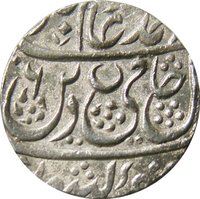
Obverse
Description:
Sa'adat Ali (1798-1814), issuing coins in the name of Shah Alam II (1761-1805).
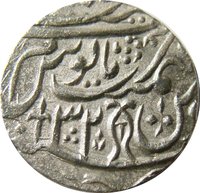
Reverse
Description:
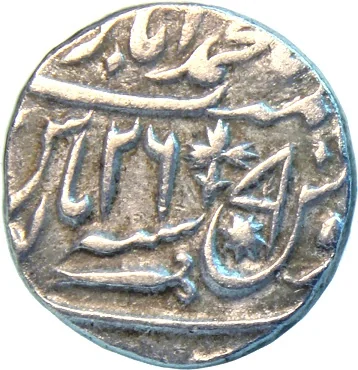
Frozen year, mint: Flag-star, fish.
Inscription:
٢٦
Edge
Plain
Mints
| Name | Mark |
|---|---|
| Lucknow | — |
Mintings
| Year | Mint Mark | Mintage | Quality | Collection |
|---|---|---|---|---|
| — | — | — |
Historical background
In 1787, the currency situation in Awadh under Nawab Asaf-ud-Daula was characterized by significant instability and complexity, a direct result of both regional politics and the growing influence of the British East India Company. The monetary system operated on a bimetallic standard, with both silver rupees (the primary currency for large transactions and revenue) and copper dams (for smaller, everyday use). However, the value and purity of these coins were not uniform. The Nawab's mint in Lucknow produced its own rupees, but these often competed with the older and more trusted Mughal silver rupees from Delhi and the newly emerging British-administered Farrukhabad rupee, which was gaining credibility for its consistent weight and purity.
This period saw a severe shortage of specie, particularly reliable silver, exacerbated by the Nawab's immense financial burdens. Asaf-ud-Daula's extravagant spending on patronage, most notably the construction of the Great Imambara, and the heavy annual tribute (subsidy) owed to the Company, drained the treasury. To meet these obligations, the Nawabi administration frequently resorted to debasement—reducing the silver content in their minted rupees to produce more coins from the same bullion reserve. This practice, while providing short-term liquidity, eroded public trust in the Lucknow rupee, leading to discounting and chaotic exchange rates between different types of coins in circulation.
Consequently, the monetary landscape was fragmented and inefficient. Merchants and revenue collectors had to navigate a confusing array of coins of differing intrinsic values, leading to disputes and hindering trade. The British, whose Resident exerted increasing financial control, often insisted on payments in their preferred, more stable currencies, further undermining the Nawab's fiscal autonomy. Thus, in 1787, Awadh's currency was not merely an economic tool but a reflection of a kingdom in financial distress, caught between traditional sovereignty and the encroaching colonial power that would ultimately exploit this monetary confusion to deepen its control.
This period saw a severe shortage of specie, particularly reliable silver, exacerbated by the Nawab's immense financial burdens. Asaf-ud-Daula's extravagant spending on patronage, most notably the construction of the Great Imambara, and the heavy annual tribute (subsidy) owed to the Company, drained the treasury. To meet these obligations, the Nawabi administration frequently resorted to debasement—reducing the silver content in their minted rupees to produce more coins from the same bullion reserve. This practice, while providing short-term liquidity, eroded public trust in the Lucknow rupee, leading to discounting and chaotic exchange rates between different types of coins in circulation.
Consequently, the monetary landscape was fragmented and inefficient. Merchants and revenue collectors had to navigate a confusing array of coins of differing intrinsic values, leading to disputes and hindering trade. The British, whose Resident exerted increasing financial control, often insisted on payments in their preferred, more stable currencies, further undermining the Nawab's fiscal autonomy. Thus, in 1787, Awadh's currency was not merely an economic tool but a reflection of a kingdom in financial distress, caught between traditional sovereignty and the encroaching colonial power that would ultimately exploit this monetary confusion to deepen its control.
✨ Legendary