

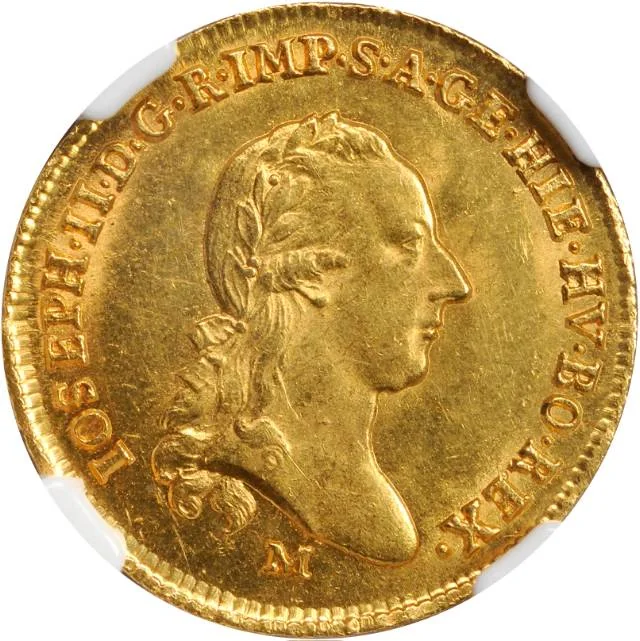

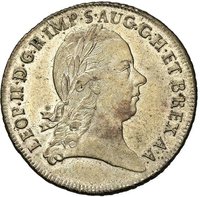
Obverse
Description:
Laureate bust right, mintmark below.
Inscription:
IOSEPH·II·D·G·R·IMP·S·A·GE·HIE·HV·BO·REX·
M
M
Script: Latin
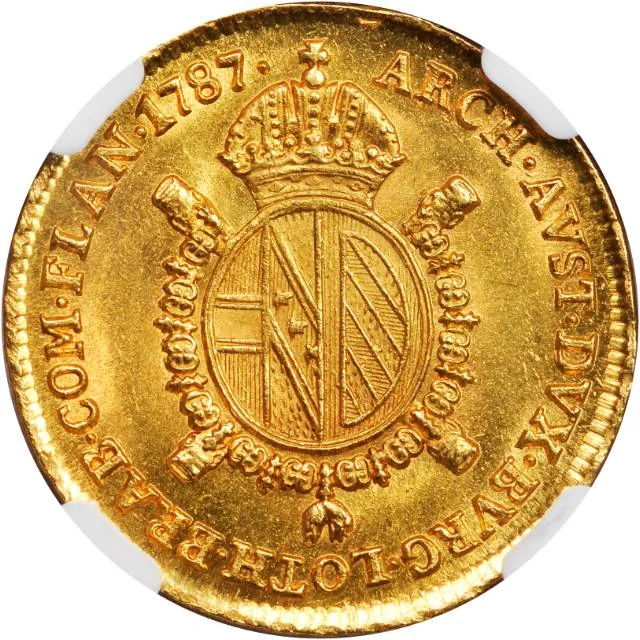
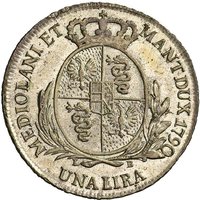
Reverse
Description:
Shield with Austro-Burgundian arms, encircled by the Golden Fleece, date in legend.
Inscription:
ARCH·AVST·DVX·BVRG·LOTH·BRAB·COM·FLAN·1787·
Script: Latin
Edge
Categories
| Object> Armour |
| Symbols> Coat of Arms |
Mints
| Name | Mark |
|---|---|
| Milan | M |
Historical background
In 1787, Milan operated under a complex and often chaotic monetary system, a legacy of its history under Spanish and then Austrian Habsburg rule. The official currency was the Milanese lira, subdivided into 20 soldi or 240 denari, but this was largely a unit of account. In daily circulation, a bewildering array of physical coins from across Europe and the Mediterranean changed hands. These included Austrian thalers, Spanish silver pesos, Venetian sequins, and even Ottoman piastres, each with fluctuating values based on their metal content and wear. The state's own mint struggled to produce enough reliable small-denomination coinage for everyday trade, leading to chronic shortages and widespread counterfeiting.
This monetary fragmentation was a significant hindrance to commerce and administration within the Duchy of Milan, then a province of the Habsburg Empire under Emperor Joseph II. The government in Vienna recognized the problem and had attempted reforms, notably through the Patent of 1778, which aimed to standardize the monetary system on a Conventionsthaler standard used elsewhere in the Empire. However, the transition was slow and incomplete. By 1787, the system existed in an unsatisfactory hybrid state: official accounts were kept in the Convention standard, but the old Milanese lira still dominated market prices and contracts, while a multitude of foreign coins continued to circulate.
Consequently, money changers (banchieri) held considerable power, and transactions required constant calculation and negotiation. For merchants and the populace, this uncertainty created friction in the economy, obscured true prices, and facilitated fraud. The situation reflected the broader challenges of modernizing the Habsburg state, caught between imperial standardization and entrenched local practices. It was a system ripe for the more decisive reforms that would come in the following decades, as Napoleonic influence and later Austrian rulers sought to impose a unified, decimal currency.
This monetary fragmentation was a significant hindrance to commerce and administration within the Duchy of Milan, then a province of the Habsburg Empire under Emperor Joseph II. The government in Vienna recognized the problem and had attempted reforms, notably through the Patent of 1778, which aimed to standardize the monetary system on a Conventionsthaler standard used elsewhere in the Empire. However, the transition was slow and incomplete. By 1787, the system existed in an unsatisfactory hybrid state: official accounts were kept in the Convention standard, but the old Milanese lira still dominated market prices and contracts, while a multitude of foreign coins continued to circulate.
Consequently, money changers (banchieri) held considerable power, and transactions required constant calculation and negotiation. For merchants and the populace, this uncertainty created friction in the economy, obscured true prices, and facilitated fraud. The situation reflected the broader challenges of modernizing the Habsburg state, caught between imperial standardization and entrenched local practices. It was a system ripe for the more decisive reforms that would come in the following decades, as Napoleonic influence and later Austrian rulers sought to impose a unified, decimal currency.
✨ Legendary