

1 Giulio – Ferrara
Italy

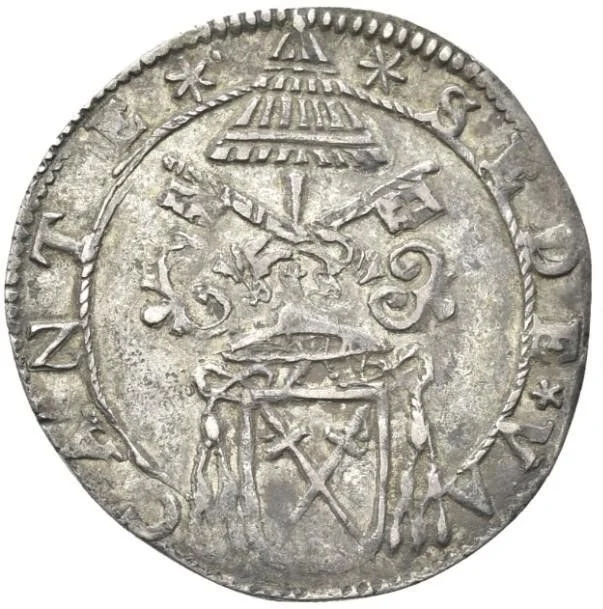
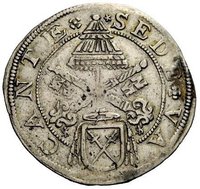
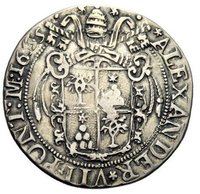
Obverse
Description:
Spada family crest with cardinal's hat and papal keys inside a beaded circle.
Inscription:
✶ SEDE ⋆ VACANTE ✶
Script: Latin
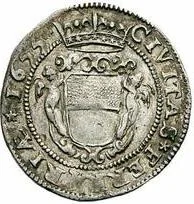
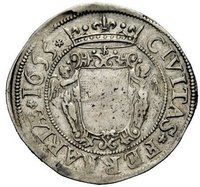
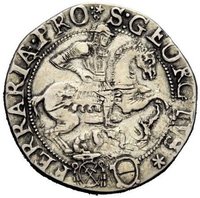
Reverse
Description:
Ferrara's crowned arms in a cartouche, supported by putti.
Inscription:
CIVITAS ✶ FERRARIA ✶1655
Script: Latin
Edge
Mints
| Name | Mark |
|---|---|
| Ferrara | — |
Mintings
| Year | Mint Mark | Mintage | Quality | Collection |
|---|---|---|---|---|
| 1655 | — | — |
Historical background
In 1655, the Duchy of Ferrara was navigating a complex monetary landscape typical of the Italian peninsula in the mid-17th century. Officially part of the Papal States since the devolution of 1598, Ferrara no longer minted its own independent currency. Instead, its economy operated on a bimetallic system reliant on a multitude of circulating coins, both domestic and foreign. The primary units of account were the Papal scudo (a gold coin) and the giulio or paolo (silver coins), but the actual circulation included a confusing array of coins from other Italian states like Venice, Florence, and Milan, as well as Spanish silver reales, each with fluctuating values based on metal content and wear.
This proliferation of currencies created significant challenges for trade and daily life. Exchange rates between gold and silver, and between different coinages, were unstable and often manipulated by money-changers (banchieri). The problem of "bad money" was acute: clipped, worn, or deliberately debased coins of lower intrinsic value drove better, full-weight coins out of circulation, a phenomenon described by Gresham's Law. This erosion of sound currency caused price inflation, complicated tax collection for the Papal administration, and created uncertainty for merchants and the populace alike.
The situation was further strained by the broader European context of the mid-1600s, including the ongoing Thirty Years' War and economic pressures on the Papacy. While Ferrara itself was not a minting center, its monetary instability reflected the lack of a unified monetary policy in the region. Authorities attempted to regulate exchange rates and fix values by proclamation, but these edicts were difficult to enforce. Consequently, the currency situation in 1655 Ferrara was one of fragmented circulation, endemic instability, and a constant struggle between official decree and the practical realities of a market flooded with heterogeneous and often degraded coinage.
This proliferation of currencies created significant challenges for trade and daily life. Exchange rates between gold and silver, and between different coinages, were unstable and often manipulated by money-changers (banchieri). The problem of "bad money" was acute: clipped, worn, or deliberately debased coins of lower intrinsic value drove better, full-weight coins out of circulation, a phenomenon described by Gresham's Law. This erosion of sound currency caused price inflation, complicated tax collection for the Papal administration, and created uncertainty for merchants and the populace alike.
The situation was further strained by the broader European context of the mid-1600s, including the ongoing Thirty Years' War and economic pressures on the Papacy. While Ferrara itself was not a minting center, its monetary instability reflected the lack of a unified monetary policy in the region. Authorities attempted to regulate exchange rates and fix values by proclamation, but these edicts were difficult to enforce. Consequently, the currency situation in 1655 Ferrara was one of fragmented circulation, endemic instability, and a constant struggle between official decree and the practical realities of a market flooded with heterogeneous and often degraded coinage.
✨ Legendary