

1 Obol – Hungary
Hungary

Obverse
Description:
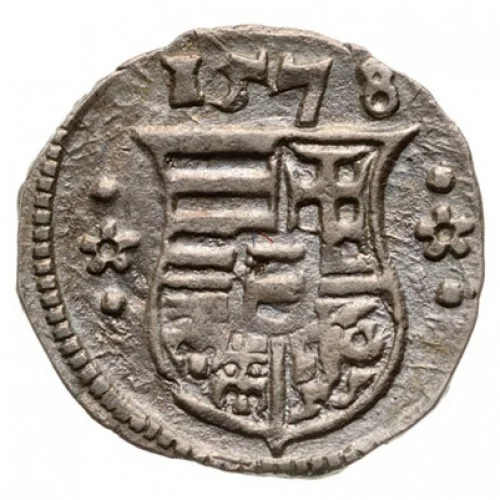
Hungarian coat of arms with Árpád stripes, double cross, Dalmatian leopard heads, and Bohemian lion; central shield with Austrian bonds. Mint year above, two side rosettes between dots.
Script: Latin
Reverse
Description:
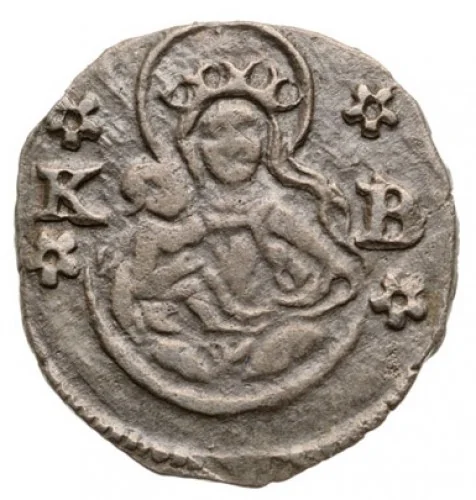
Madonna crowned on crescent, holding child, with K-B mintmark.
Inscription:
K B
Script: Latin
Edge
Plain
Mints
| Name | Mark |
|---|---|
| Kremnica | KB |
Mintings
| Year | Mint Mark | Mintage | Quality | Collection |
|---|---|---|---|---|
| 1577 | K-B | — | ||
| 1578 | K-B | — | ||
| 1579 | K-B | — | ||
| 1580 | K-B | — | ||
| 1581 | K-B | — | ||
| 1582 | K-B | — | ||
| 1583 | K-B | — | ||
| 1584 | K-B | — | ||
| 1585 | K-B | — | ||
| 1586 | K-B | — | ||
| 1587 | K-B | — | ||
| 1588 | K-B | — | ||
| 1589 | K-B | — | ||
| 1590 | K-B | — | ||
| 1591 | K-B | — | ||
| 1592 | K-B | — | ||
| 1593 | K-B | — | ||
| 1594 | K-B | — | ||
| 1595 | K-B | — | ||
| 1596 | K-B | — | ||
| 1597 | K-B | — | ||
| 1598 | K-B | — | ||
| 1599 | K-B | — | ||
| 1600 | K-B | — | ||
| 1601 | K-B | — | ||
| 1602 | K-B | — | ||
| 1603 | K-B | — | ||
| 1604 | K-B | — | ||
| 1605 | K-B | — | ||
| 1606 | K-B | — | ||
| 1607 | K-B | — | ||
| 1608 | K-B | — |
Historical background
In 1577, the Kingdom of Hungary was embroiled in a severe monetary crisis, a direct consequence of its tripartite division following the Ottoman victory at Mohács in 1526. The realm was split between the Ottoman-occupied central territories, the semi-independent Principality of Transylvania in the east, and the "Royal Hungary" of the north and west, ruled by the Habsburgs from Vienna. This fragmentation led to a chaotic circulation of over a dozen different coin types within Royal Hungary, including domestic issues, Austrian talers, Ottoman akçe, and various German and Dutch coins, causing widespread confusion and hindering trade.
The core of the crisis was the deliberate debasement of the silver coinage, particularly the denarius (denar). To finance continuous warfare against the Ottomans and cover the immense costs of frontier defense, the Habsburg treasury, under Emperor Rudolf II, systematically reduced the silver content of coins minted primarily in Nagybánya (today Baia Mare, Romania) and Körmöcbánya (now Kremnica, Slovakia). This practice, while providing short-term revenue, triggered Gresham's Law ("bad money drives out good money"), as older, higher-value coins were hoarded or melted down, leaving only the debased currency in circulation.
The resulting inflation eroded both the economy and public trust. Prices for essential goods soared, causing significant hardship for the population, especially soldiers and laborers on fixed wages. The situation created intense social tension and strained the relationship between the Hungarian estates and the Habsburg court, which was accused of exploiting the kingdom for its own imperial purposes. Thus, the currency situation of 1577 was not merely a financial issue but a symptom of the profound political instability and the heavy burdens of living on a permanent military frontier.
The core of the crisis was the deliberate debasement of the silver coinage, particularly the denarius (denar). To finance continuous warfare against the Ottomans and cover the immense costs of frontier defense, the Habsburg treasury, under Emperor Rudolf II, systematically reduced the silver content of coins minted primarily in Nagybánya (today Baia Mare, Romania) and Körmöcbánya (now Kremnica, Slovakia). This practice, while providing short-term revenue, triggered Gresham's Law ("bad money drives out good money"), as older, higher-value coins were hoarded or melted down, leaving only the debased currency in circulation.
The resulting inflation eroded both the economy and public trust. Prices for essential goods soared, causing significant hardship for the population, especially soldiers and laborers on fixed wages. The situation created intense social tension and strained the relationship between the Hungarian estates and the Habsburg court, which was accused of exploiting the kingdom for its own imperial purposes. Thus, the currency situation of 1577 was not merely a financial issue but a symptom of the profound political instability and the heavy burdens of living on a permanent military frontier.
✨ Legendary