

1 Ducat – Hungary
Hungary

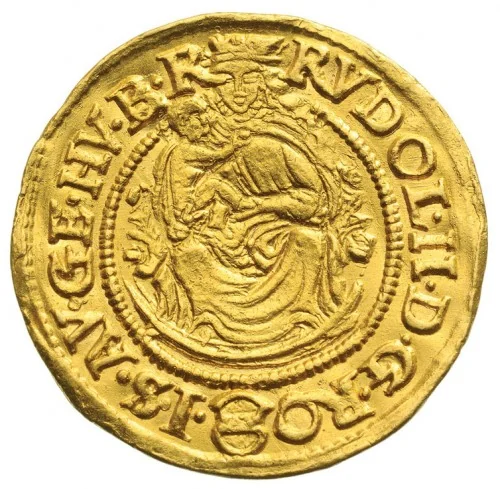
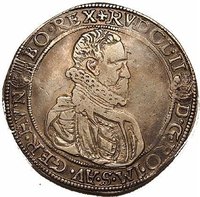
Obverse
Description:
Crowned Madonna on crescent, holding child; Austrian shield below; within pearl circle.
Inscription:
RVDOL · II · D · G · RO I · S · AV · GE · HV · B · R ·
Script: Latin
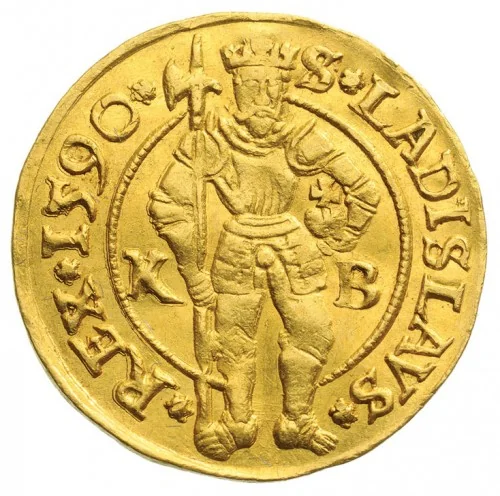
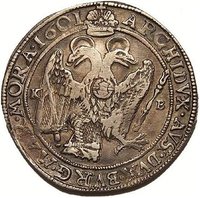
Reverse
Description:
Crowned king holding a scepter and orb, breaking through a circular line.
Inscription:
S · LADISLAVS· · REX · 1590 ·
K B
K B
Script: Latin
Edge
Plain
Mintings
| Year | Mint Mark | Mintage | Quality | Collection |
|---|---|---|---|---|
| 1578 | K | — | ||
| 1579 | H | — | ||
| 1579 | K | — | ||
| 1580 | H | — | ||
| 1580 | K | — | ||
| 1581 | H | — | ||
| 1581 | K | — | ||
| 1582 | K | — | ||
| 1583 | K | — | ||
| 1584 | K | — | ||
| 1585 | K | — | ||
| 1586 | K | — | ||
| 1587 | K | — | ||
| 1588 | K | — | ||
| 1589 | K | — | ||
| 1590 | K | — | ||
| 1591 | K | — | ||
| 1592 | K | — | ||
| 1593 | K | — | ||
| 1594 | K | — | ||
| 1595 | K | — | ||
| 1596 | K | — | ||
| 1597 | K | — | ||
| 1598 | K | — | ||
| 1599 | K | — | ||
| 1600 | K | — | ||
| 1601 | K | — | ||
| 1602 | K | — | ||
| 1603 | K | — | ||
| 1604 | K | — | ||
| 1605 | K | — | ||
| 1606 | K | — | ||
| 1607 | K | — | ||
| 1608 | K | — |
Historical background
In 1578, Hungary existed as a fractured realm, a direct consequence of the Ottoman victory at Mohács in 1526. The kingdom was divided into three parts: Ottoman-occupied central Hungary, the semi-independent Principality of Transylvania in the east (often a vassal of the Ottomans), and the "Royal Hungary" in the north and west, ruled by the Habsburgs from Vienna. This political fragmentation created a chaotic and multi-layered currency situation, where coins from competing authorities circulated alongside a flood of debased foreign money, leading to severe economic instability.
Within Habsburg-ruled Royal Hungary, the primary currency was the silver thaler (or Tallér), but its value and purity were under constant pressure. The Habsburgs, perpetually funding wars against the Ottomans and in Europe, frequently engaged in currency debasement—reducing the silver content in coins to mint more from the same bullion. This practice, alongside the influx of inferior-quality Polish and Turkish coins, caused significant inflation and a loss of public trust. Local Hungarian estates repeatedly protested these measures, as the deteriorating money hurt trade and tax revenues, deepening the economic distress of a population also burdened by wartime taxes and frontier defense.
Furthermore, the Ottoman-occupied lands and Transylvania operated with their own monetary systems. Ottoman akçe circulated in the central regions, while Transylvania, under Prince Stephen Báthory (who was also King of Poland at the time), minted its own coins. The result was a monetary mosaic where merchants and peasants had to navigate a confusing array of coins of varying intrinsic values. This complexity stifled commerce and integrated Hungary into the broader "Price Revolution" affecting 16th-century Europe, where influxes of New World silver and local debasements combined to erode purchasing power, exacerbating the hardship in a kingdom already ravaged by decades of warfare and division.
Within Habsburg-ruled Royal Hungary, the primary currency was the silver thaler (or Tallér), but its value and purity were under constant pressure. The Habsburgs, perpetually funding wars against the Ottomans and in Europe, frequently engaged in currency debasement—reducing the silver content in coins to mint more from the same bullion. This practice, alongside the influx of inferior-quality Polish and Turkish coins, caused significant inflation and a loss of public trust. Local Hungarian estates repeatedly protested these measures, as the deteriorating money hurt trade and tax revenues, deepening the economic distress of a population also burdened by wartime taxes and frontier defense.
Furthermore, the Ottoman-occupied lands and Transylvania operated with their own monetary systems. Ottoman akçe circulated in the central regions, while Transylvania, under Prince Stephen Báthory (who was also King of Poland at the time), minted its own coins. The result was a monetary mosaic where merchants and peasants had to navigate a confusing array of coins of varying intrinsic values. This complexity stifled commerce and integrated Hungary into the broader "Price Revolution" affecting 16th-century Europe, where influxes of New World silver and local debasements combined to erode purchasing power, exacerbating the hardship in a kingdom already ravaged by decades of warfare and division.
✨ Legendary