

1 Groschen – Hungary
Hungary

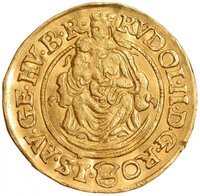
Obverse
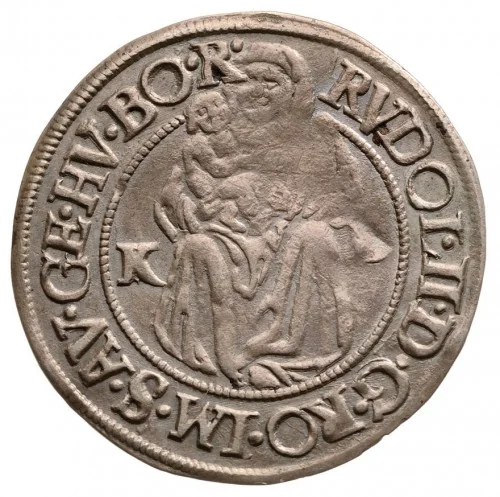
Description:
Veiled Madonna holding child, mintmark split.
Inscription:
RVDOL · II · D · G · RO · IM · S · AV · GE · HV · B · R ·
K B
K B
Script: Latin
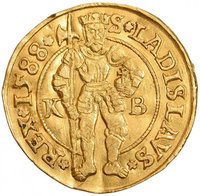
Reverse
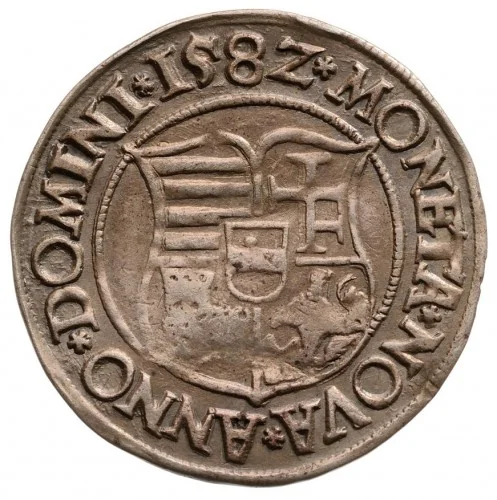
Description:
Hungarian coat of arms with Árpád stripes, double cross, Dalmatian leopard heads, and Bohemian lion; central shield: Austrian bonds.
Inscription:
MONETA·NOVA·ANNO·DOMINI·1582·
Script: Latin
Edge
Plain
Mintings
| Year | Mint Mark | Mintage | Quality | Collection |
|---|---|---|---|---|
| 1579 | K-B | — | ||
| 1580 | K-B | — | ||
| 1581 | K-B | — | ||
| 1582 | K-B | — | ||
| 1583 | K-B | — | ||
| 1584 | K-B | — | ||
| 1585 | K-B | — | ||
| 1586 | K-B | — | ||
| 1587 | K-B | — | ||
| 1588 | K-B | — | ||
| 1589 | K-B | — | ||
| 1590 | K-B | — | ||
| 1591 | K-B | — | ||
| 1592 | K-B | — | ||
| 1593 | K-B | — | ||
| 1594 | K-B | — | ||
| 1595 | K-B | — | ||
| 1596 | K-B | — | ||
| 1597 | K-B | — | ||
| 1598 | K-B | — | ||
| 1599 | K-B | — | ||
| 1600 | K-B | — | ||
| 1601 | K-B | — | ||
| 1602 | K-B | — | ||
| 1603 | K-B | — | ||
| 1604 | И-B | — | ||
| 1604 | K-B | — | ||
| 1604 | N-B | — | ||
| 1605 | K-B | — | ||
| 1606 | K-B | — | ||
| 1607 | K-B | — |
Historical background
In 1579, Hungary existed as a fractured realm, divided into three parts: the Royal Hungary in the north and west, ruled by the Habsburgs; the Ottoman-occupied central territories; and the semi-independent Principality of Transylvania in the east. This political fragmentation directly caused a severe and chaotic monetary situation. The Habsburgs, the Ottomans, and the Transylvanian princes all minted their own coins, which circulated alongside a flood of worn, clipped, and counterfeit foreign coins, leading to a complete loss of uniform monetary standard.
The primary currency in Royal Hungary was the silver Thaler (or tallér), but the most common coin in daily circulation was the debased silver denarius. The Habsburg authorities, perpetually short of funds for their wars against the Ottomans, repeatedly engaged in "coinage deterioration." This meant they reduced the silver content in the denarius while officially maintaining its face value, a form of stealth taxation that caused inflation and eroded public trust. Meanwhile, high-value Ottoman gold sultani and silver akçe circulated in the occupied lands, and Transylvania issued its own coins, further complicating trade across the divided kingdom.
This monetary chaos severely disrupted the economy. Merchants and peasants alike struggled with uncertain exchange rates and the constant risk of receiving worthless money. The debasement punished savers and those on fixed incomes, while benefiting debtors who could repay loans in weakened currency. Consequently, 1579 fell within a prolonged period of economic hardship and price instability, where the state's fiscal desperation was felt directly in the pockets of the population, undermining both commerce and the legitimacy of royal authority in the remaining Habsburg-held territories.
The primary currency in Royal Hungary was the silver Thaler (or tallér), but the most common coin in daily circulation was the debased silver denarius. The Habsburg authorities, perpetually short of funds for their wars against the Ottomans, repeatedly engaged in "coinage deterioration." This meant they reduced the silver content in the denarius while officially maintaining its face value, a form of stealth taxation that caused inflation and eroded public trust. Meanwhile, high-value Ottoman gold sultani and silver akçe circulated in the occupied lands, and Transylvania issued its own coins, further complicating trade across the divided kingdom.
This monetary chaos severely disrupted the economy. Merchants and peasants alike struggled with uncertain exchange rates and the constant risk of receiving worthless money. The debasement punished savers and those on fixed incomes, while benefiting debtors who could repay loans in weakened currency. Consequently, 1579 fell within a prolonged period of economic hardship and price instability, where the state's fiscal desperation was felt directly in the pockets of the population, undermining both commerce and the legitimacy of royal authority in the remaining Habsburg-held territories.
✨ Legendary