

1 Thaler – Hungary
Hungary
Context

Material
Weight: 28.82 g
Silver weight: 25.22 g
Shape: Irregular round
Composition: 87.5% Silver
Magnetic: No
References
KM: #Click to copy to clipboard18
Numista: #51042
Value
Bullion value: $71.67
Obverse
Description:
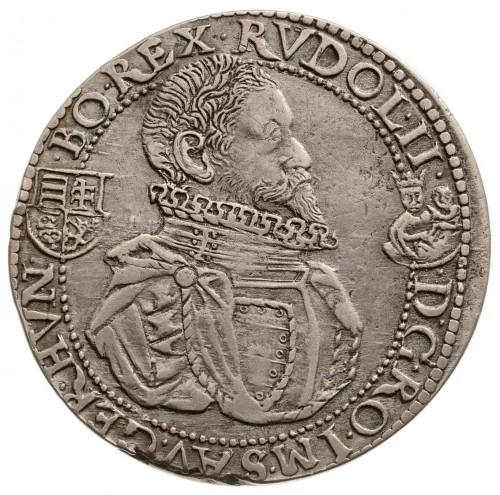
Right-facing armored bust in ruffled collar, over a ring of pearls. Mirrored Hungarian coat of arms with Austrian shield. Madonna with child on crescent to the right.
Inscription:
RVDOL · II · D · G · RO · IM · S · AV · GER · HVN · BO · REX ·
Script: Latin
Reverse
Description:
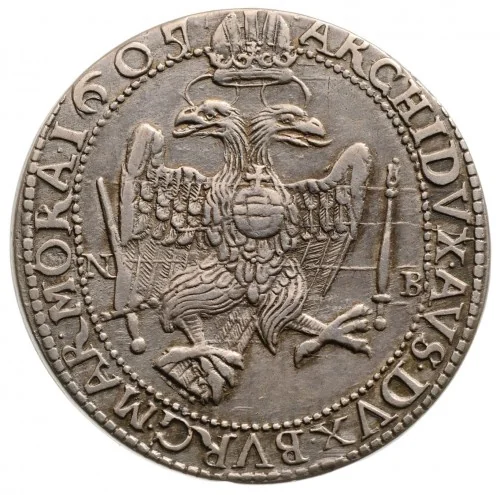
Imperial eagle with scepter and sword, orb on breast, divides "N B"; crowned legend above.
Inscription:
ARCHI · DVX · AVS · DVX · BVRG · MAR · MORA · 1604 ·
K B
K B
Script: Latin
Edge
Plain
Mints
| Name | Mark |
|---|---|
| Baia Mare | NB |
Mintings
| Year | Mint Mark | Mintage | Quality | Collection |
|---|---|---|---|---|
| 1603 | N | — | ||
| 1604 | N | — | ||
| 1605 | N | — | ||
| 1607 | N | — | ||
| 1608 | N | — |
Historical background
In 1603, Hungary existed as a fractured and war-torn kingdom, its monetary system a direct reflection of its political chaos. The realm was divided into three parts: Royal Hungary under Habsburg rule in the west and north, the Ottoman-occupied central territories, and the semi-independent Principality of Transylvania in the east. This tripartite division meant there was no unified Hungarian currency. Instead, the region was a monetary crossroads where Habsburg thalers, Ottoman akçes, and various Transylvanian and German coins all circulated, creating a complex and unstable economic environment.
The primary currency in Royal Hungary was the silver thaler (or Tallér), minted under Habsburg authority. However, the ongoing Long Turkish War (1593-1606) placed an enormous financial strain on the Vienna court, leading to severe currency debasement. To fund the military, the Habsburgs repeatedly reduced the silver content of their lower-denomination coins, such as denars and kreutzers, minted in Nagybánya (today Baia Mare, Romania) and other mining towns. This practice caused rampant inflation, a loss of public trust in coinage, and widespread economic hardship for soldiers and peasants paid in these weakened coins.
Meanwhile, in Ottoman-occupied Hungary, Turkish silver akçes were the official currency, though older Hungarian coins still circulated. The Principality of Transylvania, under the rule of Prince Mózes Székely in 1603 (briefly, before his death that year), minted its own coins, such as the silver denar, to assert sovereignty and facilitate local trade. The simultaneous circulation of these disparate, often debased currencies stifled commerce, encouraged hoarding of full-weight silver, and made Hungary a prime example of how protracted warfare and political fragmentation could devastate a early modern monetary system.
The primary currency in Royal Hungary was the silver thaler (or Tallér), minted under Habsburg authority. However, the ongoing Long Turkish War (1593-1606) placed an enormous financial strain on the Vienna court, leading to severe currency debasement. To fund the military, the Habsburgs repeatedly reduced the silver content of their lower-denomination coins, such as denars and kreutzers, minted in Nagybánya (today Baia Mare, Romania) and other mining towns. This practice caused rampant inflation, a loss of public trust in coinage, and widespread economic hardship for soldiers and peasants paid in these weakened coins.
Meanwhile, in Ottoman-occupied Hungary, Turkish silver akçes were the official currency, though older Hungarian coins still circulated. The Principality of Transylvania, under the rule of Prince Mózes Székely in 1603 (briefly, before his death that year), minted its own coins, such as the silver denar, to assert sovereignty and facilitate local trade. The simultaneous circulation of these disparate, often debased currencies stifled commerce, encouraged hoarding of full-weight silver, and made Hungary a prime example of how protracted warfare and political fragmentation could devastate a early modern monetary system.

✨ Legendary