

1 Rupee – Jaintia Kingdom
India
Context
Year: 1669
Nepal - Saka era Year: 1591
Country: India 
Issuer: Jaintia Kingdom
Currency:
Demonetized: Yes
Material

References
KM: #Click to copy to clipboard130
Numista: #510397
Value
Bullion value: $26.33
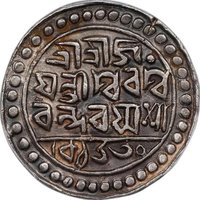
Obverse
Description:
King’s name and blessing in lettering.
Script: Devanagari
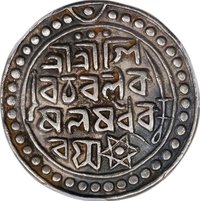
Reverse
Description:
Date below, state around dotted circle.
Script: Devanagari
Edge
Plain
Mintings
| Year | Mint Mark | Mintage | Quality | Collection |
|---|---|---|---|---|
| 1669 | — | — |
Historical background
In 1669, the Jaintia Kingdom, nestled in the Khasi and Jaintia hills of present-day Meghalaya, India, operated within a complex economic system that blended traditional barter with regional monetary flows. The kingdom’s core internal economy was largely non-monetized, relying on the exchange of locally produced goods such as rice, betel nuts, lime, and handwoven textiles. This system was underpinned by a sophisticated social and clan-based network where value was measured in utility and reciprocity rather than coined currency.
However, the kingdom was not isolated from the monetized economies of the surrounding plains. Its strategic location between the Brahmaputra Valley of Ahom-dominated Assam and the Sylhet plains of Mughal Bengal placed it at the crossroads of significant trade routes. By 1669, Jaintia was actively engaged in commerce, exporting goods like limestone, ivory, and cane to these regions. In return, it absorbed silver and copper coins from the Mughal sikka and other circulating currencies, which were used primarily for high-value transactions, state treasury reserves, and trade with external merchants, rather than in everyday village life.
Thus, the currency situation was one of duality. The internal hill economy functioned on a subsistence and barter basis, while the state and its mercantile class engaged with the broader monetary systems of South Asia. This hybrid model allowed the kingdom to maintain its traditional socio-economic structures while leveraging external trade for wealth and political leverage, a delicate balance characteristic of many autonomous hill states in the region during the 17th century.
However, the kingdom was not isolated from the monetized economies of the surrounding plains. Its strategic location between the Brahmaputra Valley of Ahom-dominated Assam and the Sylhet plains of Mughal Bengal placed it at the crossroads of significant trade routes. By 1669, Jaintia was actively engaged in commerce, exporting goods like limestone, ivory, and cane to these regions. In return, it absorbed silver and copper coins from the Mughal sikka and other circulating currencies, which were used primarily for high-value transactions, state treasury reserves, and trade with external merchants, rather than in everyday village life.
Thus, the currency situation was one of duality. The internal hill economy functioned on a subsistence and barter basis, while the state and its mercantile class engaged with the broader monetary systems of South Asia. This hybrid model allowed the kingdom to maintain its traditional socio-economic structures while leveraging external trade for wealth and political leverage, a delicate balance characteristic of many autonomous hill states in the region during the 17th century.
✨ Legendary